
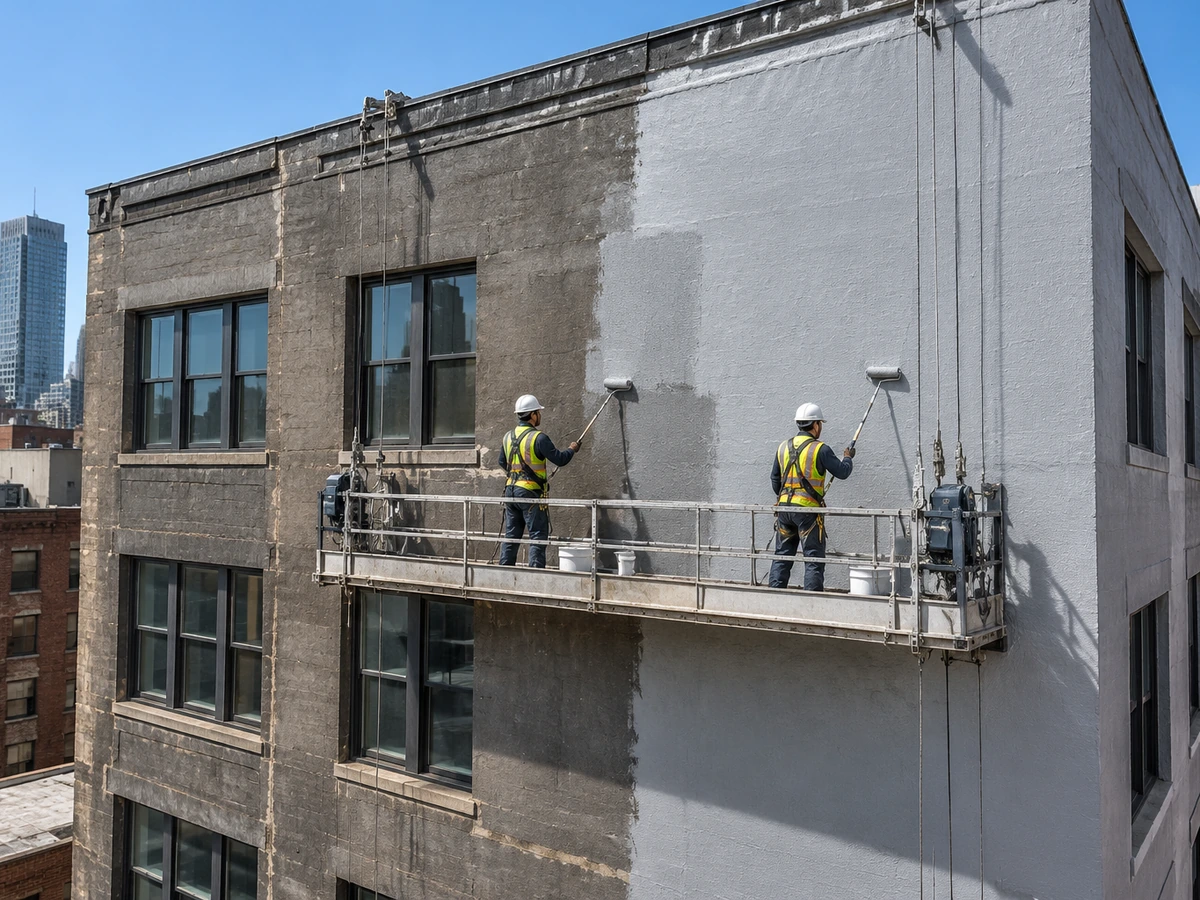


Waterproofing Contractors in New York City: The Short Answer
Waterproofing contractors in New York City (NYC) keep groundwater and rain out of basements, foundations, balconies and facades. Spark Restoration Inc is a waterproofing contractor based at 530 Yonkers Ave, Yonkers, NY 10704, working across the five boroughs, Yonkers and Westchester County. We waterproof homes — basements, foundations, balconies, terraces and bathrooms — and commercial buildings, including co-op and condo buildings, offices and retail. Every job starts with a free inspection: we trace the full water path before we recommend a fix, and we give a written estimate. Every figure is an estimate — the final price is confirmed after a free on-site inspection. Request a free inspection.
Why New York Buildings Leak
New York buildings leak for reasons that are specific to this city — its soil, its water table and its building stock. A fix that works on a new suburban house will not necessarily work on a pre-war brick rowhouse in Brooklyn or a brownstone in Harlem. These are the causes we see most often, and the building types each one hits hardest.
Clay soil and a high water table. Much of New York City sits on clay soil that holds water against the foundation instead of draining it away, and the water table is high in many neighbourhoods — particularly in low-lying parts of Queens and Brooklyn, and along the Hudson and East Rivers. When the ground is saturated, hydrostatic pressure pushes water through the cove joint where the wall meets the floor, through cracks and through porous brick and mortar.
Pre-war stock with no original membrane. Most of the city’s housing was built before modern waterproofing membranes existed. A pre-war brick or stone foundation was built to manage water by letting the wall breathe, not by sealing it. When the pointing fails or the ground level rises against the wall, water finds its way in. Brownstones, rowhouses and pre-war apartment buildings are the most affected.
Pointing failure. When the mortar joints in a brick wall erode, wind-driven rain soaks into the brick and travels down inside the wall, showing up as damp on the inside face or in the basement below. This is a common cause of damp in brownstones and brick rowhouses, and it is often mistaken for a foundation leak.
Parapet and coping failure. A cracked coping stone or a failed parapet lets water into the top of the wall, and the water travels down inside the masonry to show up floors below — sometimes in a basement that looks like it has a foundation problem. Our parapet wall repair and installation in New York service deals with this directly, and we check the parapet whenever a top-floor or basement leak has no obvious source at ground level.
Sealant and flashing failure. Sealant around windows, doors and penetrations, and flashing where a roof or balcony meets a wall, all have a working life. When they fail, rain runs down the facade and into the building. This is the most common cause of leaks in post-war concrete and brick buildings, and in balconies and terraces.
Sidewalk vaults, areaways and light-wells. Many New York buildings — particularly in Manhattan and brownstone Brooklyn — have vaults under the sidewalk, areaways and light-wells that bring water right up against the foundation wall. A failed vault roof or a blocked areaway drain can flood a basement in a single storm.
Freeze–thaw. Water that gets into brick, mortar and concrete expands when it freezes, opening cracks wider each winter. Over decades this turns small defects into real leaks. The cycle is worst on parapets, copings and exposed facades, and on any wall where the pointing has already gone.
Six Areas, Six Services
Waterproofing is not one job. It is six different areas of a building, each with its own system. These are the six services this hub covers. Each one will have its own page; for now, the work is described here.
Basement waterproofing
Interior drainage, sump pumps and crack repair that keep New York basements dry. This is the service most homes need first, and it is the one we are asked about most.
Foundation exterior waterproofing
Exterior membrane and footing drains that stop groundwater at the outside face of the wall. This is the right fix when the wall itself is cracked or has no original membrane.
Balcony and terrace waterproofing
Membrane, drainage and edge detailing for balconies, terraces and the rooms below them. A failed balcony is one of the most common sources of leaks into the floor below.
Exterior and facade waterproofing
Sealants, flashing and coatings that keep wind-driven rain out of the wall. This is the fix for damp that shows on the inside face of an exterior wall.
Bathroom waterproofing
Membranes and tanking for bathrooms, wet rooms and below-grade baths, so water stays in the shower and out of the structure.
Commercial waterproofing
Below-grade, plaza deck and envelope waterproofing for commercial buildings, co-op and condo buildings, offices and retail.
Residential Waterproofing in New York City
Most of the waterproofing we do is for homes — single-family houses, brownstones, townhouses and apartments. The system depends on the foundation and the water path, and no two houses are the same. Here is what each system is, when it wins, and what it does not do.
Interior drainage and sump pumps
What it is: a perimeter drain set into the basement floor at the cove joint, feeding a sump pump that discharges water outside the building. When it wins: most basements with water coming up at the wall–floor joint, or through the floor itself. It needs no excavation, causes little disruption, and it works on stone, brick, block and poured foundations. What it does not do: it does not stop water entering the wall from outside, and it does not fix a cracked wall or a failed exterior membrane. It manages the water that gets in; it does not seal the wall.
Exterior membrane and footing drain
What it is: the foundation is excavated to the footing, the wall is cleaned and repaired, a waterproof membrane is applied to the outside face, a footing drain is laid, and the excavation is backfilled. When it wins: a wall that is cracked, has no original membrane, or lets water through the brick itself. It stops water at the outside face, which is the most thorough fix. What it does not do: it is the most disruptive system — it needs excavation, access for machinery, and time. It is not the right first step when interior drainage would solve the problem for less disruption.
Crack injection
What it is: a resin is injected into a foundation crack, where it expands and seals the crack from the inside. When it wins: a single, stable crack in a poured concrete or block wall that is letting water in. It is fast, it needs no excavation, and it is the least disruptive repair. What it does not do: it does not fix a crack that is still moving, a wall that is bowing, or a foundation with many cracks. If the wall is moving, the crack needs structural attention first — injection alone will not hold.
Crawlspace encapsulation
What it is: the crawlspace is sealed with a vapour barrier on the floor and walls, the vents are closed, and a dehumidifier keeps the air dry. When it wins: a damp crawlspace that is feeding moisture, mould and musty air into the house above. It is common in houses with a raised ground floor and a shallow crawlspace. What it does not do: it does not fix water that is entering through the foundation wall from outside, and it does not replace drainage if the crawlspace floods. If water stands in the crawlspace, drainage comes first.
French drains
What it is: a gravel-filled trench with a perforated pipe that collects groundwater and carries it away from the foundation. It can run inside the basement at the cove joint or outside the foundation at the footing. When it wins: a site where surface water and groundwater collect against the wall, and where there is somewhere for the pipe to discharge. What it does not do: it does not seal a wall, and it does not help if the discharge point is blocked or if the pipe silts up. A French drain needs a clear outfall and occasional maintenance.
Sump pumps and battery backup
What it is: a pump in a sump pit that lifts collected water out of the basement and discharges it outside, with a battery backup that keeps it running in a power cut. When it wins: any basement with an interior drainage system, and any basement where the water table is high. The battery backup matters because the heaviest rain often comes with a power cut. What it does not do: a pump does not stop water entering — it removes the water that the drainage system collects. A pump with no drainage, or a drainage system with a failed pump, will not keep a basement dry.
Commercial Waterproofing in New York City
Commercial waterproofing is a different job from residential work. The buildings are bigger, the water paths are longer, and the work has to fit around people who live and work in the building. We waterproof co-op and condo buildings, office buildings, retail and multi-family properties across New York City.
We work for co-op and condo boards and for property managers. A board needs a written scope and estimate it can put in front of residents, a staged budget so the work can be planned across fiscal years, and a contractor who documents the work with photographs. We provide all three. We also carry out envelope surveys — a survey of the whole building envelope, from the roof and parapet down to the foundation — so a board can see every defect and prioritise the work instead of fixing one leak at a time.
Occupied buildings need planning. Waterproofing a below-grade wall, a plaza deck or a facade means noise, access and sometimes excavation, and the work has to be scheduled so residents and tenants can carry on. We stage the work, protect the areas we are not working on, and keep the site clean. For retail and office buildings we can schedule the noisiest work outside business hours where the building allows it.
Staged budgeting is how most commercial waterproofing is done. A full envelope survey may show defects at the roof, the parapet, the facade and the foundation. Few boards can fund all of it at once, so we help prioritise — the defects that are letting water into occupied space first, then the defects that will become leaks if they are left. Each stage gets its own written estimate, and every figure is an estimate — the final price is confirmed after a free on-site inspection.
How We Find the Leak Before We Sell a Fix
We do not sell a waterproofing system before we know where the water is coming from. A wet basement can have half a dozen causes, and the wrong system wastes money. This is how we work, from the first visit to the final walkthrough. The full steps are in the “How We Work” section above; here is the short version.
First, a free inspection. We visit the property, look at where water shows, and check the foundation, the drainage around the building, and the surfaces above the leak — the balcony, the parapet, the facade. Then we trace the full water path, from where it appears back to where it enters, and we photograph each step so you can see the evidence. Then we give a written estimate for the fix that fits, with the system, the scope and the price. Where the work needs a permit or board approval, we handle the paperwork. We install to the manufacturer’s specification, with the preparation the surface needs. And we test the system with water where the work allows, then walk the job through with you before we leave.
What Waterproofing Costs in New York — Estimates Only
There is no fixed price for waterproofing in New York City, and any contractor who gives one before seeing the job is guessing. What drives your price:
- The system — interior drainage and a sump pump cost less than full exterior excavation and membrane; balcony and terrace work depends on the deck build-up and the detailing.
- The area — the length of wall, the size of the basement, the number of balconies.
- Access — whether machinery can reach the excavation, whether scaffold or a sidewalk shed is needed, and whether the work is in an occupied building.
- The foundation type — stone, brick, block or poured concrete each need different preparation.
- The condition of the wall — cracks, failed pointing and previous repairs all add scope.
- Permits and approvals — where a permit or a board approval is needed, the time and cost are part of the job.
Every figure is an estimate — final price after a free on-site inspection. We give the estimate in writing before work begins, and we do not start work until you have accepted it.
Where We Work
We waterproof buildings across New York City’s five boroughs, in Yonkers and in Westchester County. These are the neighbourhoods we work in most often.
Queens. Astoria, Long Island City, Jackson Heights, Forest Hills and Flushing. Astoria is the borough’s hub for us — our kept Queens location page is waterproofing contractors in Astoria, Queens. Queens housing is a mix of pre-war brick, post-war concrete and newer construction, and the water table is high in the low-lying parts of the borough.
Brooklyn. Park Slope, Bedford-Stuyvesant, Crown Heights, Bay Ridge and Williamsburg. Brooklyn’s brownstones and rowhouses are the classic pre-war stock: brick walls, stone foundations, parapets and copings that need the right mortar and the right membrane.
Manhattan. Harlem, Washington Heights, the Upper East Side and the Upper West Side. Manhattan work is often in co-op and condo buildings, where the board and the managing agent are part of the job, and in townhouses with vaults and areaways under the sidewalk.
The Bronx. Riverdale, Fordham and Pelham Bay. The Bronx has a mix of pre-war apartment buildings, single-family houses and commercial buildings, and the same clay soil and freeze–thaw that affect the rest of the city.
Yonkers and Westchester County. Getty Square, Park Hill, Dunwoodie and Crestwood in Yonkers, and the surrounding Westchester towns. Yonkers is where we are based — 530 Yonkers Ave, Yonkers, NY 10704 — and our kept Yonkers location page is waterproofing contractors in Yonkers, NY. Yonkers basements leak for local reasons: the Saw Mill River and Hudson watershed, a 416-foot elevation gradient, schist bedrock, clay soil and a high water table.
If your neighbourhood is not listed, send us a message through the contact form — we work across the five boroughs, Yonkers and Westchester County, and we will tell you honestly whether we can reach you.
More Waterproofing Questions, Answered
Do you waterproof balconies and terraces?
Yes. Balconies and terraces are one of the most common sources of leaks into the rooms below, because the membrane, the drainage and the edge detailing all have to work together. We waterproof balconies and terraces with a membrane system, proper falls to drains, and detailing at door thresholds and upstands. We also check the parapet and coping above, because water often enters there and shows up on the balcony below. See our parapet wall repair and installation in New York service for the coping and flashing work that often goes with a balcony job.
Do you work for co-op and condo boards and property managers?
Yes. We work for co-op and condo boards, managing agents and commercial property managers across New York City. We provide envelope surveys, staged budgets so a board can plan the work across fiscal years, and work scheduled around occupied buildings. We give written scopes and estimates that a board can put in front of residents, and we document the work with photographs.
What should I send you before the inspection?
Photographs of where water shows, the dimensions of the basement or balcony, the foundation type if you know it — stone, brick, block or poured concrete — and when the leak appears: after heavy rain, in spring, or all the time. The more we know before we arrive, the faster the inspection goes. You can request a free inspection and attach the photographs when you contact us.
Spark Restoration Inc is a general contractor based at 530 Yonkers Ave, Yonkers, NY 10704, serving New York City, Yonkers and Westchester County. Request a free inspection. Read more about Spark Restoration Inc, or see our roof repair and installation in New York service — roof leaks and waterproofing often go together, and we fix both.