
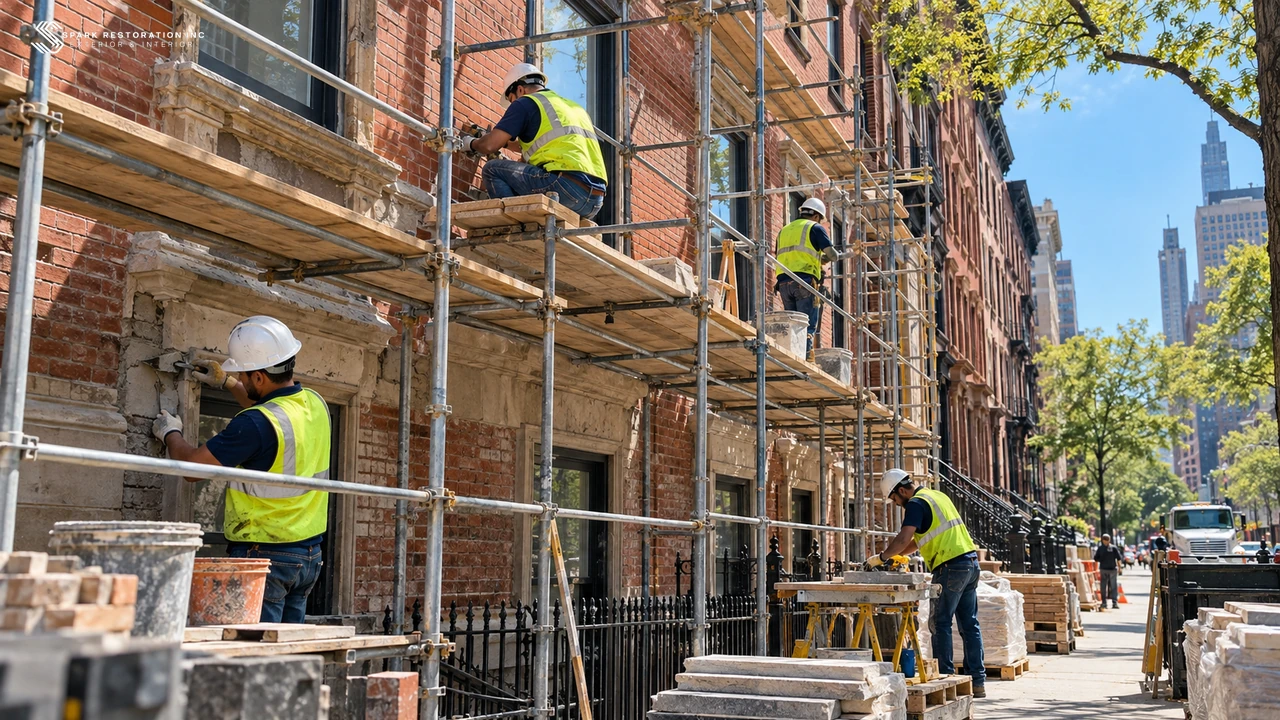


Facade repair NYC, from a Yonkers-based contractor
Spark Restoration Inc carries out facade repair NYC co-op and condo boards, managing agents, owners and commercial clients rely on: brick, brownstone, limestone, terra cotta, stucco and concrete facades, repaired and restored across the five boroughs, Yonkers and Westchester County.
We fix the wall itself — repointing and brick replacement, lintels and sills, parapets and coping, cornices, balcony and terrace edges, and the waterproofing that keeps water out once the masonry is sound. We work for the people who are responsible for the building: co-op and condo boards, managing agents, owners of brownstones, rowhouses and two- and three-family houses, and commercial owners and tenants. And we work on occupied buildings, with the entrance kept open and the pavement protected.
Every job starts with a free on-site assessment and a written, itemised estimate. The final price is set after that inspection — never before it. request a free facade assessment. For the full background on signs, materials, costs and the law, see our Complete Guide to Facade Repair & Restoration in New York.
Signs your facade needs repair
A facade rarely fails overnight. It gives warnings first: a crack that lengthens, a face that flakes, a wall that starts to lean. The eight signs below are the ones we are called out for most often in New York. Each one tells you what to look for, what usually causes it, and how urgently it needs attention.
Step cracks
What it looks like: a crack that runs in steps, following the mortar joints rather than cutting across the bricks. What causes it: settlement, thermal movement, a failing lintel, or water getting into the wall. How urgent: high if the crack is widening or the bricks have shifted — have it looked at promptly. A fine, stable step crack can wait for the next survey, but it should not be ignored.
Spalling
What it looks like: the face of a brick or stone flakes, peels or pops off, leaving a rough, crumbling surface. What causes it: water trapped behind the face, freeze and thaw, or a hard cement mortar on soft, old brick. How urgent: moderate to high. The exposed wall takes in more water, and loose faces can fall onto the pavement.
Bulging
What it looks like: a section of wall bows outwards, sometimes with the joints opening at the edges of the bulge. What causes it: corroded wall ties, water in the cavity, failed anchoring, or pressure from a parapet. How urgent: high. A bulging wall is a structural problem — it needs an engineer, and protection below it until it is repaired.
Rust-jacked lintels
What it looks like: the brickwork above a window or door cracks and lifts, with rust staining around the steel lintel. What causes it: water reaching unprotected steel, which swells as it rusts and jacks the brickwork apart. How urgent: moderate to high. The lintel keeps swelling and the cracks spread, so the lintel is replaced with a protected one and the brick above is rebuilt.
Efflorescence
What it looks like: a white, salty bloom on the face of the brick or stone. What causes it: water moving through the wall and carrying soluble salts to the surface. How urgent: low to moderate on its own. Efflorescence is a sign that water is getting in, not a structural failure by itself — but the water source still needs to be found and stopped.
Leaks
What it looks like: water stains, damp plaster or peeling paint on the inside face of an exterior wall. What causes it: failed joints, sealant, flashing or coping letting water through the facade. How urgent: moderate. Water rots timber, corrodes steel and encourages mould. Trace the entry point in the facade — repainting the inside only hides it.
Leaning parapet or cornice
What it looks like: a parapet tilts out of line, or a cornice sags and pulls away from the wall. What causes it: failed anchoring, corroded ties, water and freeze-thaw cycles. How urgent: high. Anything above a pavement that can fall is an emergency: protect the pavement below and request an emergency make-safe.
Loose stone
What it looks like: a stone unit, a coping stone or an ornament that moves when touched, or that sits in an open joint. What causes it: failed anchoring, corroded ties, or water working into the fixing. How urgent: high. Secure it before it falls — terra cotta and limestone units are heavy, and a falling unit can kill.
Facade restoration by material
New York facades are not one material. A brownstone, a limestone townhouse, a terra cotta office block and a brick tenement fail in different ways and need different repairs. We match the repair to the material — and to the mortar, the anchoring and the finish that are already there.
Brick
Brick is the commonest facade material in the city, and the most forgiving — if the mortar is right. We repoint failed joints, replace spalled and cracked bricks with units matched for size, colour and texture, and rebuild sections where the wall has failed. The mortar is matched in strength to the brick: a soft lime mortar for pre-war brick, never a hard cement mortar that will chew the face off the brick. See our masonry contractors page for the full masonry scope.
Brownstone
Brownstone is a soft, porous sandstone, and it needs a breathable repair. We patch with breathable natural cementitious patching, use Jahn mortar where a patch must match the stone, and carry out dutchman repairs — cutting out a damaged section and setting in a matching piece of stone — rather than coating the whole face. The Landmarks Preservation Commission’s guidance is clear: do not resurface a whole brownstone facade unless the stone is in extremely poor condition. A coating traps water and the stone fails underneath it. For the full scope, see our brownstone and historic facade restoration page.
Limestone
Limestone is harder than brownstone but it still moves with water and salt. We patch and dutchman damaged units, re-anchor loose stone, and clean limestone without harsh chemicals that would etch the surface. Joints are repointed with a mortar that lets the stone breathe.
Terra cotta
Terra cotta units are hollow, glazed and held by steel anchorage — and the anchorage is usually what fails first. We repair terra cotta with specialised anchorage ties, replace failed units with new ones cast to match the profile and glaze, and repoint the joints so water cannot reach the steel. Because a terra cotta unit is heavy, any loose unit is treated as urgent.
Stucco and EIFS
Stucco and EIFS (exterior insulation and finish systems) crack, delaminate and let water in at the joints. We repair cracks, re-coat failed areas, and — for EIFS — check for water trapped behind the system before we seal the surface. See our EIFS stucco systems page.
Concrete
Concrete facades spall where water reaches the steel reinforcement and the steel rusts and expands. We cut back to sound concrete, treat the reinforcement, patch with a matching repair mortar, and coat where the specification calls for it.
The mortar rule
For pre-war buildings we use a soft lime mortar — typically a Type O or a soft Type N, matched in strength to the brick. Never a hard Type S unless the engineer specifies it. A mortar that is harder than the brick does not protect the wall; it forces the brick to take the movement, and the brick fails instead.
Facade repair by job
Some clients come to us with a material in mind; most come with a job. These are the jobs we are asked for most often, and what each one involves.
Repointing
Failed joints are cut out to three quarters of an inch to an inch, or to sound mortar, and repointed with a mortar matched to the brick and the building’s age. Repointing is the repair when the bricks are sound and only the joints have failed. See our masonry page for pointing and repointing in detail.
Brick replacement and rebuild
Spalled, cracked and displaced bricks are cut out and replaced with units matched for size, colour and texture. Where a section of wall has failed — a bulge, a collapsed wythe, a lintel that has taken the brickwork with it — we rebuild the section, tying it back into the wall behind it.
Lintel and sill
Rusted steel lintels are replaced with protected steel, and the brickwork above is rebuilt. Stone and concrete sills that have cracked or spalled are replaced or repaired, with the joint and flashing detailed so water runs off the wall rather than into it.
Parapet and coping
Parapets are the most exposed part of a facade, and the most likely to be classed Unsafe. We rebuild, repoint and re-cap parapets, set new coping stones, and renew the flashing. For the full parapet scope, see our parapet wall repair and installation page.
Cornice
Sheet-metal, stone and terra cotta cornices are repaired and re-anchored, with failed sections replaced to match. A cornice that is pulling away from the wall is an emergency make-safe first, and a repair second. See our cornice and trim repair page.
Waterproofing and sealants
Once the masonry is sound, we keep water out: elastomeric coatings, membranes, flashing and joint sealant, matched to the facade material. See our waterproofing contractors page, and our crack sealing and gap filling for facades page.
Sidewalk shed and scaffolding
High work needs access, and the pavement needs protection. We arrange pipe scaffolding, swing stages and sidewalk sheds, with netting, permits and a protection plan for the building’s entrance. A shed is not a repair — but a facade cannot be repaired safely without one where the work is above a public pavement.
Emergency make-safe
When part of a facade is loose or falling, we make it safe: protection below, loose material secured or removed, and a written record with photographs for the engineer and the Department of Buildings. Request an emergency make-safe through the contact form.
Balcony and terrace
Balconies and terraces are part of the facade: the masonry at the balcony edge, the waterproofing under the deck, and the railing fixings all fail together. See our balcony and terrace repair page for the full scope.
Residential facade work
Most of our residential facade work is on brownstones, rowhouses, two- and three-family houses and garden apartments — the buildings that make up most of New York’s housing stock. We lead with brownstone and stoop restoration and with repair-in-kind in landmark districts: the patch, the mortar and the replacement stone are matched to what is already there, and where the building is landmarked or in a historic district we work to the Landmarks Preservation Commission’s requirements and obtain the approvals the job needs.
For a homeowner or a small landlord, the work is usually a single elevation: a front facade and stoop, a rear wall, a parapet. We keep the entrance usable, protect the garden and the neighbours’ property, and leave the building watertight at the end of each day’s work. See our brownstone and historic facade restoration page, and our Complete Guide to Facade Repair & Restoration in New York for the residential detail.
Commercial facade work
For co-op and condo boards, managing agents, multi-family owners and retail and office owners, facade work is a board decision as much as a building repair. We give boards a written, itemised scope with photographs and the QEWI’s numbered conditions, so the board can see what is being repaired, why, and what it will cost — and so the managing agent can put it to the board without a second survey.
Work on an occupied building is staged by elevation, with entrances, shops and offices kept open and residents and tenants told what is happening and when. Retail and office facades are repaired so the business below can keep trading, and the pavement is protected for the whole of the job.
Local Law 11 / FISP — the repair contractor’s page
If you are searching for Local Law 11 facade repair NYC, this is the repair side of that work. Local Law 11, the Facade Inspection & Safety Program (FISP), requires owners of buildings over six storeys to have the exterior walls inspected every five years by a Qualified Exterior Wall Inspector (QEWI) — a licensed professional engineer or registered architect — and to file the report with the Department of Buildings. The QEWI inspects and files. We repair what the report finds.
Your QEWI inspects and files; we are the repair contractor. Spark does NOT perform FISP inspections — only a Qualified Exterior Wall Inspector may.
Send us your FISP report — we price it line-by-line against the QEWI’s numbered conditions. Request a free facade assessment.
Cycle 10 deadlines
Cycle 10 runs from 21 February 2025 to 20 February 2030. The filing window for a building depends on the last digit of its block number:
| Sub-cycle | Block numbers ending in | Filing window |
|---|---|---|
| 10A | 4, 5, 6, 9 | 21 February 2025 – 21 February 2027 |
| 10B | 0, 7, 8 | 21 February 2026 – 21 February 2028 |
| 10C | 1, 2, 3 | 21 February 2027 – 21 February 2029 |
What the findings mean
| Finding | What it means | What happens next |
|---|---|---|
| Safe | No unsafe conditions; no repairs required at this time. | File the report and plan for the next cycle. |
| SWARMP — Safe With a Repair and Maintenance Programme | Defects are present but not an immediate danger. | Repair them before the next cycle’s filing. If they are left unrepaired, the building is automatically classed Unsafe and a $2,000 penalty applies. |
| Unsafe | A condition is an immediate danger to public safety. | Protect the public at once with a sidewalk shed and barriers, complete the repairs within 90 days of the Unsafe filing, and file an amended report within two weeks of finishing. |
Penalties
These are city penalties, not Spark’s charges. They apply after the filing period ends.
| Penalty | Amount |
|---|---|
| Late filing of the initial report | $1,000 per month |
| Failure to file the initial report | $5,000 per year |
| Uncorrected Unsafe conditions | $1,000 per month, under the schedule in 1 RCNY §103-04 |
| Unrepaired SWARMP conditions | $2,000, and the building is automatically classed Unsafe |
| Sidewalk shed left in place | $40–$100 per linear foot per month |
The 90-day clock
Once a QEWI files an Unsafe report, the owner has 90 days to complete the repairs. If the work cannot be finished in that time, the QEWI requests an extension of time in DOB NOW (the FISP1/FISP2 filings) — each 90-day extension costs $305, a Department of Buildings fee, not Spark’s. The QEWI’s initial report is due within 60 days of the inspection, and the amended report follows within two weeks of the repairs being completed. That is why Unsafe work is priced and scheduled first: the clock is running from the day the report is filed, and the shed is costing money every month it stands.
Local Law 126 — parapets
Local Law 126, in force since 1 January 2024, requires an annual parapet observation for every building that has a parapet — not only buildings over six storeys. If that observation finds a problem, the repair work is ours. See our parapet wall repair and installation page.
The 2025–26 law changes
Two laws from 2025 change the picture for owners. Local Law 51 of 2025, effective 12 January 2026, sets repair milestones once a sidewalk shed goes up: construction documents within five months, a complete work permit application within eight months, and the permitted facade work finished within two years — with penalties of $5,000 to $20,000 for missed milestones. Local Law 49 of 2025 directs the Department of Buildings to report by 31 December 2025 on replacing the five-year FISP cycle with a six- to twelve-year cycle; no change has been adopted yet, so the Cycle 10 deadlines above still apply. Local Law 48 of 2025 will also revise sidewalk-shed penalties by shed age — $10, $100 or $200 per linear foot — and the $40–$100 figure in the table above is the schedule in force until that change takes effect.
For the inspection side of the law — what the QEWI looks for, how the report is filed, and the full Cycle 10 detail — see our Complete Guide to Facade Repair & Restoration in New York.
Our process
Facade work goes wrong when the cause is guessed at. Our process is built to find the cause before we sell a fix.
1. Survey and photo log. We visit the property and look at every elevation — the walls, the parapet, the lintels, the stoops — and we photograph each condition, so the scope is built on what is actually there.
2. Written scope and board-ready estimate. You receive a written, itemised scope that lists the work item by item, the materials and the mortar, and a price for each item. The assessment is free; the final price is set after the inspection.
3. Permits and protection. Where a Department of Buildings permit, a sidewalk shed or scaffolding is needed, we arrange it. Where the building is landmarked or in a historic district, we obtain the Landmarks Preservation Commission approval the job needs.
4. Repair. Repointing, replacement, anchoring and waterproofing, carried out to the engineer’s specification and to the QEWI’s numbered conditions where the work follows a FISP report.
5. Closeout and QEWI documentation. The site is cleaned, the scaffold comes down, and we hand over a photographic record of every repair, with the documentation the QEWI needs for the amended filing.
What facade repair costs in New York
Facade repair costs in New York vary widely, because no two facades are the same height, the same material or in the same condition. The ranges below are the benchmarks we work to. They are estimates only.
| Project type | Cost per square foot |
|---|---|
| Minor repairs | $15 – $40 |
| Moderate restoration | $40 – $80 |
| Major restoration | $80 – $150+ |
For large commercial or high-rise buildings, total project costs can reach hundreds of thousands to over one million dollars, depending on complexity.
By job
| Job | How it is usually priced | What drives the price |
|---|---|---|
| Repointing | Per square foot of wall | Height and access, joint depth, mortar match, how much of the wall has failed |
| Brick replacement or rebuild | Per brick, or per square foot of rebuilt wall | Brick match, wall thickness, structural work behind the face |
| Lintel and sill replacement | Per lintel or sill | Steel size, bearing, access, whether the brick above must be taken down and rebuilt |
| Parapet and coping | Per linear foot of wall | Height, coping stone, whether the wall is rebuilt or repointed |
| Cornice repair | Per linear foot, or per section | Material — sheet metal, stone or terra cotta — anchoring and access |
| Waterproofing and sealants | Per square foot, or per linear foot of joint | Surface preparation, product, height and access |
| Sidewalk shed and scaffolding | Per linear foot of shed, or per scaffold bay | Street width, how long the shed stands, rigging and permits |
| Emergency make-safe | Per visit, or per day on site | How quickly protection must go up, shed and netting, engineer involvement |
What drives the price
- Building height and access — scaffold, swing stage or lift, and how long they stand.
- How much damage is found once the work opens up.
- Material — brick, brownstone, limestone or terra cotta — and how closely it must be matched.
- Landmark or Landmarks Preservation Commission requirements.
- Permits, sidewalk shed and protection.
- Weather and season.
- The QEWI’s or engineer’s specification, where the work follows a FISP report.
The QEWI’s inspection and filing fees are a third-party cost, not Spark’s: the Department of Buildings charges $425 for an initial or amended FISP filing and $305 for an extension of time to complete repairs.
Every figure is an estimate — final price after a free on-site inspection. Request a free facade assessment for a written estimate for your building.
Where we work
Spark Restoration Inc is based in Yonkers, at 530 Yonkers Avenue, and we work across the five boroughs, Yonkers and Westchester County. As facade contractors in New York City, these are the neighbourhoods we work in most often.
Manhattan
Upper West Side, Upper East Side, Harlem, Washington Heights, Midtown, Chelsea and the Village.
Brooklyn
Park Slope, Bed-Stuy, Crown Heights, Flatbush, Bay Ridge, Williamsburg, Brooklyn Heights and Fort Greene.
Queens
Astoria, Long Island City, Jackson Heights, Forest Hills, Flushing, Sunnyside and Ridgewood.
The Bronx
Grand Concourse, Riverdale, Fordham, Pelham Parkway, Mott Haven and Kingsbridge.
Yonkers
Getty Square, Nodine Hill, Park Hill, Dunwoodie, McLean Heights, Bryn Mawr, Crestwood, Lincoln Park, Nepperhan, Ludlow, Colonial Heights and Cedar Knolls. As facade repair contractors in Yonkers NY, we are based in the city we serve — a dedicated Yonkers facade page is planned, and until then this hub is the place for Yonkers facade work.
If your building is outside these neighbourhoods, send us a message through the contact form — if it is in the five boroughs, Yonkers or Westchester County, we will come and look at it.
Recent work
One project, three scopes, at the Jacob K. Javits Federal Building, 26 Federal Plaza, Manhattan. The three videos below show the same project: facade and plaza cleaning, stone steps and plaza restoration, and the entire soffit repaired, primed and painted. The poster image on each video is a Spark scaffolding photo, not a frame taken from the videos.
Facade repair questions, answered
Three more questions we are asked on most facade jobs. The first five — cost, Local Law 11 repairs, the FISP inspection, permits and how long a project takes — are answered in the frequently asked questions section below.
Can facade work be done in winter?
Yes, with limits. Mortar and coatings need temperatures above freezing to cure, so pointing and patching are scheduled for the milder spells, and cold-weather mixes are used only where the specification allows them. In the coldest weeks we keep to make-safe work, scaffolding, cleaning and preparation, and return for the pointing when the temperature will allow a durable repair.
What if part of my facade is loose or falling?
Keep people away from the wall and from the pavement below it, and do not try to pull loose material down yourself. Request an emergency make-safe through the contact form — we install protection, secure or remove the loose material, and document the condition with photographs for the engineer. If there is an immediate danger to life, call 911 first.
Which areas do you serve?
Manhattan, Brooklyn, Queens, the Bronx and Staten Island — plus Yonkers and Westchester County. The neighbourhoods are listed in the Where we work section above.
Ready to start? Request a free facade assessment, or read more about Spark Restoration Inc. For the full background, see our Complete Guide to Facade Repair & Restoration in New York.