
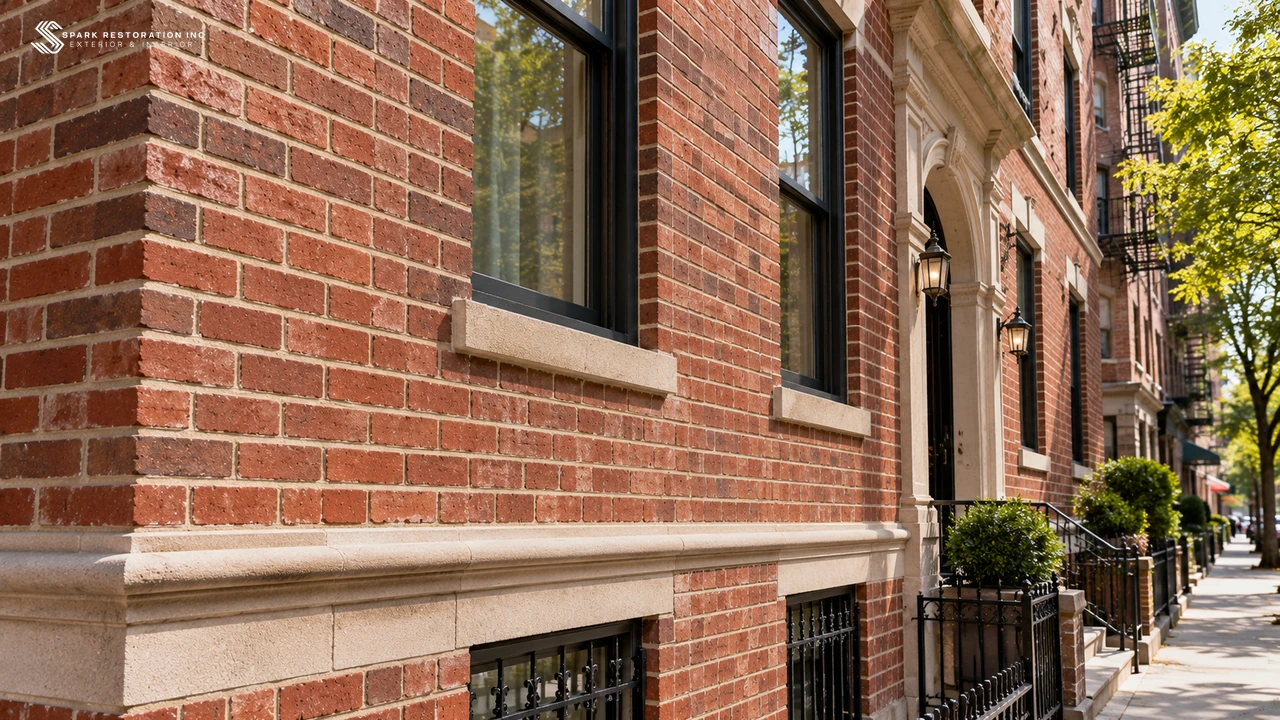


Masonry Contractors NYC: The Short Answer
Spark Restoration Inc are masonry contractors NYC homeowners, co-op boards and property managers call when brick, stone, block or concrete starts to fail. We are based at 530 Yonkers Avenue, Yonkers, and we work across all five boroughs of New York City and in Yonkers. We repair, repoint, rebuild and restore masonry on houses, rowhouses, brownstones, walk-up apartment buildings and managed blocks — and every job starts with a free on-site inspection and a written, itemised scope before any work begins. No price is promised on this page: your price is set after we have seen the wall, the mortar and the access, not before.
That matters in New York, because masonry here fails in New York ways. Much of the city’s brick was laid in soft lime mortar that moves and breathes with the building; a century of freeze–thaw winters, driving rain, road salt and hurried patch repairs has left joints hollow, brick faces spalling and parapets out of plumb. The fix is rarely a tube of sealant. It is the right mortar, cut to the right depth, packed and tooled properly, and left to cure — work that is invisible when it is done well and obvious for decades when it is not. Our two local pages for this hub are masonry contractors in Astoria, Queens and masonry contractors in Yonkers, NY. The rest of this page explains what we do, how we do it, what it costs, and where we work.
What Masonry Covers
Masonry is not one trade. It is a family of materials — brick, stone, block, concrete, stucco — and a family of failures, each with its own repair. These are the nine services this hub covers. Each has its own scope, and each links to its own service page where you can read the detail.
Brick Pointing & Repointing
Pointing is the mortar between your bricks, and repointing is replacing it when it has failed. We cut failed joints out to a sound depth, match the mortar to the brick and the building’s age, and pack and tool new joints that shed water instead of holding it. It is the single most common masonry repair in New York, and the one where the wrong mortar does the most damage. Read more about brick pointing and repointing in New York City.
Brick & Stone Repair
When the brick itself is damaged — spalled faces, cracked units, bricks pushed out by rusted lintels or failed ties — pointing alone will not hold. We cut out and replace individual bricks and stones, match the colour and size, and rebuild the bond so the repair disappears into the wall. Where stone has delaminated or a sill has split, we replace the unit rather than patching over it. See brick crack repair and replacement in New York.
Retaining Wall & Curbs
Retaining walls hold back soil, and curbs define the edge of a pavement; both take constant water, salt and impact. We rebuild leaning and bulging retaining walls, reset and repoint block and stone, and repair or replace concrete and stone curbs, including the drainage behind the wall that usually caused the failure. A wall rebuilt without drainage is a wall that will lean again. See retaining walls and curbs in New York.
Masonry Restoration
Restoration is repair with the building’s history in mind. On brownstones and historic facades, the mortar, the stone and the profile all have to match what was there — repair in kind, not a modern substitute that looks right for a year and damages the fabric underneath. We restore brownstone, limestone and brick facades, including carved and moulded elements, and we work within landmark rules where they apply. See brownstone and historic facade restoration in New York.
Chimney Repair & Rebuild
Chimneys are the most exposed masonry on any building: they take wind, rain and freeze–thaw from every side, and they carry heat and flue gases as well. We repair and rebuild chimneys from the crown down — repointing, rebuilding the stack, replacing crowns and caps, renewing flashing and, where needed, relining the flue. A leaning or spalling chimney is not a cosmetic problem. See chimney repair in New York City.
Stone Work
Stone work covers the pieces that give a building its finish: veneer, sills, lintels, coping, steps and decorative stonework. We install and repair stone veneer, replace split sills and worn coping, and reset loose stone so water runs off the wall instead of into it. Stone is unforgiving of poor bedding and poor pointing, so the mortar and the falls matter as much as the stone itself. See decorative stone and veneer installation in New York.
Block & CMU
Concrete masonry units — CMU, or block — are the workhorse of foundations, garden walls, parapets and commercial shells. We build and repair block walls, fill and grout cores where structure demands it, and repoint and parge block that has been left open to the weather. Block fails differently from brick: it is the joints and the cores that go first, and a block wall that is not properly capped will drink water all winter. See CMU block contractors in New York.
Concrete
Concrete sits alongside masonry on almost every New York property: steps, pavements, driveways, slabs, foundations and retaining structures. We repair and install concrete work — crack repair, resurfacing, replacement of failed sections, and new pours — with the falls and joints that keep water moving away from the building. Concrete that ponds is concrete that cracks. See concrete work and installations in New York.
Masonry Repair & Installation
Some jobs do not fit one label: a stoop that needs rebuilding, a garden wall that needs raising, a facade that needs a mix of pointing, replacement brick and new stone. This is the general masonry service that covers the rest — repairs and new installation across brick, block, stone and concrete, scoped item by item after inspection. See masonry repair and installation in New York City.
What Brick Pointing Actually Is
Pointing is the mortar in the joints between bricks. When a wall is built, the joints are pointed — finished — as the work goes up. Repointing is the repair: cutting out failed mortar and putting new mortar in its place. Tuckpointing is a different thing again: a decorative technique where a thin line of contrasting mortar is laid into the joint to imitate fine, expensive brickwork. The three words are often used as if they meant the same thing. They do not, and the distinction matters, because the price, the mortar and the result are all different.
The principle that governs all of it is simple, and it is the reason so much New York pointing fails. Mortar is meant to be sacrificial: it should be softer than the brick, so that when the wall moves with heat, cold and moisture, the mortar gives — and can be replaced — instead of the brick. That is why the mortar in a pre-1930 building is almost always a lime mortar or a lime blend, and why the hard, Portland-rich mixes used on modern work are wrong for it. Put a hard Portland mortar against a soft, hand-made brick and the brick loses: the mortar holds, the brick face blows off in flakes, and the wall is worse than it was. That damage is called spalling, and it is permanent — the brick cannot be un-spalled.
You can test your own joints before you call anyone. Press a screwdriver into a joint, or scratch it with a fingernail: if the mortar crumbles, powders or falls out in grains, it has reached the end of its life. If the joints are recessed — the mortar sitting back from the brick face — water is already getting in. And if the brick faces are flaking while the joints look hard and grey, the mortar is almost certainly too hard for the brick. Repointing done right, with the right mortar, lasts forty to sixty years. Done with the wrong mortar, it can fail in five to ten — and take the brick with it.
Done properly, repointing follows a sequence that cannot be hurried. The old mortar is cut out to a depth of three quarters of an inch to an inch, or to sound mortar, whichever is deeper — shallow, cosmetic pointing over failed mortar is money thrown away. The joints are cleaned out and dampened, the new mortar is mixed to match the original in strength and colour, and it is packed in layers and tooled to a profile that sheds water. Then it is left to cure for forty-eight to seventy-two hours, kept damp and protected from sun, wind and frost. That curing time is not a suggestion. Mortar that dries too fast is weak mortar.
Residential Masonry in New York City
Most of our residential masonry work is on the same buildings, built the same way: brick rowhouses and brownstones from the 1880s to the 1930s, frame houses with brick or stone veneer, and the post-war walk-ups and garden apartments that followed. The failures repeat too — pointing that has turned to sand, sills that have split, stoops that have settled, chimneys that have been ignored for a decade. What follows is how we handle each one on a home.
Brick pointing & repointing
On a house, pointing is usually the first masonry job an owner needs, and the one that sets the pattern for everything after it. We identify the mortar first: on a pre-1930 building that means a lime or lime-blend mortar, typically a Type O or a soft Type N, matched in strength to the brick — never a hard Portland mix on soft brick. We cut joints to three quarters of an inch to an inch, or to sound mortar, and we match the colour and the sand so the repair reads as part of the wall, not as a patch. The work is done in lifts, with the mortar packed and tooled, and the wall is kept damp while it cures. A repointed wall should look like the wall it always was, only sound.
Brick & stone repair
Where individual bricks have spalled, cracked or been pushed out, we cut them out and replace them, matching the size, colour and texture as closely as the stock allows. Stone is handled the same way: a split sill, a delaminated lintel or a blown brownstone tread is replaced rather than filled, because a filler will not carry the load or shed the water. Where the cause is structural — a rusted lintel, a failed tie, a settled footing — we say so, and we price the cause, not just the symptom.
Chimney repair & rebuild
A chimney is a small building on top of your building, and it is inspected the same way: crown, flashing, flue liner, cap, and the brickwork of the stack itself. The crown — the cap that sheds water off the top — is the most common failure; a cracked crown lets water straight into the stack. Flashing where the chimney meets the roof is the most common leak; a failed flue liner is the most serious problem, because it lets heat and gases into the masonry, which is a fire and carbon-monoxide risk. We follow the NFPA 211 standard for chimney inspection and repair, and on buildings with shared flues we check every flue, not just the one in use. Repointing, a new crown, a new cap and renewed flashing will save most chimneys; a stack that leans or has lost its bond is rebuilt, course by course, to the same profile.
Retaining walls & curbs
Retaining walls fail slowly and then all at once: a lean that grows a little each winter, a bulge where water has built up behind the wall, a course that has slipped. The cause is usually drainage — or the lack of it — so we rebuild with the drainage the wall should have had, and we repoint or rebuild the face to match. Curbs are repaired or replaced the same way, with the falls set so water runs to the drain rather than pooling against the wall.
Stoops & steps
Stoops are the first thing a visitor touches, and the masonry that takes the most wear: bluestone treads, flagstone landings, brick risers and stone cheeks. We rebuild stoops and steps, reset bluestone and flagstone, repoint the risers and replace split treads, so the stoop is level, drains away from the house and matches the building. A stoop that holds water will not last, however good the stone is.
Stucco
Stucco fails where water gets behind it — at the roofline, around windows, at grade — and it fails as cracks, hollow patches and blown sections. We cut back to sound stucco, repair the substrate, and reapply to match the existing texture and colour, so the repair does not read as a patch. Stucco that is simply skimmed over a hollow patch will hollow again; the repair has to reach the cause.
Commercial Masonry in New York City
Commercial masonry is a different job from residential work, and we keep the two separate. Our commercial clients are co-op and condo boards, property managers and building owners, and the work is governed by their processes as much as by the masonry: board approval, a written scope that a managing agent can circulate, certificates and documentation for the building’s files, and staging that keeps an occupied building working while the work goes on. Parapets and lintels are the most common commercial items — a parapet that has lost its bond, a lintel that has rusted and pushed the brick above it — along with facade restoration on the full elevation. The rules for parapet inspection live on our parapet wall repair and installation in New York page, and we do not duplicate them here. Where the facade is the issue, our facade repair and restoration in New York service covers it, and where water is getting in through the masonry, waterproofing in New York City is often part of the same scope. Roofs meet masonry at every parapet and chimney, so roof repair and installation in New York is frequently in the same conversation. On an occupied building, we stage the work in sections, protect the pavement and the entrance, and keep the board and the managing agent informed as the work proceeds.
Permits, Landmarks and Boards
Most repointing work in New York City does not need a Department of Buildings permit: replacing failed mortar with matching mortar is repair, not alteration. The things that do need permits, approvals or both are the things around the work. Scaffolding and sidewalk sheds need permits. Work on a landmarked property or in a historic district needs Landmarks Preservation Commission approval before it starts, and the LPC expects repair in kind — the same mortar, the same stone, the same profile. Co-op and condo boards have their own requirements: a written scope, certificates, and often a board vote before work begins on a facade or a chimney. We prepare the documentation the board and the LPC ask for, and we do not start work that needs an approval until the approval is in hand. If you are not sure whether your building needs one, the free inspection is the place to find out — we will tell you before we price the work.
What Masonry Work Costs in New York — Estimates Only
Every figure is an estimate — final price after a free on-site inspection. We do not publish prices on this page, because the price of masonry work in New York depends on things that cannot be seen from a photograph. What drives your price is the height of the work and the access it needs, including scaffolding and sidewalk sheds; the mortar — lime and lime-blend mortars cost more than a standard mix, and they are the right choice on pre-1930 brick; the extent of the failure, from a few joints to a full elevation; whether permits are needed; and whether the building is landmarked, which adds approvals and matched materials. A small pointing repair on a garden wall and a full facade repoint on a five-storey brownstone are not the same job, and no honest price can pretend they are. After the free inspection you receive a written, itemised scope with a price for that scope — and that is the price we work to.
- Height and access. Work above the second floor usually needs scaffolding or a suspended scaffold, and a sidewalk shed adds to the cost.
- Mortar type. Lime and lime-blend mortars, matched to the brick, cost more than standard mixes.
- Extent of failure. A few failed joints cost less than a full elevation, and a wall that needs rebuilding costs more than one that needs repointing.
- Permits. Sheds, scaffolds and landmark approvals add fees and time.
- Landmark status. Matched materials and repair-in-kind work take longer and cost more.
Where We Work
We work across New York City’s five boroughs and in Yonkers, from our base at 530 Yonkers Avenue. The building stock changes by borough, and so does the masonry: brownstones in Brooklyn, row houses and stoops in Queens, co-op and managed buildings in Manhattan, walk-ups in the Bronx, and the rowhouses and garden apartments of southwest Yonkers. Two local pages cover the detail for this hub: masonry contractors in Astoria, Queens and masonry contractors in Yonkers, NY.
Brooklyn
Brownstone country. Park Slope, Brooklyn Heights, Carroll Gardens, Williamsburg, Bay Ridge, Bensonhurst, Bedford-Stuyvesant, Crown Heights, Flatbush and Sheepshead Bay — streets of brownstones, limestone-fronted rowhouses and brick walk-ups, where the work is usually pointing, brownstone repair and stoops.
Queens
Row houses and stoops. Astoria, Long Island City, Forest Hills, Jackson Heights, Flushing, Bayside, Fresh Meadows, Ridgewood, Sunnyside and Kew Gardens — brick row houses, garden apartments and detached homes, where the work is usually pointing, chimney repair and retaining walls.
Manhattan
Co-op and managed buildings. Upper East Side, Upper West Side, Harlem, Washington Heights, Chelsea, Greenwich Village, Murray Hill, Midtown East, Lower East Side and Inwood — pre-war apartment buildings and townhouses, where the work is usually parapets, lintels, facades and chimneys, arranged with the board and the managing agent.
The Bronx
Walk-ups and garden apartments. Riverdale, Fordham, Pelham Bay, Morris Park, Throggs Neck, Kingsbridge, Belmont and Woodlawn — brick walk-ups, garden apartments and detached homes, where the work is usually pointing, retaining walls and stoops.
Yonkers
Our home base. Southwest Yonkers, Crestwood, Dunwoodie, Lincoln Park, Getty Square, Nodine Hill and the Bronxville border — southwest rowhouses, garden apartments and detached homes, where the work is usually pointing, chimney repair and retaining walls, and where our crews are closest.
More Masonry Questions, Answered
How long does repointing last, and what warranty do you offer?
Repointing done with the right mortar lasts forty to sixty years. Done with the wrong mortar — a hard Portland mix on soft pre-1930 brick — it can fail in five to ten years, and take the brick with it. The warranty for your job is written into your scope before work begins, so you can see exactly what is covered and for how long, in writing, before you agree to anything.
What does chimney repair include?
Chimney repair covers the whole stack, from the crown down: the crown that sheds water off the top, the flashing where the chimney meets the roof, the flue liner, the cap, and the brickwork of the stack itself. We inspect to the NFPA 211 standard, and on buildings with shared flues we check every flue, not just the one in use. Most chimneys are saved by repointing, a new crown and cap, and renewed flashing; a stack that leans or has lost its bond is rebuilt, course by course, to the same profile.
Do you work for co-op and condo boards?
Yes. Much of our commercial work is for co-op and condo boards and property managers in Manhattan, Brooklyn and Queens. We provide a written, itemised scope the board can circulate, the certificates the managing agent asks for, and staging that keeps an occupied building working. Parapet and lintel work is the most common board item; facade restoration and chimney work follow. If your board needs a second opinion on a scope another contractor has provided, the free inspection is the place to start.
If the wall outside your home or your building is telling you it needs attention — joints that crumble, brick that flakes, a chimney that leans — the next step is simple. Request a free inspection. We will come and look at the masonry with you, and tell you what it needs, in writing, before any work begins. You can also read about Spark Restoration Inc before you call.