


Basement and foundation waterproofing in Brooklyn, from a contractor that reads the whole envelope
Spark Restoration Inc. are waterproofing contractors Brooklyn NY homeowners, co-op and condo boards and property managers turn to when a basement or foundation keeps letting water in. We work across Brooklyn and the rest of New York City, and in Yonkers and Westchester County. Every job starts with a free inspection and a written estimate, and the final price is set only after we have seen the building.
We trace the water first and sell a fix second. A wet basement in Brooklyn can come from three different sources, and each one needs a different repair, so a fix chosen before the diagnosis is a gamble. Our wider service is described on our waterproofing services in New York City page.
Why Brooklyn basements leak
Brooklyn basements leak for reasons specific to how the borough was built. Much of the housing stock dates from before 1940, and most of it was put up without any waterproof membrane on the outside of the foundation. Which cause applies decides the repair.
- High water table in the filled lowlands. Gowanus, Red Hook and East New York sit on low, filled ground with a high water table, rising since the 1970s in parts of East New York. Groundwater presses up under the floor and in at the joint where the wall meets it.
- Glacial till and water-holding soil. Higher ground sits on glacial till that drains slowly, so water lingers against shallow foundations.
- Old stone and brick cellars. Brownstones and rowhouses in Park Slope, Crown Heights and Bed-Stuy often have cellars of stone or brick in lime mortar more than a hundred years old. As the mortar erodes, it opens paths for water.
- Freeze and thaw. Brooklyn winters freeze water in cracks and joints, widening them a little each year, and spring melt finds the wider path.
- Areaways and sidewalk vaults. The light wells and areaways in front of brownstones, and the vaults under the pavement, collect water when their drains clog. A failed areaway drain can flood a garden-level flat in a single storm.
- Shared party walls. Most Brooklyn rowhouses share walls with their neighbours and have no side yard, so water at a party wall cannot be reached from outside without the neighbour’s cooperation.
- Salt air. Homes near the water in Red Hook, Bay Ridge and Coney Island face salt air that wears down mortar, coatings and metal fixings faster than it does inland.
Three kinds of water, three different fixes
The most important decision in Brooklyn waterproofing is the diagnosis. Almost every wet basement we see comes from one of three sources, and the fix for one will not stop the others. A coat of waterproofing paint will not stop a sewer main surcharging in a storm, and a sump pump will not stop water running in through a cellar door.
Sewer backup: water forced back up through the lowest drain
Brooklyn’s older streets run on combined sewers carrying rainwater and sewage in one pipe. In a hard storm the pipe fills, pressure rises, and water comes back up through the lowest opening in the house, usually a floor drain, a basement toilet or a standpipe. It arrives fast, smells of sewage and floods in minutes. It was the pattern in Hurricane Ida in 2021, when basement flats in low-lying parts of the borough flooded with little warning. The fix is a backwater valve, which lets water out and stops it coming back in. It is the right answer for low-lying blocks in Canarsie, Gowanus and Red Hook.
Groundwater: water rising under the house
Groundwater pushes up through the floor and weeps through the walls, usually hours after the rain has stopped, and it returns after every wet spell. The signs are damp at the cove joint, where the wall meets the floor, and water that appears even when nothing is leaking above. The fix is an interior drainage system: a channel around the inside edge of the floor, feeding a sump pit and a pump that sends the water out, with a battery backup for power cuts. Exterior excavation will not cure groundwater on its own, because the pressure comes from below.
Surface runoff: water running in from outside
Surface runoff enters through cellar stairs, window wells, areaway drains and low door thresholds, following ground that slopes towards the house instead of away from it. It arrives during the rain and stops soon after. The fix is at the surface: regrading, clearing and rebuilding areaway drains, window-well covers and drains, and sealing the entry points. An interior drain alone will not stop it, because the water is coming in above the floor.
Residential waterproofing in Brooklyn
Most of our Brooklyn work is residential: brownstones, rowhouses, two- and three-family houses, garden apartments and detached houses in Bay Ridge and Bensonhurst. Each repair below is described the way we describe it on site: what it is, when it wins, and what it does not do.
Basement waterproofing: interior drainage and a sump
What it is: a channel cut into the floor around the inside edge of the basement, laid to fall to a sump pit, with a pump discharging the water outside. When it wins: when the water is groundwater, weeping walls or a damp cove joint, the most common Brooklyn basement problem. What it does not do: it does not stop sewer backup, or surface water running in through a door or a window well.
Foundation waterproofing: exterior membrane and crack repair
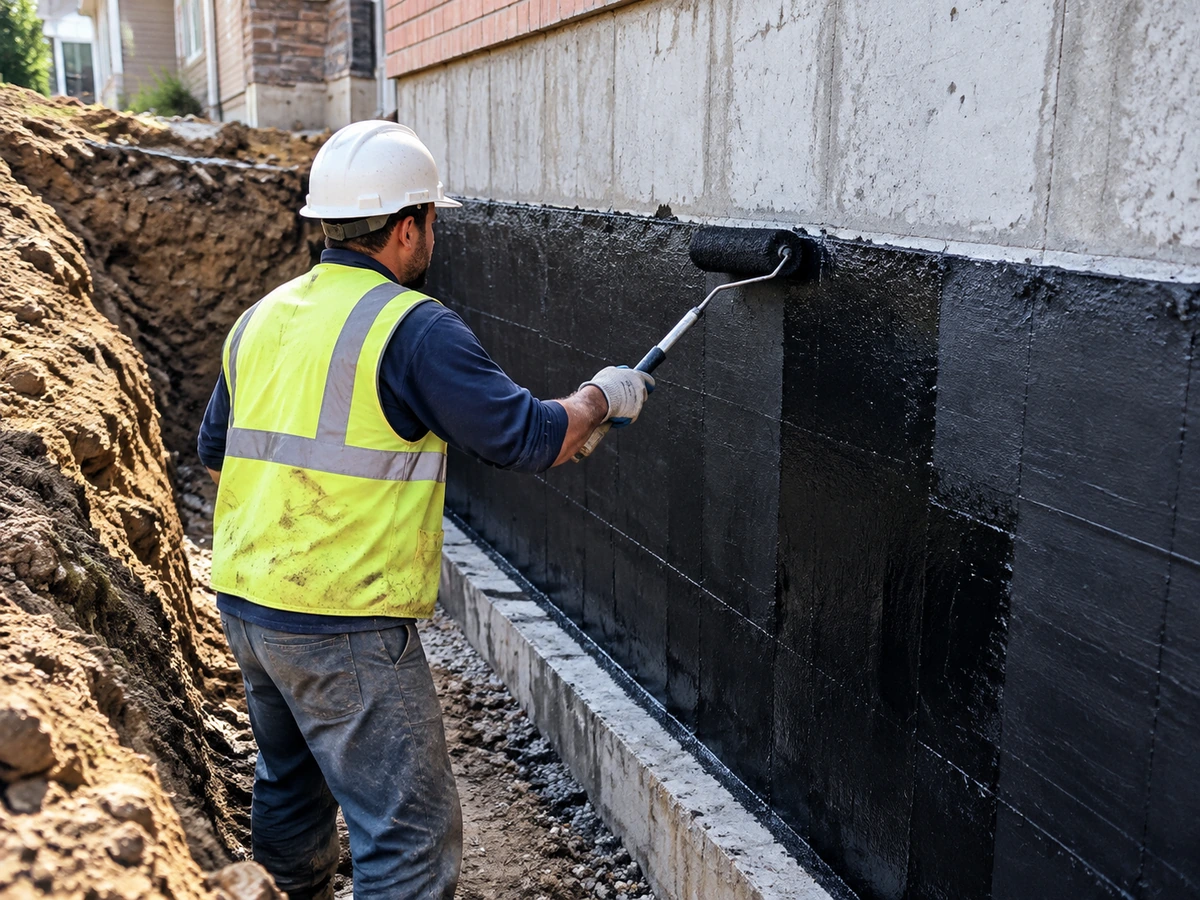
What it is: the foundation is excavated, the wall is cleaned and repaired, cracks are filled, a membrane is applied to the below-grade wall, drainage is laid at the footing, and the ground is backfilled. When it wins: when water comes through the wall itself, through cracked or porous masonry, failed pointing, or a wall with no membrane at all. What it does not do: it does not stop groundwater rising under the floor, and it is the most disruptive option, needing digging, access and usually a permit. On a rowhouse with no side yard, excavation is by hand or mini-excavator.
Crawlspace waterproofing
What it is: the crawlspace is cleared, a drainage channel and sump are fitted where the floor allows, and a sealed membrane is laid over the ground to keep damp out of the rooms above. When it wins: in houses with a shallow crawlspace that smells damp or shows mould on the joists. What it does not do: it does not fix a leaking wall above the crawlspace.
Sump pumps and battery backup
What it is: a pump in a sealed pit that switches on when water rises, with a battery backup for power cuts and an alarm if the pump fails. When it wins: wherever an interior drainage system is fitted, and in any basement that has flooded when the power has gone out. What it does not do: it does not stop water entering; it only removes the water the drainage system collects.
French drains
What it is: a gravel-filled trench with a perforated pipe that carries water away from the foundation, used outside where there is room to dig or inside as part of an interior system. When it wins: where surface water or a high water table needs a controlled path away from the building. What it does not do: it does not stop sewer backup, and a drain that is not maintained will clog with silt.
Backwater valves
What it is: a valve on the sewer line that lets waste water flow out and closes when flow tries to reverse, so a surcharging main cannot push water back into the basement. When it wins: in low-lying streets in Canarsie, Gowanus and Red Hook, and in any basement with a floor drain or a toilet below street level. What it does not do: it does not stop groundwater or surface runoff, and it needs access for inspection and cleaning.
Commercial waterproofing in Brooklyn
Co-op and condo boards, property managers and owners of multi-family, retail and office buildings in Brooklyn ask for a different kind of service from a homeowner. The water is the same, but the decisions are made by a board, the building stays occupied while we work, and the budget has to be staged across financial years. We start with an envelope survey of the whole building, not just the wet corner, and set out the scope in stages so a board can approve the urgent work first and plan the rest. Work is scheduled around the board’s rules and work hours, which in Williamsburg, Greenpoint and Bushwick can be strict, and common areas are kept usable. We document the work with photographs at each stage. Our masonry waterproofing and sealants work often sits alongside a commercial scope, because the facade and the foundation fail together on older buildings.
How we find the leak before we sell a fix
We do not quote a system until we know which kind of water we are dealing with. The inspection follows the same order on every Brooklyn job.
- Free inspection. We visit the property, look at the basement, the foundation and the outside of the building, and listen to when the water appears.
- Trace the full water path. We follow the water from where it shows to where it enters, including the roof, the parapet, the facade and the ground around the building. Where the roof edge is part of the story, our roof repair and installation team and our parapet wall repair and installation team look at it with us.
- Identify which of the three kinds of water it is. Sewer backup, groundwater or surface runoff, each with its own fix.
- Photo documentation. We photograph the entry points, the damage and the conditions, so the scope and the estimate can be checked against what we saw.
- Written estimate. You receive a written estimate listing the scope, the system and the price, so the decision is made on paper, not on a promise.
- Permits, installation, water test and walkthrough. We arrange the permits the job needs, install to the manufacturer’s specification, water-test the system, and walk the finished work through with you.
Brooklyn permits and landmark rules, handled for you
Exterior excavation in New York City needs a Department of Buildings permit, and we arrange it before digging starts. Park Slope, Brooklyn Heights, Crown Heights and Fort Greene all contain Landmarks Preservation Commission historic districts, and work that changes how the outside of a building looks needs LPC approval; repair-in-kind, matching the existing materials, is the usual route, and we check the LPC district map for your address before any exterior work. Co-op and condo board approvals and work hours are arranged with the building before we start. If excavation needs dewatering, the discharge rules matter: where dewatering discharges more than 10,000 gallons a day into the public sewer, approval from the Department of Environmental Protection is required, and smaller discharges need a self-certification form filed with DEP. We confirm which applies before pumping starts. For interior drainage, we confirm what the Department of Buildings requires for the job before we start, rather than assuming any exemption.
What waterproofing costs in Brooklyn
There is no fixed price for waterproofing in Brooklyn, and any figure given without seeing the building would mislead you. We give estimates only, and every estimate follows a free on-site inspection. What drives your price is the size of the basement, whether the work is interior or exterior, access, hand-digging or machine where there is no side yard, the foundation type, stone, brick or block, the severity of the water, the permits, and any landmark rules that apply. Every figure is an estimate — final price after a free on-site inspection.
Brooklyn neighbourhoods we serve
We work across the borough, from brownstone Brooklyn to the waterfront and the south of the borough. These are the neighbourhoods we are asked about most.
- Park Slope, 11215. Brownstones with stone cellars and areaways, where lime mortar and clogged areaway drains are the usual cause.
- Crown Heights, 11225. Pre-war rowhouses and two- and three-family houses, where shared party walls and shallow foundations set the scope.
- Bedford-Stuyvesant (Bed-Stuy), 11216. Historic rowhouses with old brick cellars, where water comes through the wall and the cove joint together.
- Gowanus, 11217. Low, filled ground beside the canal, where a high water table and combined sewer surcharge often arrive together.
- Bay Ridge, 11209. Detached houses and garden apartments near the water, where salt air and surface runoff do most of the damage.
We also work in the rest of Brooklyn and across New York City. Owners in Queens can also see our waterproofing contractors in Astoria page, and owners in Westchester can see our waterproofing contractors in Yonkers page.
Recent work in Brooklyn
We do not publish a photograph as a Brooklyn job unless its location is verified, and we do not yet have a verified Brooklyn job photograph for this page. There are no project photographs on this page. At the inspection we will show you photographs of comparable jobs, so you can see the system your building needs in a building like yours.
Frequently asked questions about waterproofing in Brooklyn
What is different about flooding in Gowanus, Red Hook and Canarsie?
All three are low-lying, and all three sit close to water or on filled ground with a high water table. Red Hook sits in FEMA’s AE flood zone, and parts of Canarsie and Gowanus are in mapped flood zones too. The practical difference is that sewer backup and groundwater often arrive together there, so a single fix is rarely enough, and the FEMA flood map for the address is part of the inspection.
How long does waterproofing take, and how long does it last?
An interior drainage system in a typical Brooklyn basement usually takes a few days, and exterior excavation takes longer because of the digging, the permit and the backfill. How long the work lasts depends on the system, the condition of the foundation and whether the pump and the drains are maintained. We do not promise a fixed lifespan, because no honest contractor can without seeing the building.
Do you do waterproofing for co-ops, condos and commercial buildings in Brooklyn?
Yes. We work for co-op and condo boards, property managers and owners of multi-family, retail and office buildings. The work is scoped in stages, scheduled around board rules and work hours, and documented with photographs at each stage, so the board has a record of what was done and why.
Request a free inspection in Brooklyn through our contact page. You can also read more about Spark Restoration before you invite us in.