


Sidewalk Repair NYC and DOT Violation Removal, from a Contractor Based in Yonkers
Sidewalk repair NYC property owners can rely on starts with a clear answer: Spark Restoration Inc repairs and replaces sidewalks and driveways across New York City, clears DOT sidewalk violations, and gives a per-square-foot estimate after a free on-site inspection.
Got a DOT Violation Notice? Start Here
A DOT sidewalk violation is not a fine — but it does start a clock. Under New York City Administrative Code §19-152, the owner of the property is responsible for maintaining the sidewalk in front of it, including the kerb. When the Department of Transportation finds defects, it issues a Preliminary Inspection Report — the PIR — with a sketch of the sidewalk and each defective flag numbered. From the day the notice is received, the owner has 75 days to repair the defects and have the violation dismissed.
Ignored, the violation gets expensive. The violation itself carries no fine, but if the work is not done within 75 days the Department of Transportation can have the sidewalk repaired and bill the owner, and the charge can be placed as a lien on the property. The violation also stays on the property’s record, and the raised flag is still there — a trip-and-fall claim waiting to happen.
There is one important exception. If the damage was caused by a city tree and the property is a one-, two- or three-family home, the city’s Trees & Sidewalks Program can take responsibility for the repair. The programme does not cover every tree. If you think your case falls under the programme, mention it when you request an inspection. See our DOT sidewalk violation removal in New York City service page.
Most of our residential work is for owners of one-, two- and three-family houses. Each job is priced on its own, after a free inspection.
Sidewalk Repair & Replacement
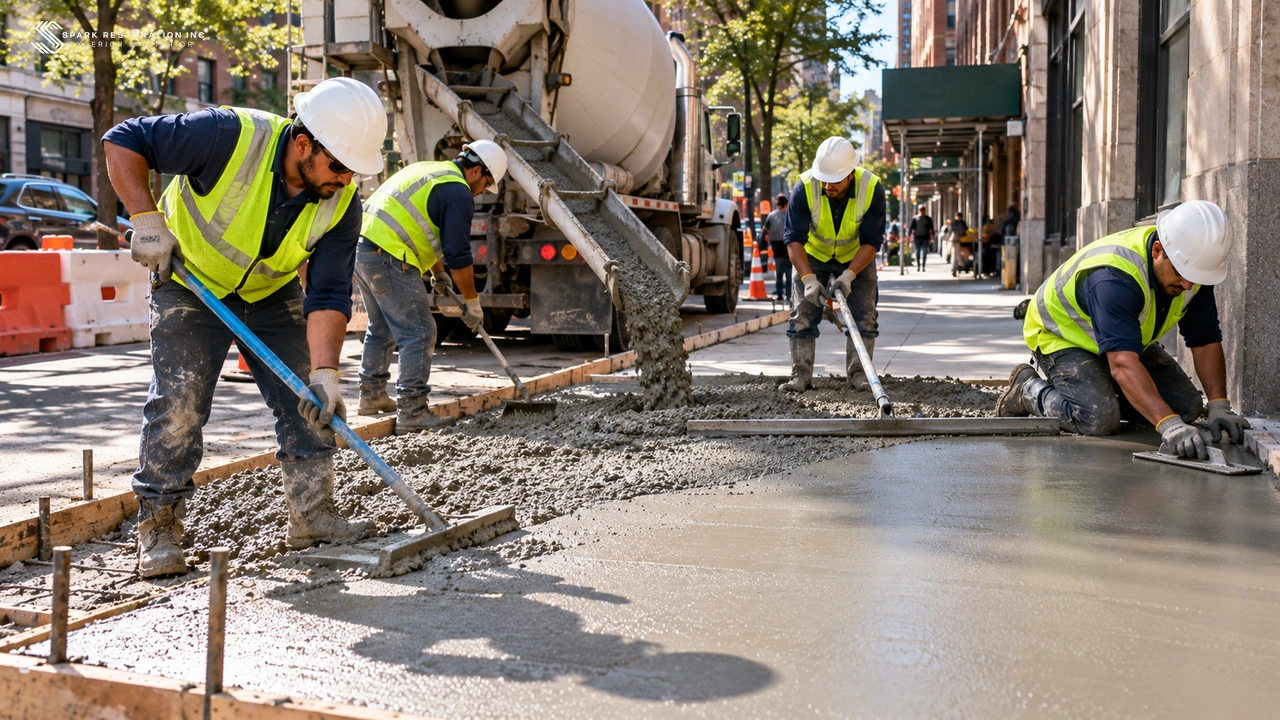
Sidewalk work is priced per flag — the individual concrete slab — or per square foot. A single cracked or settled flag can be cut out and replaced on its own. We pour to the DOT specification: 4 inches thick, 4,000 PSI, with joints where the city expects them. You can walk on new concrete after 24 to 48 hours.
Driveway work is where a house’s concrete takes the hardest punishment: cars, water and winter, every day. Our driveway repair in New York City work covers panel replacement, crack routing and sealing, edge and apron rebuilding, joint sealing, and drainage correction where water pools or runs towards the house. You can walk on new driveway concrete after 24 to 48 hours, but do not drive on it for about 7 days.
The kerb is part of the sidewalk under §19-152, and it is the part that gets hit: cars mount it, snowploughs scrape it, and salt eats at it. A chipped kerb is a small job; a kerb that has sunk or broken away is bigger, because the gutter line has to be rebuilt.
Tree-Root Damage & Root Barriers
Tree roots are the most common cause of a raised flag in the older neighbourhoods, and the hardest to fix, because the tree is usually a street tree the city owns. Cutting roots or removing a tree is not an option we can take on our own — the city’s Parks Department controls that. We lift the affected flags, prune roots only where the city allows it, and rebuild around the tree. If the tree caused the damage, the Trees & Sidewalks Program may cover the repair — ask us. See our page on tree-root damage to sidewalks in New York.
Many older New York buildings have vaults — basement space that extends under the sidewalk — and the sidewalk above a vault is not ordinary concrete. It is a structural slab, with the right thickness, reinforcement and waterproofing underneath. Vaulted work takes longer and costs more than a standard flag, and it should never be priced as one.
Where a sidewalk meets the street, the ramp matters — for wheelchairs, for pushchairs, for anyone with a bad knee. We rebuild pedestrian ramps to the city’s standard details.
Commercial Sidewalk & Driveway Work
Commercial sidewalk and driveway work is a different job from residential work, and we keep the two separate. Our commercial clients are co-op and condo boards, property managers and owners of mixed-use and retail buildings. Their problems are different: a whole frontage that has failed at once, a loading bay that takes trucks every day, or a violation that has to be cleared before a refinancing or a sale.
Frontage programmes are the usual shape of the work: a survey of the whole frontage and a schedule that replaces the worst flags first. We stage the work around tenants and trade — half the pavement at a time, so entrances stay open — and for boards the deliverable is not just concrete: a written scope, a permit number, photographs of each flag before and after, and a dismissal letter from the city. If you manage a building, start with a walk-through and request a free inspection.
How We Clear a Violation, Step by Step
These are the steps we take on every violation job.
- Send us the violation number and the address. Photograph the notice and request a free inspection. The number tells us which flags the city flagged and the time left on the 75-day clock.
- Site visit and PIR review. We walk the sidewalk against the Preliminary Inspection Report and confirm the numbered flags one by one. If the damage is tree-related and the Trees & Sidewalks Program applies, we say so now.
- Permit filed. We file the DOT sidewalk construction permit — $70 per 300 linear feet for one property — to the specification the inspector will check: 4-inch concrete, 4,000 PSI, expansion joints every 20 feet.
- Repair. The defective flags are cut out and replaced, the kerb rebuilt where it has failed, and the new concrete finished to match the existing sidewalk. The work is photographed flag by flag, so the record matches the report.
- DOT re-inspection. We report the repair to the city through 311 and request a re-inspection. A DOT inspector returns, walks the flags against the original report, and confirms the defects are gone.
- Dismissal. The violation is signed off and the property’s record is clear. We confirm the dismissal with you in writing, with the inspector’s sign-off and the photographs of the finished work.
What Sidewalk Repair in NYC Costs — Estimates Only
Every figure is an estimate — final price after a free on-site inspection. We do not publish prices, because a single flag and a full frontage are different jobs. What we can tell you is what moves the price, so you can judge any estimate on its merits.
- Borough and access. Manhattan frontages cost more than a driveway in Yonkers: permits, traffic, staging and getting a mixer truck to the kerb all count.
- Tree roots. Root work is slow and sometimes needs the Parks Department. A flag over a root costs more than a flag over soil.
- Thickness and specification. A 4-inch DOT-spec sidewalk flag and a 6-inch driveway slab are different jobs, and a vaulted sidewalk is different again.
- Landmark and bluestone. Landmark districts and bluestone sidewalks need matched materials and repair-in-kind work, which takes longer and costs more.
- Vaults and utilities. Vault covers, utility boxes and cellar doors all have to be worked around, and each one adds time.
- Size of the job. One flag is the most expensive work per square foot, because the permit, mobilisation and inspection are the same whether we pour one flag or twenty.
Our written estimates are per square foot and per flag. For a detailed look at how replacement work is priced, see our guide to sidewalk replacement cost in NYC and Westchester.
Where We Work
We work across New York City’s five boroughs and in Yonkers, from our base at 530 Yonkers Avenue. These are the neighbourhoods we know best.
Brooklyn
Bay Ridge, Bushwick, Crown Heights, Flatbush and Williamsburg. Brownstones, rowhouses and long frontages, with tree-root damage the most common call.
The Bronx
Co-op City, Fordham, Mott Haven, Pelham Bay and Riverdale. Walk-ups and garden apartments, and driveway aprons that take a beating from parked cars.
Queens
Astoria, Far Rockaway, Flushing, Forest Hills and Jamaica. Our kept Queens location page covers sidewalk and driveway contractors in Astoria, Queens.
Manhattan
Harlem, Inwood, the Lower East Side, Midtown and Washington Heights. Co-op and managed buildings, and frontage programmes staged around tenants.
Yonkers
Our home base. Getty Square, Nodine Hill, Park Hill, Dunwoodie, Crestwood and Homefield. See our sidewalk and driveway contractors in Yonkers, NY page.
Sidewalk work sits alongside the rest of what we do. See our masonry contractors in New York City, our waterproofing contractors in New York City and our exterior restoration in New York City pages, or read about Spark Restoration.
Frequently Asked Questions About Sidewalk & Driveway Work in NYC
How long before I can walk or drive on new concrete?
You can walk on a new sidewalk after 24 to 48 hours. A driveway needs longer: do not drive on new driveway concrete for about 7 days, so the slab can cure to full strength. Cold weather slows curing and hot weather speeds it.
Will the new concrete match the old sidewalk?
Honestly, not at first. New concrete is lighter and cleaner than concrete that has weathered for years, and the difference is visible for the first few months. It fades as the flags weather in, and after a season the join is hard to spot. If a perfect match matters, replace a longer run so the join falls at a joint.
Do Yonkers properties get sidewalk violations too?
Yes — but Yonkers enforces sidewalk defects under its own code, not under New York City’s DOT rules. Under Yonkers Code §103-3, the city serves a notice on the owner, who has 30 days from service to make the repair; if the work is not done, the city can do it and charge the owner. See our sidewalk and driveway contractors in Yonkers, NY page.
If the pavement outside your home or building needs attention, request a free inspection. We will price it by the flag and the square foot, and stay with it until the city signs it off.