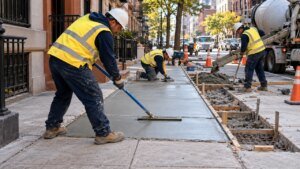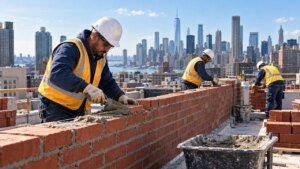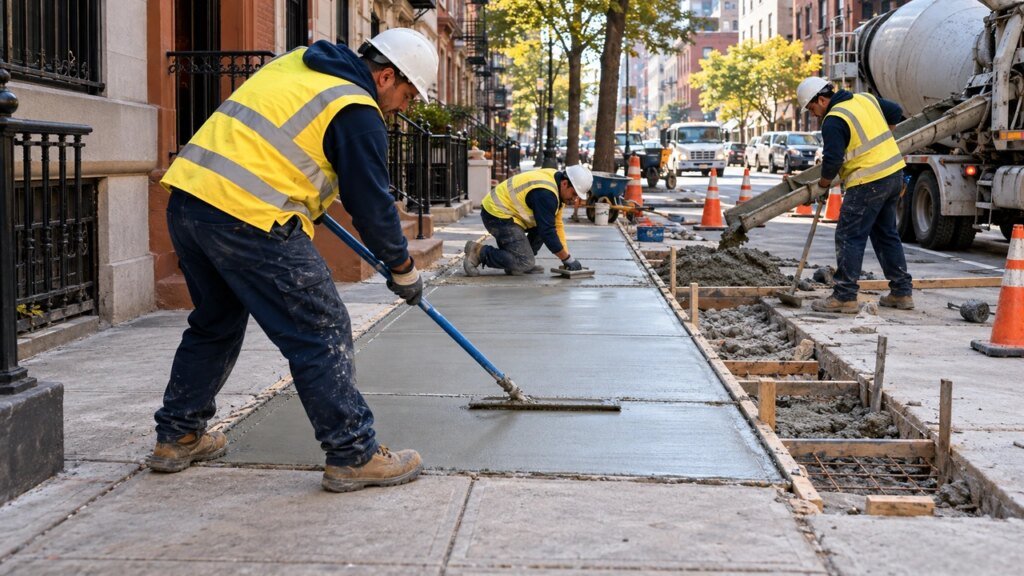
If you are looking up sidewalk replacement cost NYC property owners face, the first thing you should know is that there is no single price anyone can quote without seeing your sidewalk. Spark Restoration Inc does not publish a standard sidewalk price, because the cost is set on site: by the size of the walk, the thickness and specification of the concrete, the permits your municipality requires, tree roots, demolition, utility covers, access, and whether a DOT violation is involved. This guide walks through each of those factors in the order an estimator weighs them, so you know exactly what shapes the figure you will receive, and why a free on-site estimate is the only reliable way to pin it down.
The short answer
Sidewalk replacement in NYC and Westchester is priced per project, not per menu. Four things set most of the figure: how many flags are being replaced, the concrete thickness and specification the work must meet, the permit and inspection path in your municipality, and the site conditions an estimator finds — tree roots, utility covers, vaults, and access. Everything below unpacks those four drivers in the order they are weighed on a real estimate, so you can compare any two quotes on scope instead of on a single number.
Why is there no standard price for sidewalk replacement?
Two sidewalks on the same block can cost different amounts to replace. One may be a short run of standard pedestrian flags; the other may cross a driveway, sit under tree roots, or carry utility covers that have to be worked around and reset to grade. A fixed price cannot account for that. A responsible estimate is built from measured frontage, the number of flags being replaced, the concrete specification required, demolition and disposal, permits and inspections, and site conditions. Any figure given without a site visit is a guess, and it usually misses something expensive.
How does the size of the sidewalk affect the cost?
Size is the starting point of every estimate. The estimator measures the linear feet of frontage and counts how many flags, or slabs, need full replacement versus how many can stay. Replacing the full width of a building front is a different job from replacing a few isolated flags, even though the concrete and labor rates are similar per flag. Longer runs need more concrete, more forming, more joints, and more time, while very short runs carry the same setup, permit, and inspection steps as larger ones, which spreads those fixed costs over less work. Grading matters too: a walk that must shed water away from the building or line up with a driveway crossing takes more layout and finishing work than a straight, flat run. Our sidewalk and driveway services in New York cover both full frontage replacements and targeted flag work across the boroughs.
How does concrete thickness and specification affect the cost?
Not all sidewalk concrete is the same. A standard pedestrian walk and a walk that carries vehicles across a driveway are poured to different thicknesses and strengths, and the heavier-duty work costs more in material and labor. Base preparation is part of the same decision: the old base is inspected once the flags are out, and weak or settled base material may need to be corrected before new concrete goes in, so the walk does not fail again. Where the work must follow a municipal specification, the mix, thickness, and finish have to comply, and there is no cheaper way to do it that will pass inspection. Our concrete work and installations in New York are built to the specification the site and the municipality require, not a one-size pour.
Who is responsible for paying for sidewalk replacement?
In New York City, the property owner is responsible for the sidewalk next to the property. NYC Administrative Code §19-152 makes installing, repairing, and maintaining that sidewalk the owner’s obligation, and when DOT finds a defect it issues a violation to the owner — the repair bill does not go to the City. The same principle applies across Westchester, where each municipality’s code places the sidewalk in front of a property with that property’s owner.
There is one exception worth checking before you pay for anything: if a City-owned street tree caused the damage, the City may repair the sidewalk at no cost to the owner through its Trees & Sidewalks program, which covers eligible owner-occupied one- to three-family homes. That path starts with a City inspection to confirm eligibility, and it is one more reason to identify the cause of the damage before scoping the repair.
What permits and inspections are required in NYC, and how do they affect cost?
In New York City, sidewalk work is regulated by the NYC Department of Transportation. A sidewalk permit is generally required before replacement begins, and the finished work must meet DOT specifications for grade, slope, and construction quality before it passes inspection. That adds real cost to a project: there is the permit process itself, the scheduling that goes with it, and the possibility of re-inspection if anything needs correction. Work done without the right permit can be flagged, stopped, and redone, which is far more expensive than permitting it properly from the start. A contractor familiar with the DOT process folds the paperwork, scheduling, and inspection steps into the estimate instead of treating them as an afterthought.
How do the rules differ in Westchester?
Cross the city line and the rulebook changes. NYC DOT jurisdiction does not apply in Westchester, and there is no single county-wide permit office for sidewalks. Each city, village, and town runs its own process: one municipality may require a straightforward permit with an inspection, another may have different application steps, review times, or specifications for the finished work. That means the permit path for a sidewalk in Yonkers is not the same as the path in Scarsdale or White Plains. The estimate for a Westchester property reflects whichever process that municipality requires, including its inspection steps and any corrections they demand. Compare that with a typical Bronx frontage, where DOT rules govern the whole job, as on our Jerome Park sidewalk and driveway contractors page, and you can see why location is a cost factor in its own right.
How does tree-root damage change the cost?
Tree roots are one of the most common reasons a sidewalk fails, and one of the biggest drivers of replacement cost. Roots lift and crack flags, and replacing the concrete without addressing the root problem sets the new walk up for the same failure. Root pruning or removal near the walk adds labor and care to the job, and the work has to protect the tree where the rules require it. In New York City, work near a City tree can involve NYC DOT tree-related requirements, which adds coordination and paperwork to the project. In Westchester, tree ownership and work rules vary by municipality, but roots complicate the job in exactly the same way. Where root damage is the cause, the estimate covers both getting the roots handled properly and pouring a walk that has a fair chance of lasting.
If the tree is a City tree and your home qualifies for the Trees & Sidewalks program described above, part or all of the repair may be handled by the City instead. Ask about eligibility before authorizing root work, because cutting or grinding roots around a City tree without approval can create a second problem on top of the first.
What does demolition and disposal of the old sidewalk add?
Before any new concrete is poured, the old flags have to come out. Breaking up and removing existing concrete takes labor, equipment time, and hauling, and disposing of the debris is a line item on every estimate. The old walk can also hide surprises: thicker-than-expected concrete, buried reinforcement, or a base that has settled badly and needs to be rebuilt. None of that is visible until demolition starts, which is another reason site-specific estimates beat generic prices. The estimate accounts for the removal work and for the condition of what is found underneath.
How do utility covers, vaults, and other obstacles affect cost?
Sidewalks rarely run uninterrupted. Utility covers, grates, gas and water shutoffs, cellar doors, and sidewalk vaults all sit within the walk, and each one has to be worked around. Covers must be set to the finished grade of the new concrete so there are no trip hazards, which takes careful forming and finishing. Utility-owned covers may require coordination with the utility before they can be adjusted. Vaults add a further layer: the condition of a vault structure under the walk can expand the scope of the job well beyond the flags themselves. Every obstacle in the run is counted and priced into the estimate.
Does replacing a sidewalk after a DOT violation cost differently?
The physical work is the same, but a DOT violation changes the project around it. The replacement has to address the specific defects cited in the violation notice, follow DOT specifications, and go through the inspection and dismissal process once the work is complete. That paperwork trail is part of the scope, and it has to be done right for the violation to be cleared. The timeline is also driven by the violation rather than by your own schedule, so there is less room to plan around convenience, and delay carries its own risks. An estimate on a violation job covers the same concrete work plus the urgency and documentation the violation adds. Getting the work permitted and inspected promptly is the simplest way to keep the process straightforward.
If you have received a notice and want the dismissal process itself explained step by step, our guide to how to get a DOT sidewalk violation dismissed walks through it in order.
How do access, parking, and site conditions affect cost?
Getting material and equipment to the sidewalk shapes the labor cost. A job with clear street access and room to stage concrete is faster and cheaper than one where parking is tight, deliveries have to be timed, or the frontage is hemmed in by traffic and pedestrians. Pedestrian flow has to be managed safely around the work zone, building entrances need to stay usable while flags are out, and in busy corridors the work may need to be sequenced around those constraints. All of that adds labor hours. A straightforward residential frontage with open access is simply a less expensive site than a congested commercial block, even when the concrete work itself is identical.
What if curb work is included?
The curb is a separate element from the sidewalk, and including it changes the scope. Curb work means additional demolition, forming, and pouring, plus tying the new curb line into the existing curb and aligning it with the roadway edge. The interface between the curb and the gutter has to drain properly, and on streets where the road profile is uneven, that takes care to get right. If your project includes curb replacement alongside the sidewalk, expect the estimate to reflect the added material, labor, and inspection attention that the curb line demands.
How long does sidewalk replacement take?
Most residential frontages are measured in days, not weeks. Demolition and forming usually happen on the first day, the pour follows, and pedestrians can typically walk on new concrete within 24 to 48 hours. The concrete keeps curing after that — full strength takes about 28 days — but the walk is in normal use well before then. Permit scheduling, inspection timing, and weather are the variables that stretch the calendar, which is why a violation job on a deadline should be started as early as possible.
Is sidewalk replacement covered by homeowners insurance?
Sometimes. Damage from a sudden event — a storm, a vehicle strike, vandalism, or a fallen tree — may fall under a homeowners policy, while gradual wear, settling, and age-related cracking usually do not. Policies differ, so the practical step is to photograph the damage, keep the violation notice if there is one, and ask your insurer what documentation they need before work begins. Whether or not a claim applies, the repair obligation itself stays with the property owner.
How can you get an accurate cost for your sidewalk?
There is no shortcut around a site visit. During a free on-site estimate, the frontage is measured, the flags to be replaced are counted, and every factor in this guide is checked at your property: the thickness and specification the work requires, tree roots, demolition and disposal, utility covers or vaults, the permit path for your municipality, access and parking, and any curb work. You then get a cost based on your sidewalk’s real scope, not a general guess. Spark Restoration Inc serves the boroughs and Westchester County, and you can see the full list of service areas we cover in NYC and Westchester to confirm your neighborhood. If you are comparing options, ask every bidder how they priced each factor above, and be wary of any number that was set without measuring your walk.