If you manage a building in New York City, the parapet is easy to overlook — until mortar starts crumbling, a coping stone loosens, or an inspection report flags the wall. Then the first question is usually the simplest one: how much is this going to cost?
There is no honest single figure we can publish, because parapet repair cost in NYC depends on the scope of work, the condition of the wall, and how a crew can safely reach it. What we can do is explain exactly what drives the price, so you can read any quote with confidence and compare proposals fairly. This guide is written for building owners, co-op and condo boards, and property managers.
What are the signs that a parapet needs repair?
Parapets usually warn you before they fail. On the roof side and the street side, look for open or crumbling mortar joints, cracked or displaced brick, a wall that leans or bulges, and coping stones that rock, sit unevenly, or have open joints between them. Inside the building, the top floor tells the same story: ceiling or wall stains near the exterior walls and corners, peeling paint or bubbling plaster high on the wall, and white crystalline deposits — efflorescence — on interior brick all point to water entering through the parapet and working its way down. Water staining on the face of the parapet itself is another marker. Any of these signs means the wall should be looked at up close; most parapet problems are inexpensive while they are still mortar-and-coping problems.
What drives the cost of parapet repair in NYC?
The final price is built from a handful of variables, and every building scores differently on each one. The biggest is the extent of the damage: loose mortar joints on an otherwise sound wall are a very different project from brickwork that has cracked, bowed, or shifted out of line. The size of the parapet matters too — its length along the roofline and its height above the roof both shape how much material and labor the job needs. The condition of what sits on top of and behind the wall matters as well. Worn coping, failed flashing, and a roof edge in poor shape all add work, because a sound repair has to address the path the water was taking, not just the damage you can see. Materials play a part, particularly on older buildings where replacement brick and stone should match what is already there. And finally there is access. Some parapets can be reached from the roof itself; others call for scaffolding, a sidewalk shed, and permits, and those logistics can shape the budget as much as the masonry does.
What is the difference between repointing, a partial rebuild, and a full rebuild?
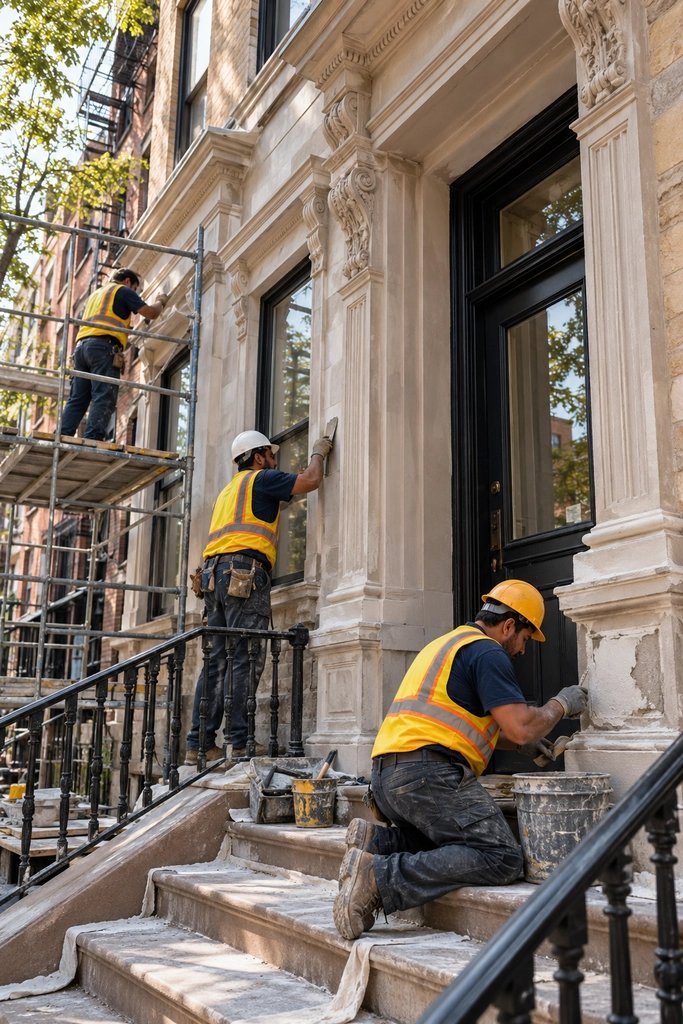
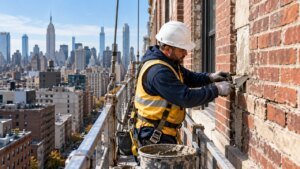
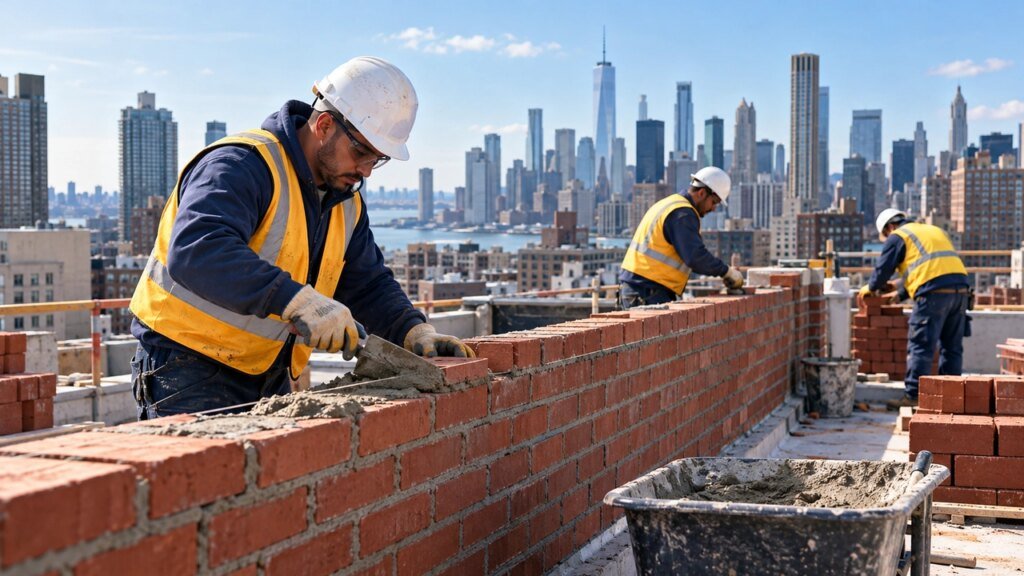
These three scopes involve very different amounts of work, which is why quotes for parapet repair on similar buildings can vary so widely. Repointing is the lightest intervention. The crew rakes out cracked or crumbling mortar joints and packs in fresh mortar, restoring the wall’s weather seal. It suits parapets whose bricks are sound and whose alignment is still true. A partial rebuild takes down only the damaged sections — a corner, a stretch between roof drains, or the top courses — and rebuilds them, reusing sound brick where practical and tying the new work into the wall that remains. It is the usual answer when deterioration is real but localized. A full rebuild removes the parapet along an elevation, or around the whole building, down to sound structure, and builds it back with new or salvaged masonry, fresh flashing, and new coping. It is the largest undertaking of the three, but when a wall is leaning, deeply cracked, or saturated throughout, rebuilding is often the only repair that actually lasts. Your contractor should be able to show you, with photographs, which scope your wall genuinely needs, and why.
Does it matter whether the parapet is structural or ornamental?
It does, because it changes what a repair has to accomplish. A structural parapet is tied into the building’s frame or floor structure and contributes to the integrity of the roof edge; an ornamental parapet provides the facade’s profile and weather line without carrying that structural role. Both keep water out, and both can become hazards when they deteriorate, but stabilizing or rebuilding a structural parapet involves the connections behind the masonry, not just the masonry itself. Identifying which type your building has is part of a proper inspection, and it is one reason two parapets that look alike from the street can be scoped very differently.
How do coping and flashing affect the price?
A parapet rarely fails in the middle of the wall. It fails at the top and at the back, which is where coping and flashing come in. Coping is the cap that sheds water off the top of the wall. Stone, metal, and precast coping each involve different materials and fabrication, and damaged units may need to be reset, repaired, or replaced to match the existing run. Because the coping usually has to come off for rebuild work, its condition is assessed on almost every project. Flashing is the waterproof layer that ties the parapet into the roof. When flashing has split, lifted, or corroded, water gets behind the masonry and deteriorates the wall from the inside out. Renewing through-wall and base flashing adds materials and careful detailing to a job, but skipping it leaves the main leak path open. This is also where parapet work meets the roof itself: the wall, the flashing, and the roof surface have to work as one system, which is why owners often review their building’s waterproofing and sealants at the same time as a parapet project.
One coping shortcut deserves a warning: retrofitted metal caps are sometimes sold as a quick fix over tired masonry. A metal cap can work well over a sound wall with proper waterproofing beneath it, but over cracked or saturated masonry it can trap moisture inside the wall and speed up the very deterioration it was meant to stop. The cap is only as good as the wall underneath it.
Why do scaffolding, sidewalk sheds, and permits add so much?
In New York City, getting to the work can be as involved as the work itself. If a parapet can be serviced safely from the roof, access may be straightforward. When repairs run along a street-facing elevation, the public below has to be protected, and that is where supported scaffolding and sidewalk sheds enter the picture. A shed has to be designed, filed, erected, lit, inspected, and eventually dismantled, and it may need to stay in place for the duration of the project. Permits and filings with the Department of Buildings add their own requirements and lead time, and occupied buildings add coordination — notices to residents, protection for entrances and terraces, and debris handling that keeps sidewalks and neighboring property clean. None of this is padding. It is the cost of working safely and legally over a public way, and it is one of the main reasons two similar-looking walls on different buildings can carry very different budgets.
How does the annual parapet inspection affect timing and cost?
New York City requires the parapets on many buildings to be observed up close and checked every year, with the findings documented, so problems are on record whether or not repairs follow right away. That annual rhythm works in your favor when you use it well. An inspection that catches open joints or a loose coping stone early usually points to a smaller, planned repair. The same defect left through repeated freeze-and-thaw cycles can grow into a rebuild. Timing matters for budget reasons too. Planned work lets you gather quotes, complete filings, and schedule access equipment in an orderly way, while an unsafe condition can force emergency protection, such as a sidewalk shed, before any masonry begins. If your latest inspection flagged the parapet, treat that report as the starting point for pricing, and ask your contractor to walk the roof with it in hand. Our overview of parapet wall repair and installation services in New York explains how inspection findings turn into a repair scope.
The annual observation described above is a Local Law 126 requirement: buildings with a parapet facing a public right-of-way must have that parapet observed up close every year by a person qualified to judge its condition, with the findings documented and kept on file. Taller buildings face a second regime as well — under Local Law 11 (the Facade Inspection Safety Program), facades including parapets on buildings over six stories are inspected and filed on a multi-year cycle, and defects found there come with repair deadlines. The two regimes overlap on many buildings, and either one can turn a parapet finding into required work with a clock attached.
How can you get an accurate quote for parapet repair?
An accurate quote starts with an accurate look. A price given from the sidewalk, or from a single photograph, is a guess, because the real condition of a parapet is only visible from the roof, up close. Ask the contractor to inspect the full run of the wall, check the coping joints and flashing, look at the roof side as well as the street side, and document conditions with photographs. Then ask for the proposal in writing, broken down by scope: what is being repointed, what is being rebuilt, what happens with coping and flashing, and how access and permits are being handled. A clear written breakdown lets a board or a manager compare two proposals on scope rather than on a single bottom-line number. It also protects you if conditions change once the coping comes off, because the agreement should say how hidden damage is documented and approved before any extra work proceeds.
How can you avoid overpaying for parapet work?
Most overpaying happens in one of two ways: paying for more wall than you need, or paying twice because the first repair skipped the cause. You can guard against both. Get more than one written proposal for the same scope, and be wary of a price that comes in far below the others — it often means flashing, coping, or access was left out and will return later as an extra. Ask each bidder to separate the masonry from the access and filing items, so you can see what you are actually buying. Phase the work if the building allows it: a sound elevation can wait while a failing one is rebuilt, as long as a contractor confirms in writing that deferring it is safe. Finally, keep your annual inspection reports, proposals, and photographs together. A documented history is what lets you challenge a scope that seems inflated, and it is the same discipline we apply on every building, from parapet work in Harlem to large roofline projects elsewhere in the city.
What should a co-op or condo board ask for before approving parapet work?
Boards approve parapet projects on paper long before anyone goes up on the roof, so the paperwork is worth insisting on. Ask for a photo-documented condition report tied to the latest inspection findings, a written scope that separates repointing, rebuilding, coping, and flashing into line items, and a clear statement of which filings and permits the contractor will handle. Confirm the contractor’s insurance certificates are current and issued for your building, and ask how residents will be notified and entrances protected while work is overhead. A contractor who produces that package without being pushed is showing you how the job itself will be run — and for a board, that documentation becomes the building’s record that it acted on the inspection findings responsibly.
The bottom line on parapet repair cost in NYC
Parapet repair cost in NYC is not a menu price, and any contractor who quotes one without standing on your roof is guessing with your money. The price you pay will follow the scope the wall actually needs, the coping and flashing above and behind it, and the access and filings required to do the work safely and legally. Get the wall inspected, insist on a written scope supported by photographs, and compare proposals line by line. If your parapet has been flagged, or you can see open joints, displaced brick, or staining below the roofline, we are glad to take a look. Spark Restoration provides parapet repair and related masonry services across our service areas in New York City and Westchester. Contact us to arrange an on-site assessment and a detailed written estimate.