A new driveway is one of the largest pieces of concrete most homeowners will ever buy, so it is natural to ask about concrete driveway cost before anything else. In NYC and Westchester, though, there is no honest single figure to quote from a distance, because the price is built from the property in front of the contractor: its size, its ground, its access, and the rules of the street it meets.
This guide explains how a driveway price is put together, factor by factor, so you can read any quote with confidence: what a quote usually includes, what drives the cost, how concrete compares with asphalt and pavers, and how to compare proposals without surprise extras. For a broader look at the work itself, see our page on concrete work and installations in New York.
The short answer
There is no honest single figure for a concrete driveway in NYC or Westchester, because the price is assembled from the property: the size and layout, demolition of the old surface, the ground and base underneath, slab thickness and strength, drainage and slope, the finish, and the apron and sidewalk work where the driveway meets the street. Two driveways that look alike from the curb can be priced very differently once those factors are read properly. This guide breaks the price down factor by factor, so you can see what a quote includes, what it may have left out, and how to compare proposals on scope.
What Does a Concrete Driveway Quote Usually Include?
A complete quote is more than a price for pouring concrete. It normally covers the work in sequence: demolishing and removing the existing driveway, excavating and preparing the base, setting forms, placing reinforcement, pouring and finishing the new slab, cutting control joints so the concrete can move without cracking at random, and cleaning up and hauling debris away at the end. Work at the edges is where proposals often diverge: the apron at the street, any sidewalk flags that have to be replaced, drainage corrections, and permit or inspection steps may be included, listed as allowances, or left out entirely.
How Does Size and Layout Affect the Cost?
Size is the starting point of every estimate, because it sets how much material is needed, how much base must be prepared, and how long the work takes. A long driveway, a wide parking area in front of a garage, or a layout that widens, turns, or wraps around plantings all add area and forming work compared with a short, straight, single-width drive. Layout matters as well: straight runs with good access move faster than tight, curved, or stepped layouts where every section is formed, poured, and finished in smaller pieces, so two driveways with the same area can carry different labor.
Why Do Thickness and Base Preparation Matter?
A driveway slab is only as good as what sits under it. The quote reflects the thickness the slab is designed to, which follows the use it will get: a drive that carries parked cars and delivery vehicles needs a more substantial build than a surface that only ever sees foot traffic.
Base preparation is the hidden half of the job. The ground is excavated, soft or loose material is dealt with, and a compacted aggregate base is placed and leveled so the slab is supported evenly. Where the existing ground is poor, more excavation and more base material go into the same driveway. Skipping this work is how a new driveway ends up settling and cracking early, so a quote that describes the base clearly is taking the job seriously.
Strength is specified alongside thickness. Driveway mixes are ordered by compressive strength, commonly in the 3,000 to 4,000 PSI range for residential work, with the higher end and a thicker section used where vehicles are heavier, turning movements are tighter, or the freeze-thaw exposure is severe. A proposal should state both numbers — the slab thickness and the mix strength — rather than just naming a thickness, because a thin, weak slab and a properly specified one can look identical on the day they are poured and age very differently.
What About Demolition and Removal of the Old Driveway?
Most replacements start with a removal. The existing surface has to be broken up, loaded, hauled away, and disposed of, and the cost follows what that material is: a thin, broken slab comes out differently from thick, reinforced concrete, and asphalt behaves differently again. Buried surprises, such as an older layer underneath the visible one, add to the same line.
Access drives removal cost as much as material does. A driveway a machine can reach directly is a different job from one where debris has to be carried out by hand through a gate, down steps, or along a side path.
How Do Drainage and Grading Change the Price?
Water is the enemy of every driveway, so a good quote pays attention to where rain will go. The surface is graded to shed water away from the garage and the house, and low spots that would hold puddles are corrected in the base before the slab is poured. On some properties that is a matter of careful grading alone; on others it means adding drainage, such as a channel or a drain connected to an appropriate outlet, which adds trenching, pipework or channel units, and connections before the concrete work can start. Water left to run toward a foundation, pool on the slab, or freeze across a walking route is what brings a driveway back for repair.
Does Slope Make a Driveway More Expensive to Build?
Yes, slope changes the work in several ways at once. A sloped driveway needs more careful forming and grading to hold its shape, the concrete has to be placed and finished in a way that keeps it from moving downhill while it is wet, and the finished surface needs enough texture that tires and shoes can grip it in wet or icy weather. Steeper properties can also involve steps, landings, retaining edges, or a reworked meeting point with the sidewalk and street, each of which adds forming and finishing.
What Role Does Reinforcement Play in the Cost?
Concrete is strong under compression but weak where it is pulled, so driveways are reinforced to help the slab hold together as the ground moves and loads pass over it. Depending on the design, that reinforcement can be steel mesh, steel bars, or fibers mixed through the concrete, placed on supports so it ends up inside the slab where it belongs rather than pressed into the base.
Reinforcement adds material and labor to the quote, following the size of the driveway, the thickness of the slab, and how the slab is divided into sections by its joints. It is not an optional extra to be trimmed when a quote needs trimming, and a proposal should say, in plain terms, what reinforcement is included and where.
How Do Finish Choices Affect the Cost?
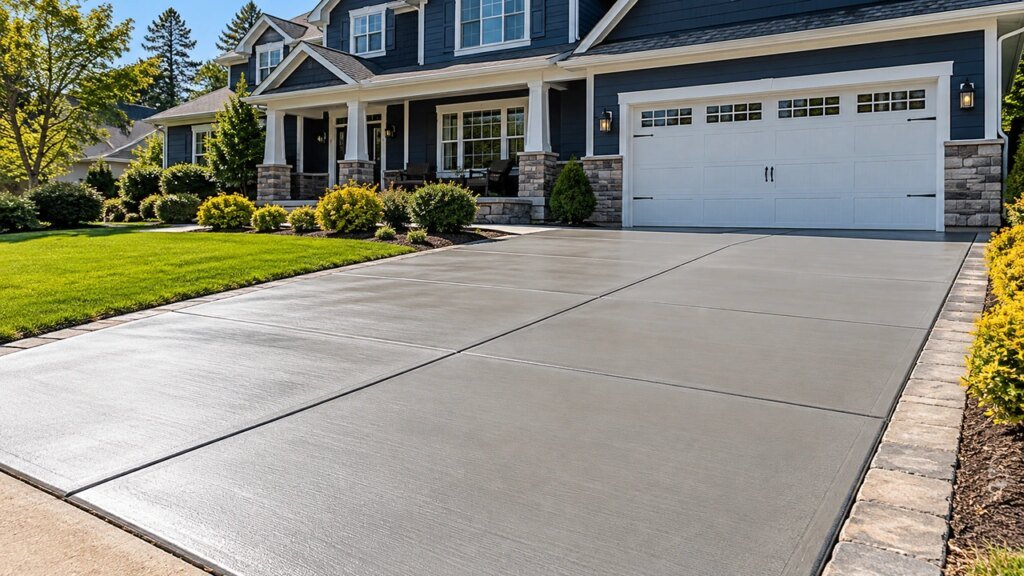
The standard finish is a simple broomed surface: practical, slip resistant, and the baseline most quotes start from. From there, choices add work. Decorative finishes, exposed stone looks, stamped patterns, and colored concrete each add materials, steps, or skill, and borders or bands in a second finish divide one pour into several smaller, more careful pours. A pattern also has to be laid out to suit the shape of the driveway, and edges at the garage, walk, and apron are finished by hand, so an upgraded finish mostly buys time and craft on the day of the pour.
Do Permits and City Rules Add to the Cost?
They can, and this is an area where general guidance is the only honest kind, because requirements vary by city, by neighborhood, and by the scope of the work. In NYC and across Westchester communities, driveway work may involve permits, inspections, or rules about how a driveway meets the street, and sidewalk or apron work is typically held to municipal standards.
The cost effect is usually indirect: application and filing steps, time spent meeting a specification, and work built to a required standard rather than the cheapest available method. What matters for your budget is that the subject is addressed in writing: ask who confirms the requirements for your address, and whether that step is included in the quote or left to you.
What About the Apron and Sidewalk Where the Driveway Meets the Street?
The apron is the section between the sidewalk and the street, and it is one of the most consequential parts of the whole job. It carries vehicles across the pedestrian route, it is built where public and private work meet, and it often has to match the curb, the gutter, and the sidewalk around it. Replacing a driveway is frequently the moment when a worn apron or damaged sidewalk flags next to it are dealt with at the same time.
Whether that edge work is inside your quote or outside it can change the comparison between two proposals completely, so read this part line by line. Our page on sidewalk and driveway services in New York explains how the driveway, apron, and sidewalk are handled as one system at the curb.
Concrete vs. Asphalt vs. Pavers: How Do the Cost Factors Compare?
Homeowners often cross-shop three surfaces, and each is priced by a different mix of factors. Concrete is priced mainly by area, build, and finish, as this guide describes. Asphalt is a different material placed in layers and compacted; its quotes turn on similar ground preparation, with its own later pattern of sealing and eventual resurfacing.
Pavers are priced more like individual units: many pieces, bedding and jointing material, edge restraints, and the labor of laying and leveling each piece, with patterns adding time. Over the life of the surface, the comparison shifts again: concrete asks little routine care but is a bigger operation to repair in a section, while pavers allow small areas to be lifted and relaid. The right comparison is not which material is cheapest on day one, but which mix of installation scope, upkeep, and repair fits your property.
Service life is part of that comparison. A well-built concrete driveway on a properly prepared base commonly serves 25 years or more, while asphalt typically reaches the end of its surface life sooner and asks for periodic sealing and eventual resurfacing along the way, and pavers trade a longer-lasting unit for joints that need occasional re-sanding and leveling. In a freeze-thaw climate like New York’s, the base and drainage decisions made at installation matter more to that lifespan than the surface choice itself — which is why the sections above weight them so heavily.
How Do Contractors Measure and Quote a Driveway?
A careful quote starts with a visit. The contractor measures the length and width of the proposed driveway, notes where it widens or turns, checks the existing surface and its condition, looks at slope and drainage, and studies access for machines, materials, and debris removal. Photographs and rough dimensions can start a conversation, but they cannot price demolition, base condition, or drainage honestly.
The written quote that follows should turn those observations into a defined scope: the area to be built, the build of the slab and base, demolition and disposal, reinforcement, finish, drainage work, and the treatment of the apron and sidewalk. Where something genuinely cannot be known until the old surface comes up, a good quote says so and explains how that situation would be priced if it appears.
How Can You Compare Quotes and Avoid Surprise Extras?
Compare scope before you compare totals. Line the proposals up and check the same items on each: demolition and disposal, excavation and base, slab build and reinforcement, finish, joints, drainage, apron and sidewalk work, and permits or inspections. The lowest total is often simply the proposal that left the most out, and the missing items do not disappear; they return as extras once the old driveway is already torn out. Then protect yourself in writing: ask what would count as an extra, how extras are priced and approved before the work is done, and what the quote assumes about the ground under the existing surface.
How long does a driveway replacement take — and when can you use the new slab?
The visible work is usually a matter of days — demolition, excavation and base preparation, forming and reinforcement, then the pour and finish — but the calendar is longer than the crew time. Concrete gains strength by curing, and the new slab needs protection while it does: walking on it is typically fine after a day or two, but vehicles should stay off for about a week, and the concrete does not reach its full design strength for roughly 28 days. Weather can move every one of those dates, since cold slows curing and heavy rain can postpone a pour. Ask any proposal what access you will have during the work and when the driveway can take a car again, and treat the first winter gently — going easy on de-icing salts while the surface is young is one of the checks on our freeze-thaw damage checklist.
The Bottom Line on Concrete Driveway Cost in NYC & Westchester
There is no honest single figure for a concrete driveway, because the price is a summary of the property: its size and layout, the ground under the old surface, drainage and slope, the build of the slab, the finish on top, and the rules at the curb. Two driveways that look alike from the street can be priced very differently once those factors are read properly, and that is normal.
Start with a site visit and a written, itemized quote for your own driveway. If your home is in New Rochelle, our page for concrete contractors in New Rochelle, NY explains how this work is handled locally, and our service areas page lists the communities we cover across NYC and Westchester.