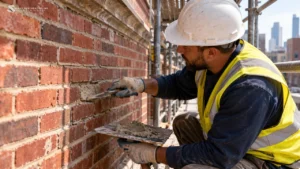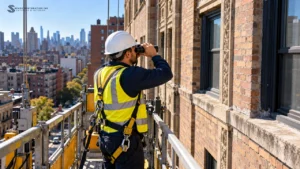
Local Law 126 is a New York City law that requires the owner of a building with a parapet fronting a public right-of-way to have that parapet observed every year. In plain terms, it is an annual safety check for the low wall at the edge of a roof, carried out to catch deterioration, displacement, or loose material before it can fall onto the street, sidewalk, or neighboring property below. The law is concerned with public safety, not with how a building looks, and it applies whether the building is tall or low-rise, residential or commercial, so long as its parapet faces a public way.
For many owners, Local Law 126 is easy to overlook because a parapet sits above eye level and is exposed to wind, rain, and freeze-thaw cycles, while small defects develop slowly over years. An annual observation creates a regular, documented record of the parapet’s condition, so problems are found while they are still manageable rather than after masonry has already loosened. This guide explains what the law requires, which buildings must comply, what the observation looks at, and what to do when a problem is found.
What Local Law 126 Requires
Local Law 126 requires an annual observation of parapets that front a public right-of-way. The requirement has been in effect since January 1, 2024, and it is an ongoing, yearly obligation rather than a one-time inspection. Each year, the parapet must be observed, and the owner must be able to show that the observation took place and what it found. Because parapet conditions change with weather, age, and use, a single check years ago cannot tell an owner what the wall looks like today.
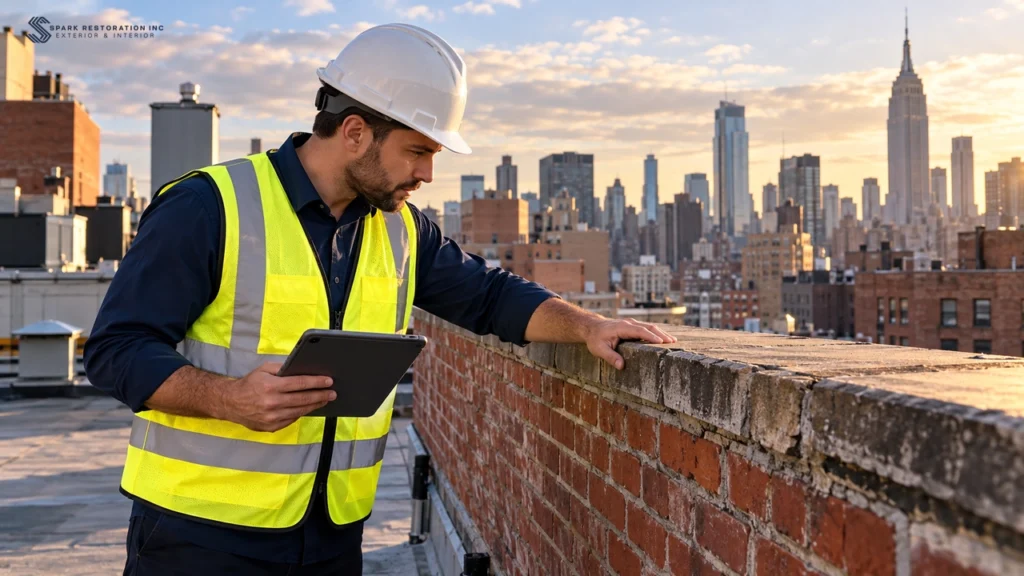
The observation must be performed by a competent person. That term matters, because the law does not treat a casual glance from the sidewalk as a substitute for a proper observation. A competent person is someone with the knowledge, training, and experience to recognize parapet defects and unsafe conditions, and to judge whether the wall is stable, deteriorating, or in need of attention. Owners should therefore arrange the observation through a suitably qualified professional, rather than assuming that any contractor or tradesperson on site can provide it.
After the observation, a written report must be prepared and kept on file for at least six years. The report is the owner’s evidence of compliance, and it should record the date of the observation, the condition found, and any defects or unsafe conditions identified. Keeping reports for at least six years allows an owner to demonstrate a history of annual observations and to track whether a defect is new or worsening. If a report cannot be produced, it is difficult to prove that the annual requirement was met.
Where the observation identifies an unsafe condition, the law requires that the condition be reported to the New York City Department of Buildings and made safe. That step is not optional, and it should not be delayed while an owner waits for a convenient time to repair the wall. Making a condition safe may mean restricting access below the parapet, installing protection, removing loose material under controlled conditions, or carrying out a repair, depending on the nature and severity of the problem.
Which Buildings Must Comply — and Which Parapets Count
Local Law 126 applies to buildings whose parapets front a public right-of-way, regardless of height. That point surprises many owners, because other New York City facade rules are tied to building height. Local Law 126 is different: a low-rise building is not exempt simply because it has only a few stories. The test is the relationship between the parapet and the public way in front of it. If the parapet fronts a street, sidewalk, or other public right-of-way, the annual observation requirement applies.
A parapet, for this purpose, is the portion of a wall that extends above the roofline. It may be a brick or masonry wall, a concrete wall, or another form of construction, and it often serves as a guard at the roof edge as well as a visual termination of the facade. Not every roof edge is necessarily a parapet, and not every parapet faces a public way. A parapet on the rear of a building that fronts only a private yard raises a different question from a parapet directly above a busy sidewalk. Owners who are unsure whether a particular wall counts should have the building reviewed by a competent person rather than assuming the law does not apply.
What the Observation Looks At
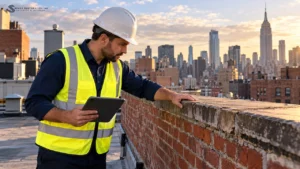
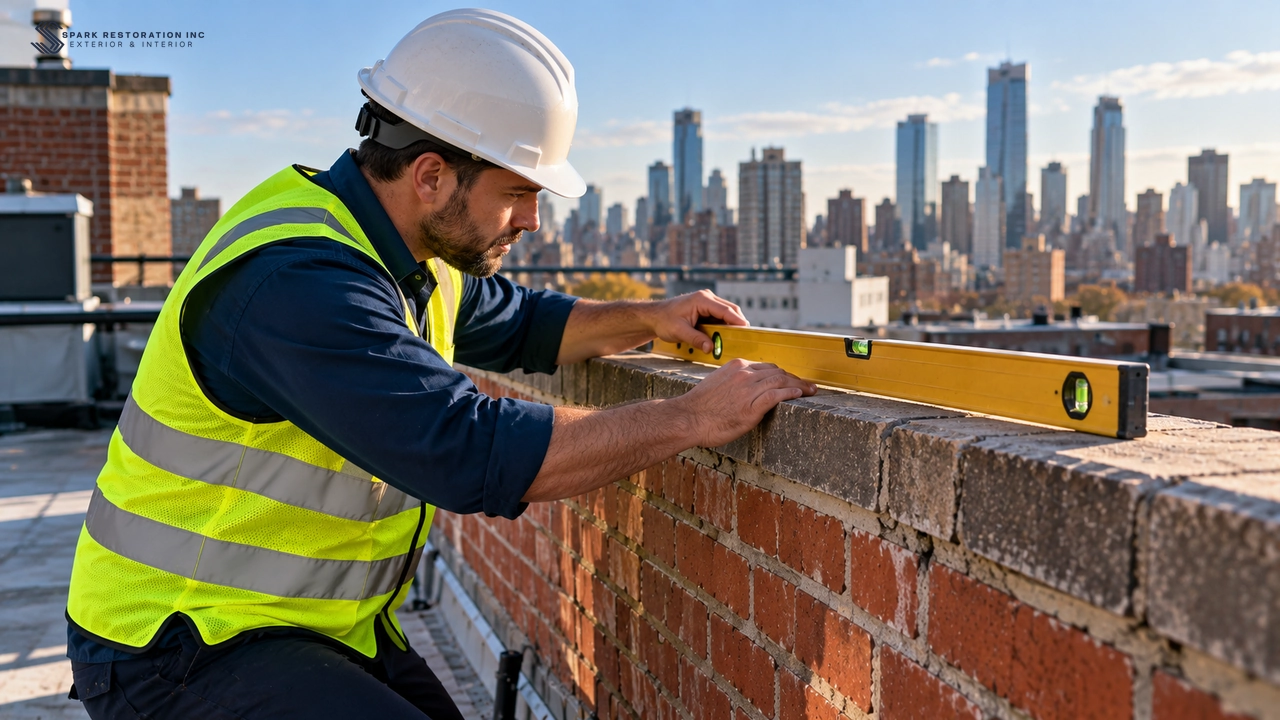
The annual observation is a careful, close examination of the parapet’s condition, not a general impression of the building. It should be carried out from a position where the wall can actually be seen and assessed, which often means roof-level access rather than a view from the ground. The competent person looks for signs that the wall is moving, weakening, or shedding material, and for anything attached to or resting on the wall that could become loose.
One of the first things checked is alignment and plumb. A parapet should stand straight and true, and any leaning, bowing, bulging, or displacement from its original line is a warning sign. Even a small amount of movement can indicate that mortar has deteriorated, that the wall has lost support, or that repeated freeze-thaw or wind loading has affected its stability. The observer also looks for displacement or leaning of individual sections, coping stones, or courses of brick, because a wall that is moving is a wall whose condition needs to be understood before it worsens.
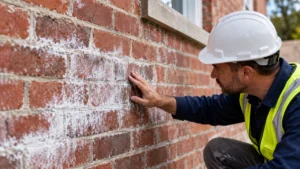
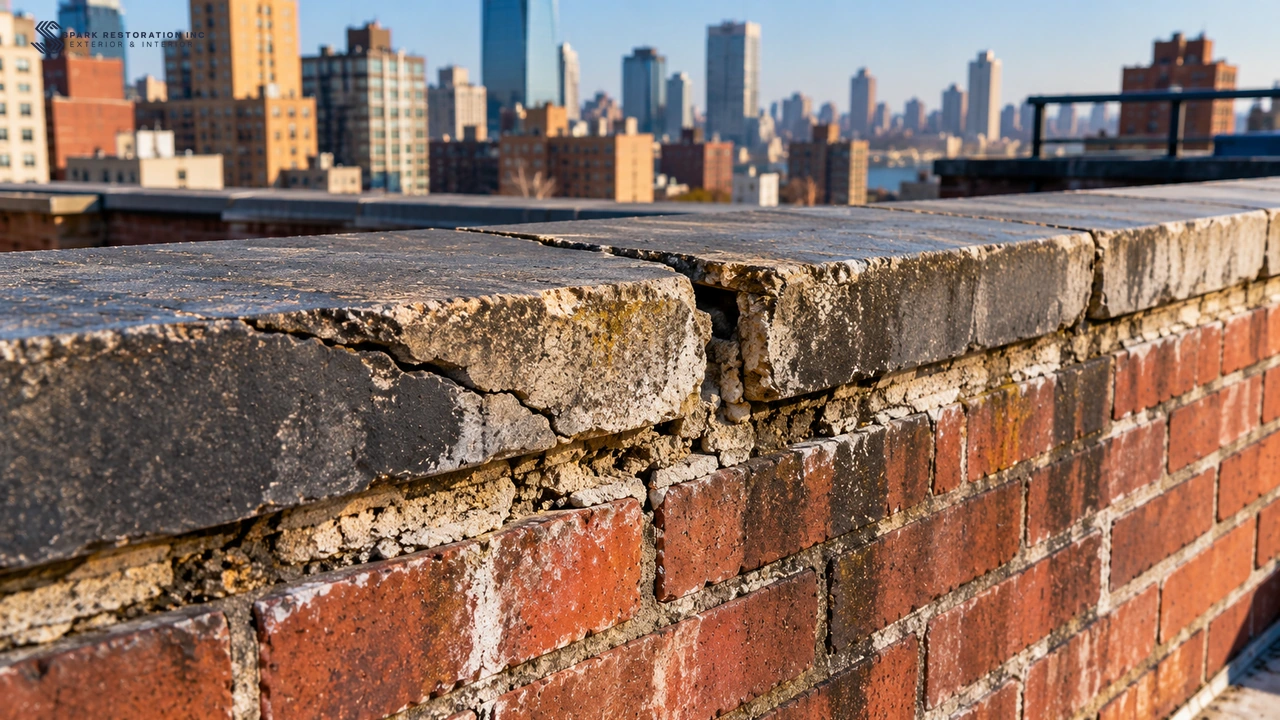
The observation also examines cracked or deteriorated mortar and masonry. Mortar joints that are cracked, crumbling, washed out, or missing leave bricks less firmly held in place and allow water to enter the wall, which can accelerate further deterioration. Cracked, spalled, or otherwise damaged bricks, stones, or concrete units are likewise noted, along with any pattern of cracking that might suggest settlement or thermal movement. Coping condition is checked separately, because the coping is the cap at the top of the parapet that sheds water and protects the wall below. A cracked, displaced, loose, or missing coping stone lets water into the core of the wall and can itself become a falling hazard. Finally, the observation looks at attachments such as railings, antennas, and signs. Railings must be secure, antennas and their supports must be stable, and signs, brackets, and conduits must be checked for loose fasteners, rust, or movement.
What Happens When a Problem Is Found
When the observation finds a defect, the first question is whether the condition is unsafe. Not every defect is an immediate danger, but every defect should be recorded and assessed honestly. Minor deterioration may be noted for repair in the near term, with the parapet monitored in the meantime. A condition that could lead to falling material, collapse of a section, or failure of an attachment is treated differently, because it presents a direct risk to people below. In that case, the owner must report the unsafe condition to the Department of Buildings and make it safe, as required by the law.
Making a condition safe does not always mean completing a full permanent repair on the same day, but it does mean taking prompt, effective action to protect the public. That may include closing or protecting the area below, removing loose material in a controlled way, bracing or securing a section, or arranging emergency stabilization. Owners should not simply note an unsafe condition in a report and leave it for a later maintenance cycle. After the immediate risk is addressed, the owner should plan the permanent repair, keeping the original report and records of the work carried out together with the rest of the building’s compliance file, for at least six years.
Local Law 126 vs. Local Law 11: How They Differ
Local Law 126 is often confused with Local Law 11, now known as the Facade Inspection and Safety Program, or FISP. The two laws are related in spirit, because both are concerned with the safety of building exteriors, but they are different programs with different scopes, cycles, and reports. Understanding the difference helps owners avoid the mistake of assuming that compliance with one program satisfies the other. In fact, both can apply to the same building at the same time.
Local Law 126 is an annual, ground- and roof-level observation focused specifically on parapets fronting a public right-of-way. It applies regardless of building height, and its report is kept by the owner for at least six years. Local Law 11, by contrast, operates on a five-year FISP cycle and applies to taller buildings, requiring a periodic inspection of the entire facade by a qualified exterior wall inspector, with a report filed with the Department of Buildings. The FISP inspection is broader in scope, covering the full exterior wall system, while the Local Law 126 observation is narrower and more frequent, focused on the parapet alone. The reports also serve different purposes: a FISP report is filed with the city as part of a formal cycle, while a Local Law 126 report is retained by the owner as evidence of the annual observation, with unsafe conditions reported to the Department of Buildings. Readers who want background on facade findings may also find our guide to what a SWARMP finding means and what NYC building owners should do next useful.
Repairs That Commonly Follow a Parapet Observation
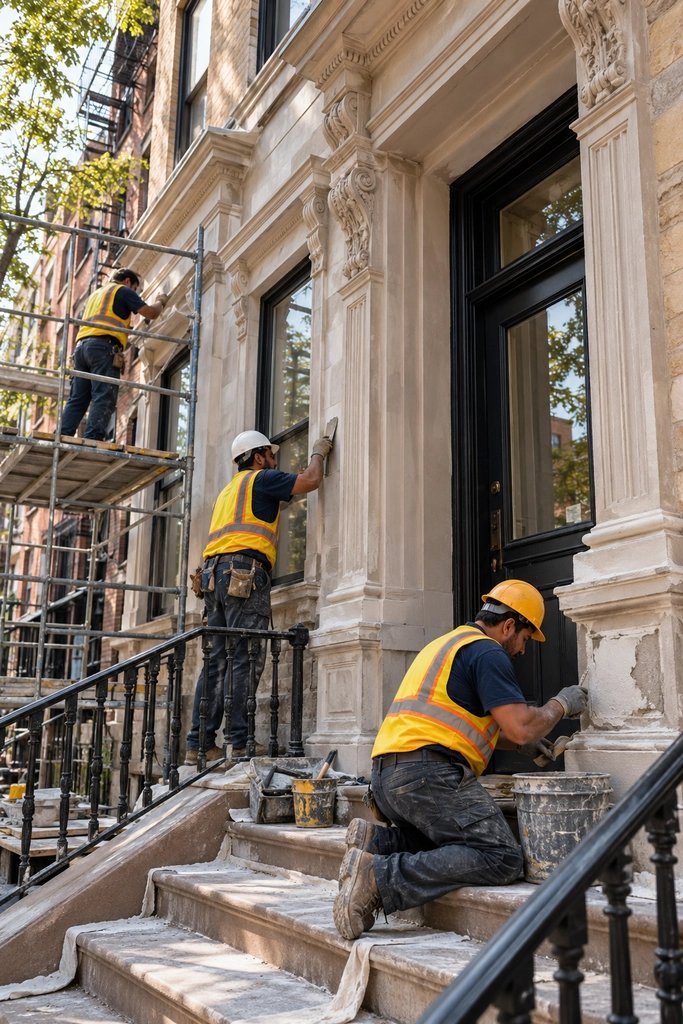
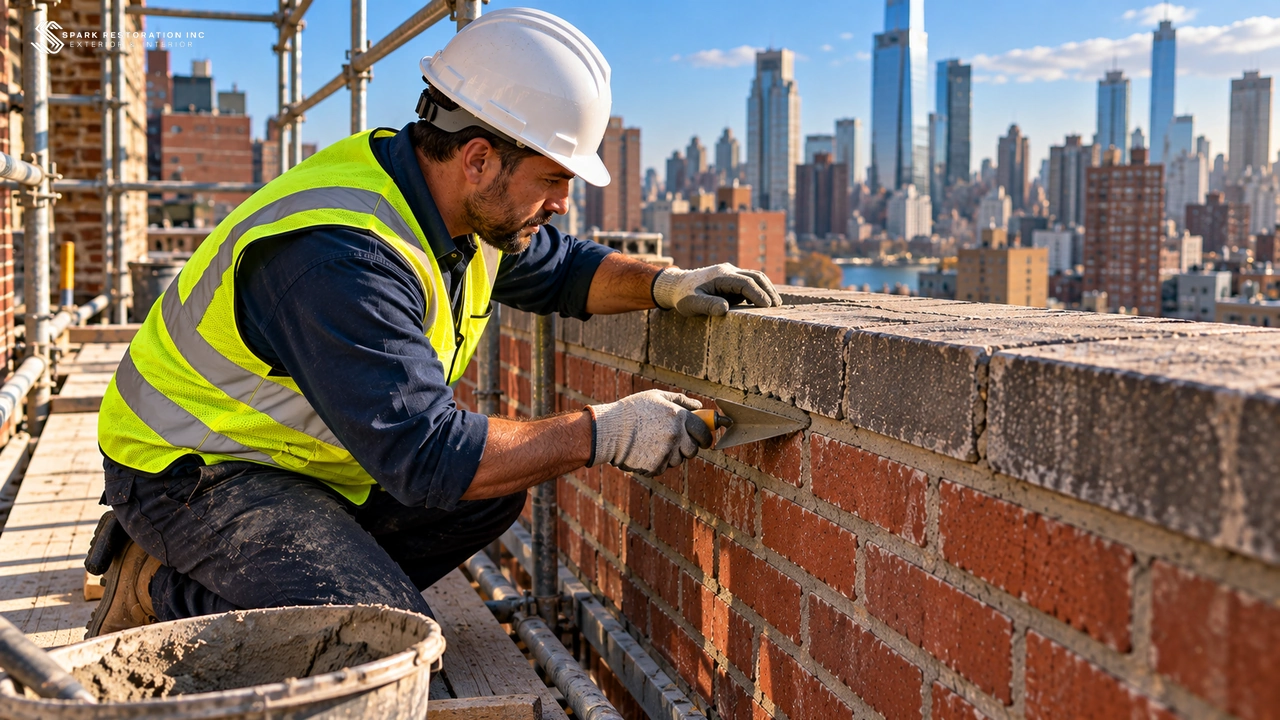
Many parapet observations lead to repair work, and the type of repair depends on what the observation found. One of the most common is repointing, where deteriorated mortar joints are raked out and replaced with new mortar. Repointing restores the bond between bricks, reduces water entry, and helps the wall hold together as a single, stable unit. It is often needed where mortar has cracked, crumbled, or washed out over years of weather exposure, and it is best carried out before deterioration spreads deeper into the wall.
Coping replacement is another frequent follow-on repair. When coping stones are cracked, displaced, or missing, replacing them protects the top of the wall and prevents water from entering the parapet from above. Where a section of parapet has moved, leaned, or become unstable, rebuilding that displaced section may be necessary, restoring alignment and structural integrity rather than simply covering over a wall that has already shifted. Securing attachments is also common: railings may need to be refixed, antennas and signs may need new or reinforced supports, and brackets or conduits may need to be repaired or removed where they have damaged the masonry.
It is important to be clear about roles here. Spark Restoration Inc performs this kind of parapet repair work, including repointing, coping replacement, rebuilding displaced sections, and securing attachments. The Local Law 126 observation and report itself, however, is the owner’s responsibility through their own competent person. Spark does not carry out the observation or issue the Local Law 126 report on the owner’s behalf. Owners should therefore arrange the observation separately, keep the report on file, and then engage a repair contractor, such as Spark, for any repair work the observation identifies. For owners planning repair work, our parapet wall repair and installation services in New York describe the kind of repair work involved, and owners in Queens can also review our parapet wall contractors in Queens, NY page for local service information.
Local Law 126 is, at its heart, a simple idea: check the parapet every year, write down what you find, keep the record, and act quickly when something is unsafe. Owners who build that routine into their annual building maintenance will find compliance far less stressful than owners who discover a parapet problem only after it has become an emergency. Arrange the observation with a competent person, keep each report for at least six years, and address repairs promptly. If repair work is needed after an observation, contact Spark Restoration Inc to discuss the scope and next steps, and keep your building, and the people who walk past it, safe.