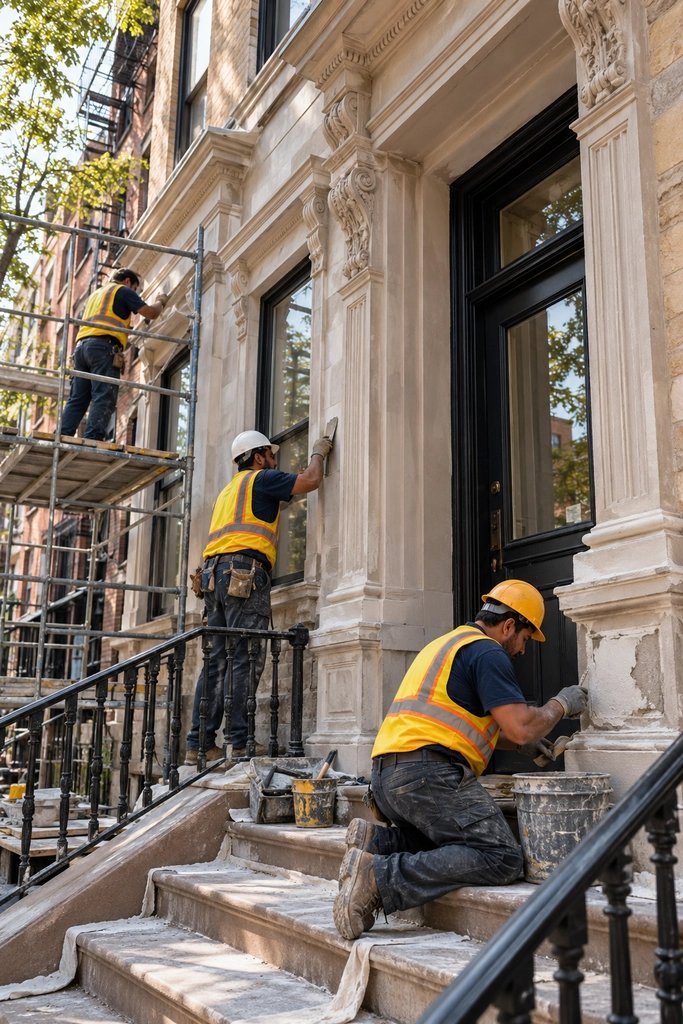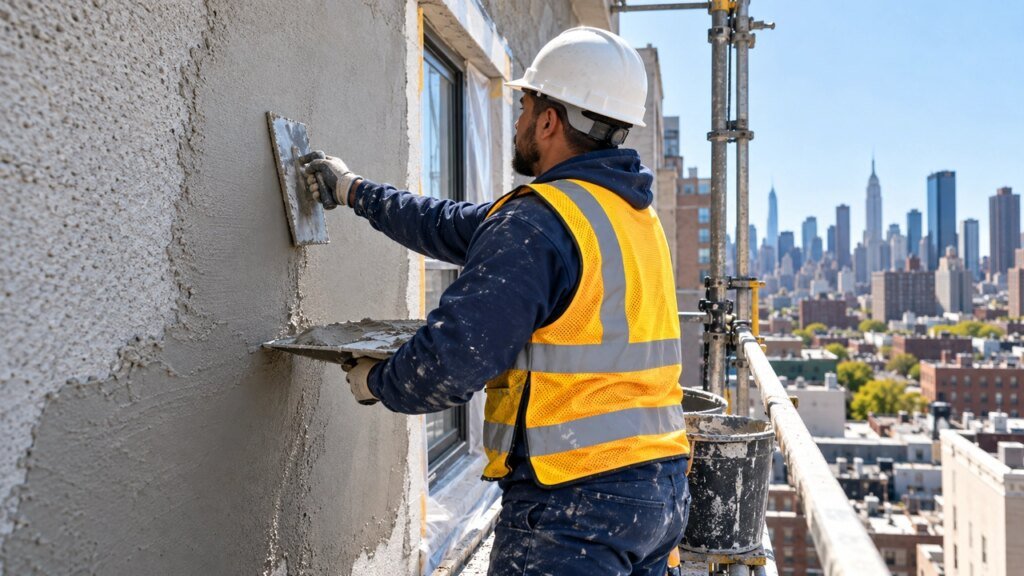
When a homeowner, a co-op or condo board, or a property manager first asks about stucco repair cost, the honest answer is that the price follows the wall, not a price list. Two buildings can show a crack that looks almost identical from the sidewalk and need completely different work once the surface is sounded, opened up, and checked for moisture.
This guide explains how stucco repair cost is built in NYC and Westchester, factor by factor, so you can read a proposal, ask the right questions, and compare quotes on scope rather than on a total alone.
The short answer
Stucco repair cost follows the wall, not a rate card. The price is built from what the cracking means, whether moisture has reached the backing behind the finish, the size and scatter of the failed area, the access needed to reach it, and the texture and color matching that makes the repair disappear. Two patches that look the same from the sidewalk can be priced very differently once the wall is sounded and opened. This guide explains each factor so you can read a proposal on scope, not on a total alone.
What Counts as Stucco Repair, and What Counts as Re-Coating or Replacement?
Stucco is a cement plaster applied in layers over masonry or over lath, and it works as a system: the finish coat you see, the base coats under it, and the backing that supports them all have to stay bonded and shed water. Repair means correcting a defined failure in that system — cutting out a cracked or delaminated area back to sound material, fixing what caused it, and rebuilding the coats so the patch bonds and matches.
Re-coating means applying a new finish over a wall that is still fundamentally sound, to refresh appearance or renew a worn surface across a whole elevation. Section replacement goes further: a larger area is removed down to the backing and rebuilt because the stucco, the lath, or both have failed beyond what a patch can hold. Knowing which of these a quote describes is the first step in understanding its price — see our brick and stucco services in New York page, which treats them as separate scopes.
What Drives the Cost? Start With the Size and Pattern of the Crack
Not all cracks carry the same meaning. A fine, isolated hairline in the finish can be a surface issue, while a network of cracks, a stepped pattern, or cracks that run around corners and openings can point to movement, impact damage, or failure in the coats underneath. The crack has to be traced, its edges sounded, and the surrounding area checked for hollow, loose stucco that is no longer bonded.
Pattern matters because it changes how much must be opened up. A single, stable crack may need only a small cut-out and rebuild. Widespread cracking suggests the problem is not the crack itself but what the wall is doing behind it, and the repair area grows accordingly. A quote that names the crack pattern it found is easier to trust than one that simply promises to fill cracks.
Why Does Moisture Damage Behind the Stucco Change the Price?
Stucco is meant to shed water, but cracks, failed joints at windows and doors, and worn surfaces let water in — and stucco can hold that moisture against the wall where you cannot see it. Once water is behind the finish, the damage often extends well beyond the visible stain: base coats soften, bonding fails, and the area that must be removed grows until sound, dry material is reached.
Moisture also adds a diagnostic step a dry repair does not need. The source of entry has to be found and corrected — a joint, a sill, a flashing detail, or the surface itself — or the new repair will fail the same way. That is why two patches of the same size can be priced differently: one is a straightforward rebuild on a dry wall, and the other includes tracing water and fixing the entry point first. Our wider masonry services in New York work runs into the same pattern, because water rarely respects trade boundaries.
Is it traditional stucco or EIFS — and why does it change the quote?
Not every stucco-looking wall is built the same way. Traditional stucco is cement plaster applied in coats over masonry or lath. EIFS — exterior insulation and finish system — is a synthetic finish over foam insulation board, common on newer and renovated buildings across NYC and Westchester. The two fail differently and are repaired differently. EIFS is especially unforgiving of water that gets behind the finish at windows, joints and penetrations, because the moisture has nowhere to dry and can damage the sheathing and framing silently while the surface still looks acceptable. That is why EIFS quotes often include a moisture investigation first — in practice, small probe holes drilled at suspect points, read with a moisture meter, and sealed afterward — before any repair scope is promised. If a proposal prices EIFS patchwork without asking what is behind the finish, it is guessing; on this system, the diagnosis is part of the job.
How Does the Condition of the Lath and Substrate Affect the Quote?
Behind many stucco finishes sits lath — the backing the plaster keys into — and behind that, the substrate of the wall itself. If the lath is sound and the substrate is solid, a repair can rebuild the stucco coats on a reliable base. If the lath has corroded, detached, or rotted where moisture sat against it, or the substrate underneath is cracked, soft, or uneven, that backing has to be repaired or replaced before any new stucco goes on.
This is one of the most common reasons a small-looking repair becomes a larger job. The surface cannot be assessed honestly until failed stucco is removed and the backing is visible, which is why careful contractors explain what they expect to find and how a worse-than-expected backing is handled in the proposal.
How Does the Size of the Area Change Stucco Repair Cost?
Area matters in two ways. First, a larger area of failed stucco means more removal, more material, more coats, and more curing time between them. Stucco is built in layers, and each layer needs its proper thickness and cure, so a bigger repair is not simply a longer version of a small one — it is more stages, often over more visits.
Second, a wall rarely fails in one neat rectangle. Scattered patches across an elevation can take longer to set out, cut, rebuild, and blend than one continuous area of similar size, because each patch is its own small job with its own edges to feather and match. Ask any proposal to state the area it assumes and whether it is one section or many separate patches.
Why Do Access and Height Matter So Much in New York?
Before a single crack is cut out, the crew has to reach it safely — and in NYC and Westchester, reaching the wall is often a project in itself. Work above the ground floor can require scaffolding, a suspended platform, a lift, or ladder and staging arrangements, along with protection for sidewalks, entrances, plantings, and anything below. A rear elevation with no vehicle access, a wall over a busy sidewalk, and a house wall reached from a flat garden are very different jobs, even if the stucco damage is identical.
Access also affects time. Materials, tools, and debris move by the route the building allows, and occupied buildings need dust, noise, and entryways managed during the work. Check that each proposal describes the same access method — a lower total built on a lighter access plan is not the same offer.
What About Texture and Color Matching?
A repair that performs well but stands out as an obvious patch has only done half the job. Matching the existing stucco means matching its texture — smooth, sanded, dashed, or patterned — and its color, which shifts as stucco ages and weathers. New material goes on looking different from old, so an experienced contractor works with samples and test areas, and explains honestly how close a match is realistic on a weathered wall.
Matching takes time and skill, and on a prominent front elevation it can justify re-coating a larger area so the finish reads as one wall rather than a collection of patches. That choice should be made with you, in advance, and written into the scope, because it changes both the appearance and the price.
Does the Stucco Need Paint or a Coating After Repair?
Sometimes, and the answer depends on the wall. Some stucco is colored through its finish coat and is never painted; other walls carry paint or a protective coating that has to be renewed over the repair so the new work is protected and the color holds together across the elevation. If a whole wall was previously painted, a repair left uncoated will read as a patch even when the texture is well matched.
Painting also has its own preparation and timing. New stucco must cure properly before it is coated, surfaces need cleaning and priming where the system calls for it, and failed, peeling paint around the repair may need to come off first. Ask whether a proposal includes coating the repair only, the full elevation, or no coating at all.
Patching vs. Re-Coating vs. Section Replacement: How Do You Choose?
Patching suits isolated, well-understood damage: a limited area of cracking or delamination on a wall whose backing is sound and whose water problem, if any, has been found and fixed. It is the smallest scope, and the right one when the rest of the wall is honestly in good condition.
Re-coating suits a wall that is structurally sound but tired, uneven, or covered in older patches — the base system stays, and a new finish restores a uniform appearance. Section replacement is for failure that goes through the system: extensive delamination, damaged lath or substrate, or moisture damage that has undermined the coats. It is the largest scope because it rebuilds the wall covering, not just its surface.
How Do Contractors Inspect and Quote Stucco Work?
A careful estimate starts at the wall. The contractor examines the cracking and staining, sounds the surface for hollow areas where the bond has failed, checks joints and openings where water enters, and — where the signs point that way — opens a small test area to see the backing and check for moisture. Photographs and notes from that visit are what a written quote should be built on.
The quote itself should name the areas to be repaired, the condition it assumes underneath, how failed material will be removed and rebuilt, how texture and color will be matched, whether coating is included, how the wall will be accessed, and how worse-than-expected backing will be handled and agreed before extra work proceeds. If a proposal gives only a total, ask for that breakdown.
What Are the Warning Signs You Should Not Delay?
Do not delay when cracks are widening or returning after a previous patch, when stucco sounds hollow or bulges away from the wall, when pieces loosen or fall, or when stains, damp patches, or peeling paint appear inside below an exterior wall. Bubbling and blistering of the surface, and stucco that crumbles when rubbed, point the same way.
Delay changes the scope. A crack that admits water this season can mean a larger cut-out, damaged backing, and interior repairs later, because the failure spreads outward from the wet area while the surface still looks much the same. An inspection while the signs are new keeps the repair smaller and simpler far more often.
How Should You Compare Stucco Quotes?
Compare scope before you compare totals. Line the proposals up and check the same items on each: the area assumed, whether the water source is fixed or only the symptom patched, the condition of the backing and how surprises are handled, access and protection, texture and color matching, and whether coating is included. A quote that omits an item will often look cheaper simply because that work is not in it.
Then ask each contractor to explain, in plain language, why their scope is the right size for your wall. That conversation, plus a written, itemized scope you can hold the work to, is worth more than a small difference in totals.
How long does a stucco repair take?
Longer on the calendar than the crew hours suggest, because stucco is built in coats and each coat needs time to cure before the next goes on. A small patch can involve a first visit to cut out and rebuild the base, a return visit for the finish coat once the base has cured, and a further wait before paint or coating can be applied over new material. Weather stretches the schedule further: cold, wet periods slow curing and can postpone coating altogether. When you compare proposals, ask how many visits the scope assumes and what cure time is built in between them — a quote that promises the whole repair in a single day is usually planning to skip a cure the system needs.
The Bottom Line on Stucco Repair Cost in NYC & Westchester
There is no honest single figure for stucco repair, because the price is a summary of the wall in front of the contractor: the crack and its pattern, the moisture behind it, the lath and substrate, the size and scatter of the area, the access, the matching, and the finish that follows. Once you can see those factors, a quote becomes a scope you can question, compare, and approve with confidence.
Start with an inspection and a written, itemized estimate for your own building. If your property is in Yonkers, our page for brick and stucco contractors in Yonkers, NY explains how this work is handled locally, and our service areas page lists the neighborhoods and communities we cover across NYC and Westchester.