
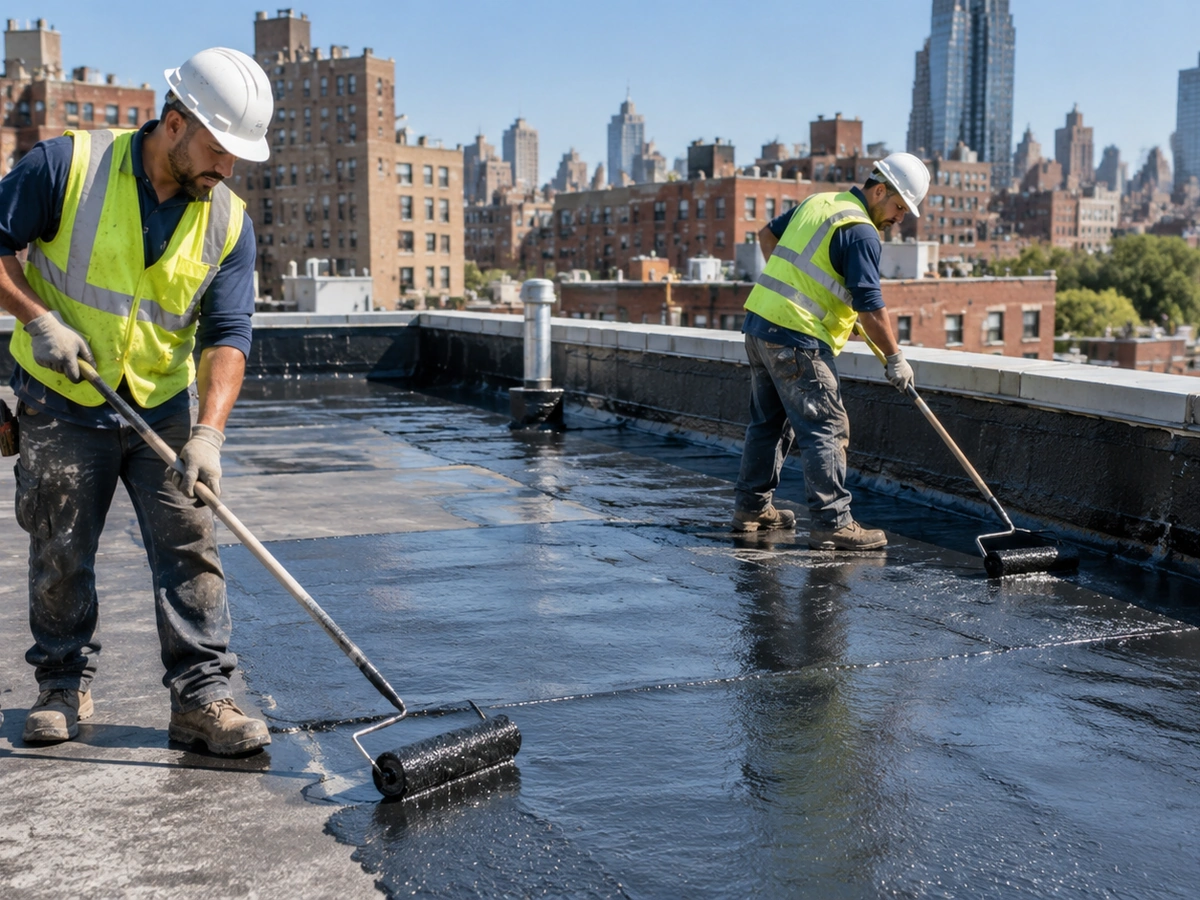


Roof Repair and Installation in New York: The Short Answer
Spark Restoration Inc repairs and installs roofs across New York City and Westchester County, from our base at 530 Yonkers Ave, Yonkers, NY 10704. We work on residential roofs, houses, brownstones, townhouses and co-ops, and on commercial roofs, offices, shops, multi-family buildings and institutions. Most of the roofs we see in the city are flat or low-slope, with shingle and metal roofs on pitched houses. Every job starts with a site inspection and a written estimate. That figure is an estimate only; the final price is confirmed after the site inspection. Use the contact form to arrange an inspection.
Residential Roof Repair and Installation in New York
A residential roof in New York has a hard life. Summer sun and winter freeze-thaw work on every seam and flashing, and a flat roof holds standing water after heavy rain until the drains clear it. On houses in Yonkers and Westchester, and on brownstones and townhouses in the boroughs, the roofs we repair most are architectural shingle roofs on pitched sections and flat membrane roofs over extensions, top floors and garages. Co-op and condo buildings usually have a flat roof over the whole building, with plant, vents and the parapet junction to look after.
Residential leak repair starts with finding the entry point, not the stain. Water that comes in at a chimney flashing or a parapet junction can travel along the deck and show up as a damp patch two rooms away. We inspect from the roof and from inside, at the ceilings, the top floor and the loft or attic, and we photograph what we find. That is also how we decide whether a repair will hold or whether the roof has reached the point where replacement is the honest answer. A sound roof with one failed flashing needs a repair. A roof with widespread blistering, soft decking and seams opening across the field needs a new roof, and saying so early saves the cost of repeated repairs.
On pitched residential roofs we work with architectural shingles and metal, matched to the house and the street. On flat residential roofs we install and repair EPDM, TPO, modified bitumen and built-up systems. The details decide whether the roof stays dry: counter-flashing at walls, flashing at chimneys and skylights, the junction where the roof meets the parapet, and falls and drains that clear water instead of letting it pond. Gutters and downspouts matter too, because a blocked gutter backs water onto the roof edge and into the fascia. For co-op and condo buildings we handle the board and managing-agent paperwork before work starts, and we agree access to roof and top-floor flats in advance.
Residential roof questions
Can a leak be repaired without replacing the whole roof? Yes, when the roof itself is sound and the leak traces to one detail, a failed flashing, an open seam, a blocked drain or a cracked boot around a vent. We repair the detail and check the rest of the roof. When the membrane or shingles are failing across the field, a repair buys time but does not fix the roof, and we say so in the estimate.
Do I need to be at home while the work is done? Not for the roof work itself, but we need agreed access to the roof and, for leak tracing, to the rooms below where the water shows. We agree the access, the working hours and the cleanup with you before we start, and we leave the roof, yard and driveway tidy, with no nails or offcuts behind.
Commercial Roof Repair and Installation in New York
Commercial roofs are bigger, flatter and busier than residential ones. A typical commercial roof in Manhattan, Queens or the Bronx carries plant, vents, skylights, drains and outlets, and its edge runs the full length of the parapet. The leaks we find most often start at those details, at seams and at drains that have silted up, not in the middle of the membrane. We install and repair TPO and EPDM flat roof systems, modified bitumen and built-up roofs, and we renew the flashing, coping and parapet tie-ins that keep a large roof watertight. Where the roof meets the parapet, we work with our parapet wall repair and installation service so the wall and the roof are fixed as one junction, not two separate jobs.
Commercial work has to fit around the building. Offices, shops and multi-family buildings stay open while we work, so we phase the job, keep access and fire escapes clear, and protect the areas below the roof. For a full replacement we strip to the deck in sections, repair the deck, lay new underlayment and membrane, and fit new flashing and drains, so the building is never left open overnight. Where a Department of Buildings permit is needed, we arrange the filing. Where a full replacement triggers Local Laws 92 and 94, we build the new roof to meet them, and we say so plainly in the estimate.
Commercial roof questions
Can roof work be done while the building stays open? Yes. We phase the work, keep entrances, corridors and fire escapes clear, and strip and re-cover in sections so the building is never left open. Noisy work and crane or lift days are agreed with the building manager in advance.
What do Local Laws 92 and 94 mean for a commercial roof replacement? Where a full roof replacement triggers them, the new roof must include a sustainable roofing zone, and be solar-ready where the law requires it. We build to meet that requirement and include it in the estimate, so there are no surprises at the permit stage.
Flat Roofs, Pitched Roofs and Metal Roofs
Most New York City roofs are flat or low-slope, and they need a membrane system: EPDM rubber, TPO single-ply, torch-applied or self-adhered modified bitumen, or a built-up roof of felts and bitumen. The choice depends on the building, the exposure, the foot traffic and what is already on the roof. EPDM and TPO suit large flat areas; modified bitumen suits smaller and more detailed roofs; a built-up roof suits a roof that needs a heavy, proven assembly. A roof coating can extend the life of a sound existing roof by sealing minor defects and reflecting heat, but it is not a substitute for a roof that has failed.
Pitched roofs in the city and in Westchester are usually architectural shingles, with metal on some houses and outbuildings. Shingles need sound decking, proper underlayment, flashing at every penetration and a ridge detail that vents the roof. Metal roofs last well and shed snow and rain, but their flashing and fasteners need checking, and a metal roof over a poorly ventilated attic will sweat from inside. We match the system to the building and to the street, and we say when a system is wrong for a roof rather than fitting it anyway.
How We Find a Roof Leak
Finding a leak is detective work, and guessing is expensive. We start inside, at the stain and the rooms around it, and we look at the roof above and up-slope from the stain, because water runs downhill along the deck before it drips. On the roof we check the membrane or shingles, the seams, the flashing at walls, chimneys, skylights and vents, the drains and scuppers, and the parapet junction. We look for blistering, ponding, open seams, cracked sealant, rusted or lifted flashing, and soft spots in the deck underfoot. Where the cause is not obvious we test with water in a controlled way, section by section, and we photograph each defect so the estimate is based on evidence, not a guess. That is the same approach we take on a roof leak repair: trace the water to its actual entry point, then repair that point.
Local Laws 92 and 94: Green and Solar-Ready Roofs
Local Laws 92 and 94 require a sustainable roofing zone on new buildings and on certain roof replacements in New York City, and they require the roof to be solar-ready where the law applies. In practice that means a new roof is not just a membrane: part of it must be a green roof, solar panels or a combination, or another qualifying sustainable surface, and the structure and layout must allow solar to be added. The trigger depends on the scope of the work, so we check it at the estimate stage and include what is needed in the written estimate. We do not fit a plain membrane and leave the owner to discover the requirement at the permit office. Our parapet waterproofing and flashing service and our coping stone installation and replacement service are often part of the same job, because a new roof and a sound parapet edge go together.
Our Roof Inspection: What We Look At
Every roof job starts with an inspection, and we look at the whole system, not just the leak. We check the membrane or shingles for blistering, cracking, lifting and wear; the seams and laps for openings; the flashing at walls, parapets, chimneys, skylights and vents for lifting, rust and gaps; the drains, outlets, scuppers and gutters for blockage and falls; the parapet junction and coping for cracks and open joints; the deck for soft spots and deflection; and the ceilings, top floor and attic inside for stains, mould and the leak path. We photograph each defect and note the roof system, its age and its condition. The written estimate that follows lists the scope, repair or replacement, the system, the flashing and drains, any deck work and the materials, and the figure is an estimate only, with the final price confirmed after the site inspection.
What a Roof Repair or Replacement Costs
We do not publish fixed prices for roof work, because the price is always given after seeing the job, according to the job. What we can say is what decides the figure, so the estimate makes sense when you read it. The size of the roof and the number of layers to remove; the system being installed; the condition of the deck underneath; access, scaffold or a lift, and whether a sidewalk shed is needed; the number of penetrations, drains and flashing details; and permits. A small patch to one flashing detail is a different job from a full tear-off and new membrane over a large commercial roof, and the estimate shows that. Every figure we give is an estimate only, clearly labelled as such, and the final price is confirmed after a site inspection, once we have seen the deck, the access and the full scope. A written estimate is provided before work begins, and we do not copy other companies’ prices. If you want a figure for your roof, call +1 (914) 591-4188 or +1 (347) 728-4188 and arrange an inspection.
Roof Work Across New York City and Westchester
We work across the five boroughs and Westchester County, from our Yonkers base. That includes flat roofs on apartment buildings and brownstones, pitched shingle roofs on houses, and large commercial flat roofs with plant and parapets. Our other exterior work often sits alongside a roof job: facade and parapet work where the roof meets the wall, described in our facade repair and restoration guide, and the full list of places we serve is on our service areas page. If your roof is leaking, ponding or at the end of its life, or if you need a roof that meets Local Laws 92 and 94, contact Spark Restoration Inc and arrange a site inspection.