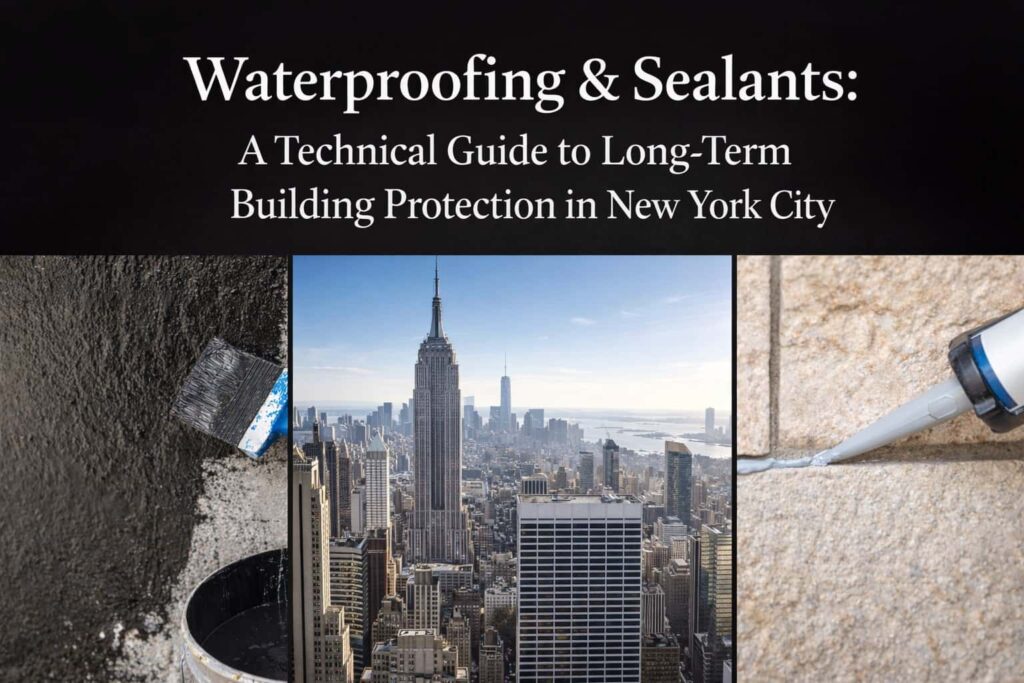
Water infiltration is one of the most persistent and damaging issues affecting buildings in dense urban environments. In cities like New York, where structures are exposed to frequent precipitation, freeze–thaw cycles, coastal humidity, and aging infrastructure, waterproofing and sealants are not optional upgrades—they are essential components of long-term building performance.
This guide explains how waterproofing systems and construction sealants work, where failures typically occur, and how properly designed solutions protect masonry, concrete, and structural assemblies over decades.
Understanding Waterproofing as a Building System
Waterproofing is not a single product or coating. It is a systematic approach to preventing water intrusion by controlling how moisture interacts with a building envelope. Effective waterproofing manages surface water, capillary movement, vapor transmission, and hydrostatic pressure.
In New York City buildings—particularly pre-war masonry structures—waterproofing failures often occur because original assemblies were never designed for modern exposure levels. Retrofitting waterproofing systems requires an understanding of how water moves through walls, joints, and substrates.
What Are Construction Sealants and How Do They Function?
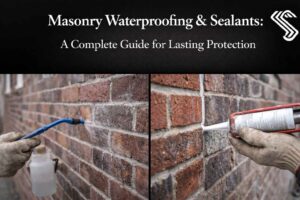
Sealants are flexible compounds designed to bridge gaps, joints, and transitions where building materials meet or move independently. Unlike rigid mortars or fillers, sealants accommodate thermal expansion, settlement, and vibration while maintaining a watertight barrier.
Sealants are commonly used at:
- Window and door perimeters
- Expansion and control joints
- Masonry-to-metal transitions
- Precast panel joints
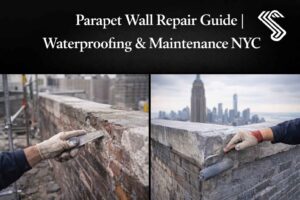
- Roof and parapet interfaces
When sealants fail, water bypasses surface protection and enters concealed wall cavities.
Why Waterproofing Failures Are Common in NYC Buildings?
New York City presents a unique combination of risk factors that accelerate waterproofing breakdown.
Key contributors include:
- Repeated freeze–thaw cycling
- High wind-driven rain exposure
- Air pollution and acid deposition
- Building movement from traffic and subway vibration
- Aging masonry and deteriorated mortar joints
Many buildings experience slow, cumulative moisture damage long before visible leaks appear inside.
Critical Areas That Require Waterproofing & Sealants
Water intrusion is rarely random. It typically occurs at predictable weak points within the building envelope.
High-Risk Zones Include:
- Foundations and below-grade walls
- Parapet walls and roof edges
- Window lintels, sills, and frames
- Balconies, terraces, and horizontal ledges
- Expansion joints and façade transitions
Targeting these zones is essential for long-term protection.
Types of Waterproofing Systems Used in Urban Construction
Different substrates and exposures require different waterproofing approaches. Selecting the wrong system often leads to premature failure.
Common Waterproofing Technologies:
- Liquid-applied membranes for complex geometries
- Sheet membranes for consistent below-grade protection
- Cementitious waterproofing for masonry and concrete
- Elastomeric wall coatings for breathable façade protection
- Crystalline waterproofing for concrete densification
Each system has specific limitations related to vapor permeability, UV resistance, and substrate movement.
Sealant Types and Their Appropriate Applications
Sealant performance depends heavily on chemistry, joint design, and installation conditions.
Common Sealant Categories:
- Polyurethane sealants – strong adhesion, high flexibility
- Silicone sealants – UV resistant, excellent longevity
- Hybrid sealants – balance of adhesion and elasticity
- Acrylic sealants – limited exterior use, low movement tolerance
In NYC façades, silicone and polyurethane sealants are most commonly specified due to their durability in harsh conditions.
How Does Waterproofing Prevent Structural Deterioration?
Unchecked moisture infiltration leads to progressive structural damage rather than immediate failure.
Common long-term consequences include:
- Masonry spalling from freeze–thaw expansion
- Corrosion of embedded steel and anchors
- Efflorescence indicating salt migration
- Interior mold growth and air quality issues
- Loss of insulation performance
Waterproofing interrupts these mechanisms before structural repairs become necessary.
Surface Preparation: The Most Overlooked Factor
Even high-performance materials fail when applied to improperly prepared surfaces. Substrate condition directly affects adhesion and longevity.
Proper preparation includes:
- Removal of loose mortar and deteriorated coatings
- Cleaning salts, pollutants, and biological growth
- Repairing cracks and voids before waterproofing
- Verifying substrate moisture levels
In practice, surface preparation often determines whether a system lasts five years or twenty.
Inspection, Maintenance, and Lifecycle Planning
Waterproofing and sealants are long-term assets, but they require monitoring. Regular inspections identify early-stage failures that are inexpensive to correct.
Recommended practices:
- Annual façade and joint inspections
- Resealing joints showing early elasticity loss
- Monitoring parapet and roof transitions
- Addressing hairline cracks before widening occurs
Preventive maintenance significantly reduces emergency repair costs.
Waterproofing Strategies for NYC Boroughs and Neighborhoods
Different areas of New York face different exposure conditions. Buildings in Manhattan and Brooklyn often experience higher wind-driven rain, while Queens and the Bronx see more temperature-driven expansion and contraction.
Coastal zones near Staten Island face elevated salt exposure, increasing sealant degradation. Effective waterproofing strategies account for microclimate conditions and building orientation.
When Waterproofing Should Be Addressed Proactively?
Many owners wait until leaks appear inside before acting. By then, the damage is already advanced.
Waterproofing should be evaluated:
- Before façade restoration projects
- During roof replacement or repairs
- After recurring efflorescence appears
- When sealants exceed expected service life
Early intervention reduces both cost and disruption.
Conclusion
Waterproofing and sealants are not cosmetic upgrades—they are risk management tools that protect structural integrity, occupant health, and asset value in dense urban environments like New York City. Buildings that lack proactive moisture protection face accelerated deterioration.
A system-based approach—combining proper material selection, skilled installation, and ongoing maintenance—delivers measurable long-term performance.