New York City is home to some of the world’s tallest and oldest buildings. While these structures define the city’s skyline, they also present unique maintenance and public safety challenges. Over time, exposure to harsh weather conditions, freeze-thaw cycles, moisture infiltration, pollution, and aging construction materials can cause exterior building components to deteriorate. Loose bricks, cracked masonry, damaged parapets, and deteriorating concrete can eventually become dangerous hazards for pedestrians below.
To address these risks, New York City established Local Law 11, officially known today as the Façade Inspection & Safety Program (FISP). This law requires periodic inspections of building façades to identify unsafe conditions before they become life-threatening.
If you own or manage a commercial, residential, condominium, cooperative, institutional, or mixed-use building in New York City, understanding Local Law 11 is essential. Failing to comply can result in significant penalties, emergency repairs, insurance complications, and potential legal liability.
At Spark Restoration INC, we help property owners throughout New York navigate every stage of Local Law 11 compliance—from façade inspections and masonry restoration to waterproofing, structural repairs, sidewalk sheds, and complete exterior restoration. Our experienced team works closely with engineers, architects, and property managers to ensure buildings remain safe, compliant, and visually appealing.
This comprehensive guide explains everything you need to know about Local Law 11, including:
- What Local Law 11 is
- Which buildings must comply
- What FISP means
- Inspection cycles
- Qualified Exterior Wall Inspectors (QEWI)
- Safe, SWARMP, and Unsafe classifications
- Common violations
- Required repairs
- Sidewalk sheds
- Filing procedures
- Costs
- Penalties
- Best practices for maintaining compliance
Whether you own a single commercial property or manage a portfolio of residential buildings, this guide will help you understand your responsibilities and protect your investment.
What Is Local Law 11?
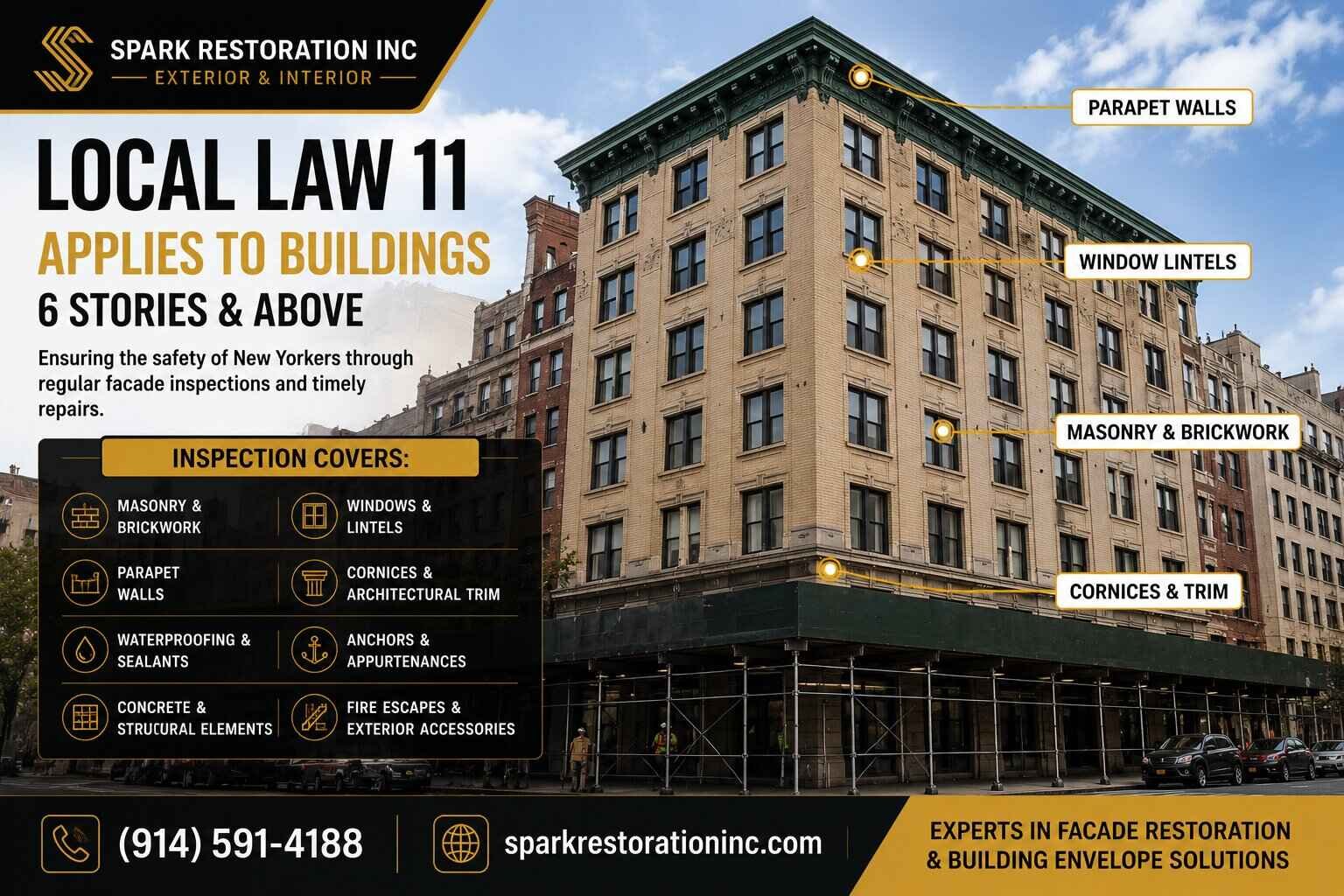
Local Law 11 is a New York City building safety regulation that requires the periodic inspection of exterior walls and façades on buildings that are six stories or taller.
Its primary purpose is to protect pedestrians, building occupants, neighboring properties, and public infrastructure from hazards caused by deteriorating building exteriors.
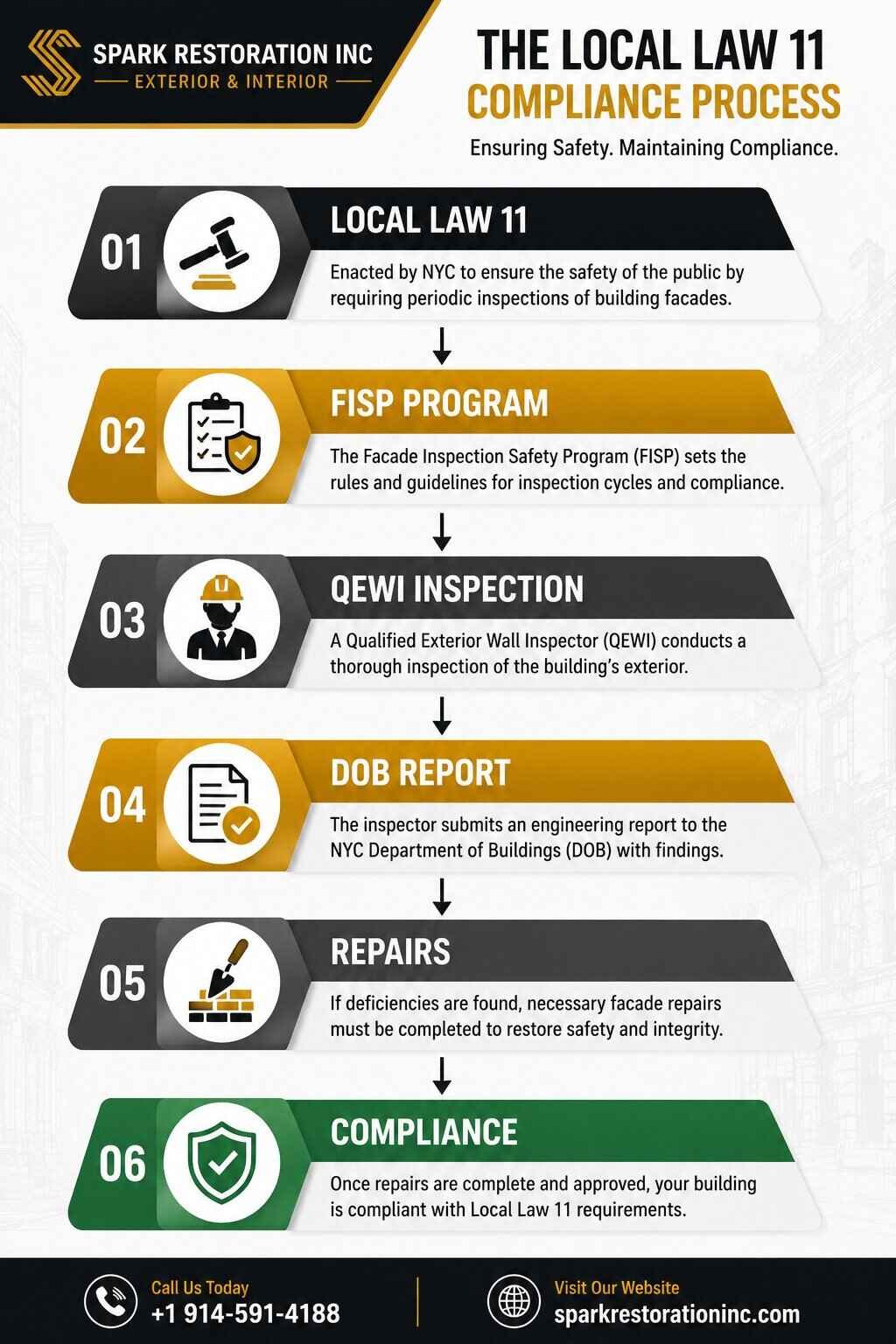
The law requires owners of qualifying buildings to hire a licensed Qualified Exterior Wall Inspector (QEWI) to conduct detailed façade inspections at regular intervals. Following the inspection, the QEWI submits an official report to the New York City Department of Buildings (DOB) describing the condition of the building and identifying any required repairs.
If unsafe conditions are discovered, building owners must take immediate corrective action to eliminate hazards and restore the building to a safe condition.
Today, Local Law 11 is administered under the Façade Inspection & Safety Program (FISP), one of the most comprehensive façade safety programs in the United States.
Why Is Local Law 11 Important?
Thousands of people walk beneath New York City’s buildings every day.
Without regular inspections and maintenance, exterior building components can become dangerous due to:
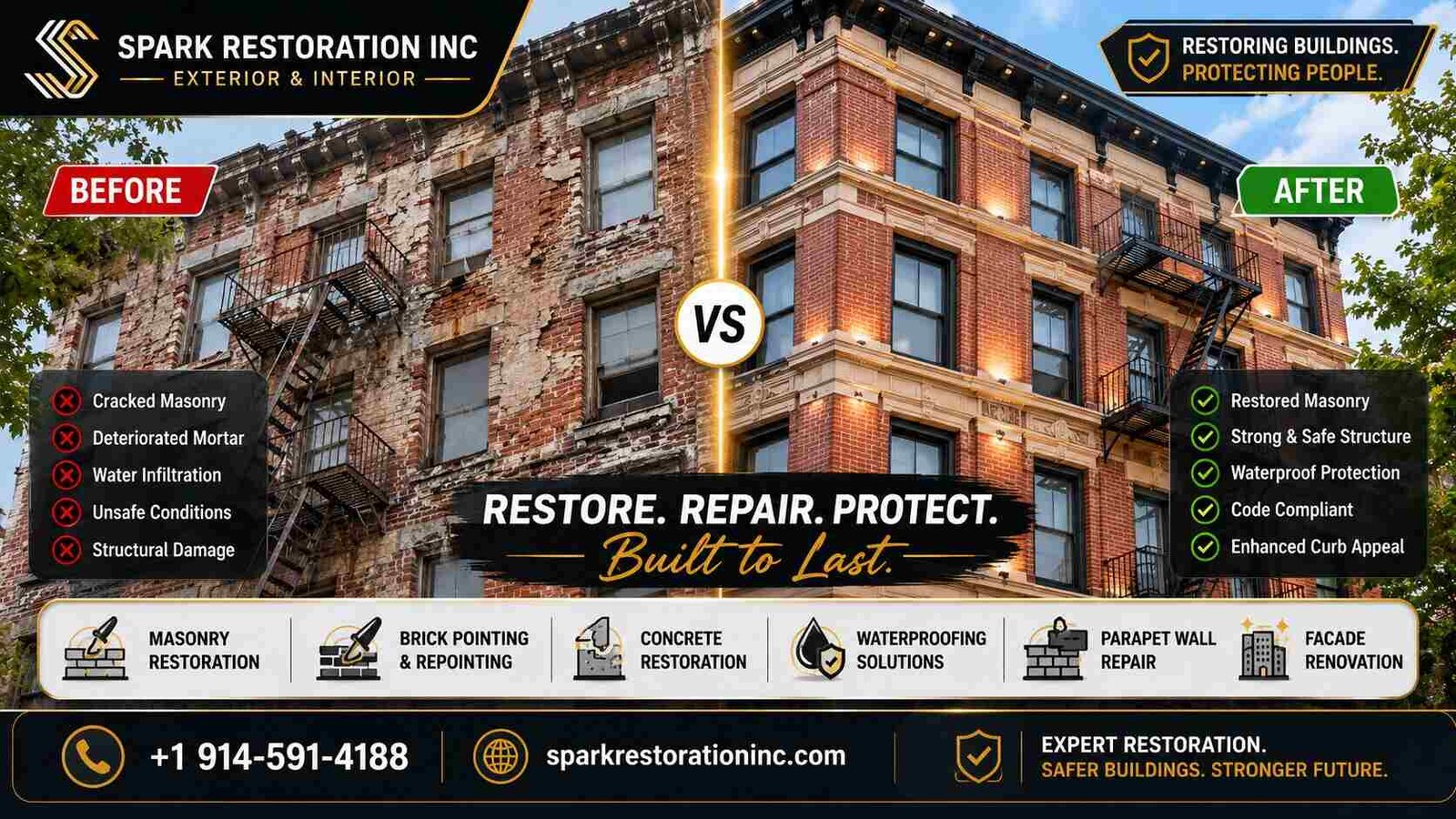
- Loose bricks
- Cracked stone
- Deteriorated mortar joints
- Rusted steel supports
- Concrete spalling
- Water infiltration
- Failed lintels
- Damaged parapet walls
- Aging façade systems
Even a small piece of masonry falling from several stories can cause catastrophic injuries or fatalities.
Local Law 11 exists to prevent these incidents before they occur.
What Does Local Law 11 Cover?
The inspection evaluates every accessible exterior component, including:
- Brick masonry
- Stone façades
- Concrete walls
- Stucco finishes
- Terra cotta
- Window lintels
- Window sills
- Copings
- Cornices
- Balconies
- Fire escapes
- Exterior anchors
- Decorative architectural elements
- Parapet walls
- Roof edge conditions
- Sealants and expansion joints
The goal is to determine whether each component remains structurally sound and poses no danger to the public.
Why Was Local Law 11 Created?
Before Local Law 11 existed, building façade inspections in New York City were minimal.
Throughout the 1970s and 1980s, several tragic accidents occurred when deteriorated pieces of masonry fell from aging buildings.
One of the most significant incidents happened in Manhattan, where falling masonry fatally struck a young college student. This tragedy highlighted the serious risks posed by neglected building exteriors and prompted city officials to strengthen façade safety regulations.
As a result, New York City introduced Local Law 10 of 1980, which required exterior inspections for buildings taller than six stories.
However, Local Law 10 only required inspections of street-facing façades.
City officials later determined that unsafe conditions could develop on any side of a building, not just the front.
To address this limitation, Local Law 11 of 1998 expanded inspection requirements to include all exterior walls, regardless of whether they faced the street, courtyard, alley, or neighboring property.
This marked a major advancement in public safety and building maintenance standards.
Evolution into the Façade Inspection & Safety Program (FISP)
As building technology evolved, New York City continued updating façade regulations.
The program eventually became known as the Façade Inspection & Safety Program (FISP).
Today, FISP incorporates:
- Updated inspection procedures
- Enhanced reporting requirements
- Digital filing systems
- Increased engineering standards
- More detailed repair documentation
- Stronger public safety measures
Modern inspections are significantly more comprehensive than those conducted under the original Local Law 10.
Why FISP Matters Today?
Every inspection cycle identifies thousands of buildings requiring repairs.
Common issues include:
- Water damage
- Masonry deterioration
- Cracked concrete
- Corroded steel
- Structural movement
- Failed waterproofing systems
- Unsafe parapets
By identifying these problems early, FISP helps prevent expensive emergency repairs while protecting both property owners and the public.
What Is FISP?
Many property owners ask:
“Is FISP different from Local Law 11?”
The answer is both yes and no.
Local Law 11 is the legislation passed by New York City.
FISP (Façade Inspection & Safety Program) is the official inspection program established to implement that legislation.
In simple terms:
- Local Law 11 = the law
- FISP = the inspection program that enforces the law
When people refer to “Local Law 11 inspections,” they are generally referring to FISP inspections.
Objectives of FISP
The primary objectives include:
Protect Public Safety
Prevent falling façade debris before accidents occur.
Preserve Building Integrity
Identify deterioration before it affects structural stability.
Promote Preventive Maintenance
Routine maintenance is significantly less expensive than emergency reconstruction.
Improve Property Value
Well-maintained façades improve curb appeal, tenant confidence, and long-term property value.
Reduce Liability
Regular inspections reduce legal exposure associated with façade failures.
How FISP Works?
Every inspection cycle generally includes:
- Review of previous inspection reports
- Visual examination of all exterior walls
- Close-up inspections where required
- Documentation with photographs
- Condition assessment
- Hazard classification
- Official DOB filing
- Repair recommendations
- Follow-up inspections if necessary
Depending on the building’s condition, the inspector may recommend immediate repairs or routine maintenance.
The Role of Preventive Maintenance
One of the biggest misconceptions about Local Law 11 is that it’s only about passing inspections.
In reality, the program is designed to encourage proactive building maintenance.
Regular maintenance can help prevent:
- Water infiltration
- Masonry deterioration
- Freeze-thaw damage
- Corrosion of embedded steel
- Cracking and displacement
- Costly structural repairs
- Emergency sidewalk shed installations
- Long-term code violations
Property owners who invest in preventive maintenance often experience lower repair costs over the life of the building and avoid the disruption associated with emergency corrective work.
Which Buildings Must Comply with Local Law 11?
One of the most common questions property owners ask is:
“Does Local Law 11 apply to my building?“
The answer depends primarily on your building’s height, not necessarily its use.
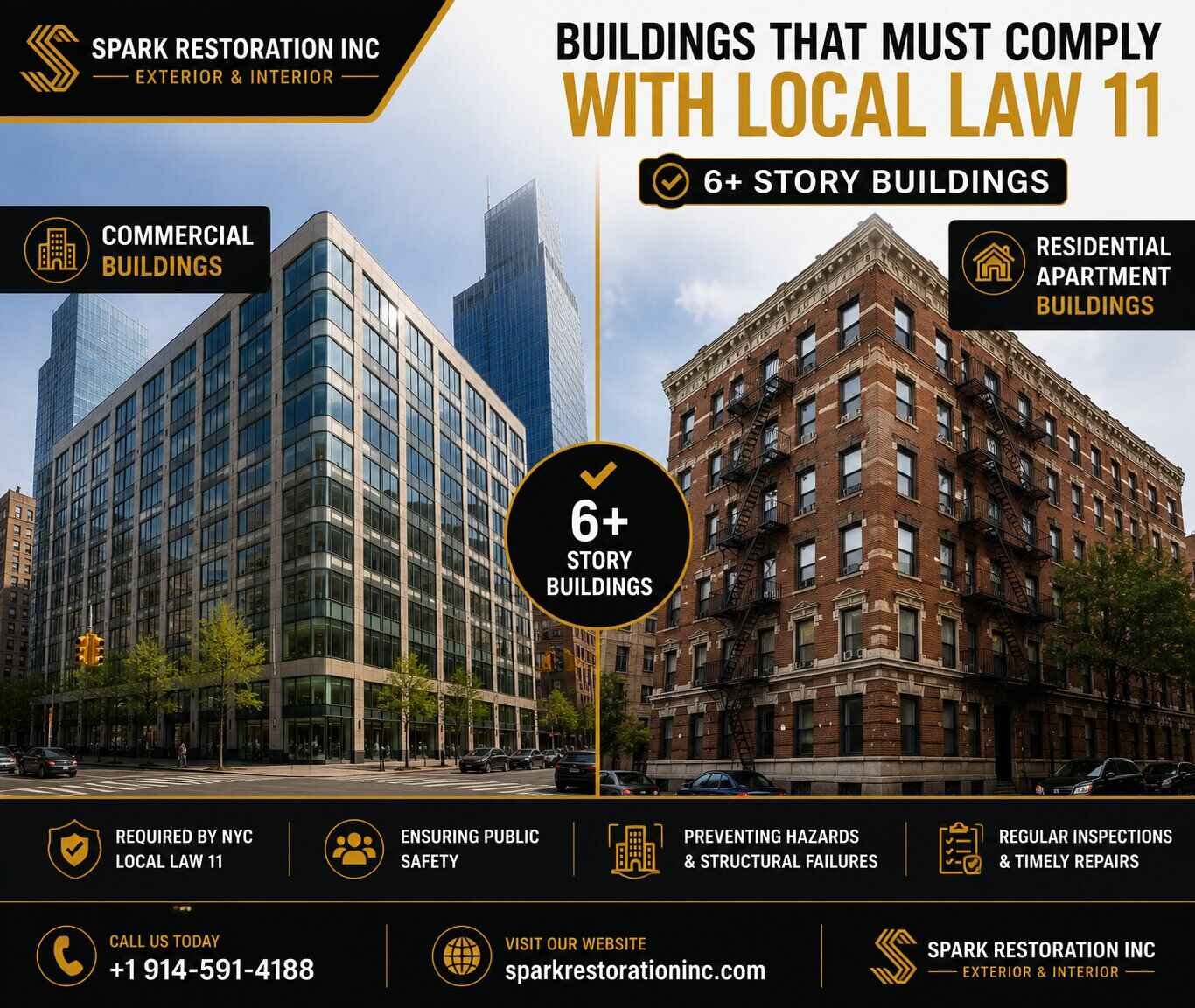
According to the New York City Department of Buildings (DOB), Local Law 11 applies to all buildings that are six stories or taller within the five boroughs of New York City.
This includes privately owned, commercial, residential, institutional, and mixed-use buildings.
If your building falls within this category, you are legally responsible for ensuring that it is inspected during the applicable FISP cycle and that all required repairs are completed within the required timeframe.
Types of Buildings Covered Under Local Law 11
The law applies to a wide range of property types, including:
Commercial Buildings
Commercial properties are among the most common buildings subject to Local Law 11 inspections.
Examples include:
- Office buildings
- Retail centers
- Shopping plazas
- Corporate headquarters
- Warehouses
- Medical offices
- Restaurants
- Hotels
Because these buildings experience heavy daily occupancy and pedestrian traffic, maintaining façade safety is especially important.
Residential Buildings
Many residential buildings are also required to comply.
Examples include:
- Apartment buildings
- Condominiums
- Cooperative (Co-op) buildings
- High-rise residential towers
- Luxury residential developments
Residential property managers must ensure exterior walls remain safe for both residents and the public.
Mixed-Use Buildings
Buildings containing both commercial and residential occupancy must also comply.
Examples include:
- Retail space on the first floor with apartments above
- Office buildings with residential penthouses
- Mixed commercial developments
Institutional Buildings
Many institutional facilities are also subject to Local Law 11, including:
- Hospitals
- Universities
- Schools
- Museums
- Government buildings
- Religious facilities exceeding six stories
Industrial Buildings
Industrial properties may also require inspections when they exceed six stories.
Examples include:
- Manufacturing facilities
- Distribution centers
- Processing plants
Does Local Law 11 Apply to Small Buildings?
Generally, buildings under six stories are exempt from FISP.
However, exemption does not mean maintenance can be ignored.
Exterior deterioration can still create serious safety hazards.
Spark Restoration INC regularly performs:
- Masonry Restoration
- Waterproofing
- Façade Repairs
- Concrete Restoration
- Structural Repairs
for smaller buildings even when Local Law 11 inspections are not required.
Preventive maintenance is always recommended.
Buildings Exempt from Local Law 11
Although Local Law 11 covers thousands of buildings throughout NYC, not every property must comply.
Common exemptions include:
- Buildings under six stories
- Detached one-family homes
- Detached two-family homes
- Small townhouses
- Certain low-rise commercial buildings
However, owners should remember that NYC Building Code still requires buildings to be maintained in a safe condition.
Ignoring visible deterioration can still result in DOB violations.
Understanding Local Law 11 Inspection Cycles
One of the most misunderstood parts of Local Law 11 is the inspection cycle.
Many owners assume inspections occur whenever they choose.
This is incorrect.
FISP inspections follow official citywide inspection cycles established by the NYC Department of Buildings.
Every building owner must submit an inspection report during the assigned filing period.
Missing the filing deadline can result in substantial penalties.
What Is an Inspection Cycle?
A cycle is the official inspection period established by NYC.
Each cycle lasts several years and is divided into filing windows based on your building’s block number.
This system prevents every building from filing at the same time.
Why Are Inspection Cycles Important?
Inspection cycles help the DOB:
- Manage thousands of inspection reports
- Schedule reviews efficiently
- Maintain consistent building safety
- Ensure every qualifying building is inspected regularly
What Happens If You Miss the Filing Deadline?
Missing a filing deadline can create significant problems.
Possible consequences include:
Financial Penalties
Late filing penalties may continue accumulating until compliance is achieved.
Additional Violations
Failure to file may result in DOB violations that remain attached to the property.
Delayed Property Transactions
Many lenders, attorneys, and buyers review DOB records before closing.
Outstanding Local Law 11 issues can delay:
- Property sales
- Refinancing
- Commercial leasing
- Insurance approvals
Increased Liability
Ignoring inspections increases the owner’s legal exposure if façade hazards develop.
Why Early Planning Matters?
The busiest time for engineers and contractors is immediately before filing deadlines.
Property owners who wait until the last minute often experience:
- Higher engineering fees
- Limited contractor availability
- Longer repair schedules
- Sidewalk shed delays
- Material shortages
Scheduling inspections early allows time to complete repairs before deadlines.
Who Performs Local Law 11 Inspections?
Not every contractor or engineer can perform an official Local Law 11 inspection.
The inspection must be completed by a licensed professional known as a Qualified Exterior Wall Inspector (QEWI).
What Is a QEWI?
A QEWI is a licensed New York State Professional Engineer (PE) or Registered Architect (RA) who meets the NYC Department of Buildings’ qualifications for façade inspections.
These professionals possess specialized knowledge of:
- Structural engineering
- Exterior wall systems
- Masonry construction
- Concrete deterioration
- Waterproofing failures
- Façade movement
- Building envelope systems
Responsibilities of a QEWI
The QEWI performs a comprehensive evaluation of the building exterior.
Responsibilities include:
- Visual inspections
- Close-up examinations
- Identifying unsafe conditions
- Reviewing previous inspection reports
- Photographing deficiencies
- Classifying building conditions
- Preparing the official DOB report
- Recommending repairs
Can a General Contractor Perform Local Law 11 Inspections?
No.
Only a licensed QEWI can officially inspect and file Local Law 11 reports.
However, experienced contractors like Spark Restoration INC work alongside engineers to perform all required repairs after inspection findings are issued.
This collaborative approach helps streamline the compliance process.
How Does a Local Law 11 Inspection Work?
Many property owners are surprised by how detailed the inspection process actually is.
A typical inspection follows several stages.
Step 1 – Review Previous Reports
The QEWI begins by reviewing:
- Previous FISP filings
- Repair history
- Existing violations
- Maintenance records
This provides valuable context before the physical inspection begins.
Step 2 – Visual Façade Inspection
The engineer carefully examines every accessible exterior wall.
Inspection areas include:
- Brickwork
- Concrete
- Stone
- Stucco
- Windows
- Parapets
- Copings
- Cornices
- Fire escapes
- Balconies
- Roof edges
Signs of deterioration are documented throughout the inspection.
Step 3 – Close-Up Inspection
Visual observations alone are not always sufficient.
Close-up inspections are often required using:
- Suspended scaffolds
- Boom lifts
- Aerial platforms
These allow engineers to inspect areas that cannot be evaluated from street level.
Step 4 – Hands-On Examination
During close-up inspections, the QEWI may physically examine building materials to identify hidden deterioration.
They check for:
- Loose bricks
- Hollow masonry
- Cracked mortar joints
- Rusted steel
- Water penetration
- Concrete delamination
- Structural movement
Step 5 – Documentation
Every significant observation is documented with:
- High-resolution photographs
- Location maps
- Engineering notes
- Deficiency descriptions
Accurate documentation is essential for the official DOB filing.
Step 6 – Condition Classification
After completing the inspection, the QEWI assigns one of three official classifications:
- Safe
- Safe With a Repair and Maintenance Program (SWARMP)
- Unsafe
Each classification determines the owner’s next steps and repair obligations.
We will cover these classifications in detail in the next section.
Can Drones Be Used?
In some situations, drones may assist with preliminary visual observations.
However, drone imagery does not replace the close-up inspection requirements established by FISP.
Hands-on examinations remain mandatory where required by DOB regulations.
Common Problems Found During Inspections
At Spark Restoration INC, we frequently address issues identified during Local Law 11 inspections, including:
- Loose or displaced bricks
- Cracked masonry
- Spalling concrete
- Rusted lintels
- Water infiltration
- Failed sealants
- Damaged parapet walls
- Deteriorated mortar joints
- Corroded structural steel
- Window perimeter deterioration
- Façade bulging
- Exterior waterproofing failures
Addressing these issues promptly helps property owners maintain compliance, extend the life of their buildings, and avoid more costly repairs in the future.
Local Law 11 Classifications, Common Violations & Required Repairs
After completing the façade inspection, the Qualified Exterior Wall Inspector (QEWI) must classify the building’s exterior condition according to the NYC Façade Inspection & Safety Program (FISP).
These classifications determine whether the building is compliant, requires future repairs, or poses an immediate danger to the public.
The three official classifications are:
- Safe
- Safe With a Repair and Maintenance Program (SWARMP)
- Unsafe
Understanding these categories is critical because they directly affect repair deadlines, filing requirements, and the building owner’s legal responsibilities.
1. Safe Classification
A Safe classification means the building’s exterior walls and appurtenances are in good condition and do not pose a hazard to pedestrians or occupants.
Although minor cosmetic issues may exist, there are no conditions requiring immediate corrective action.
Characteristics of a Safe Building
- Stable brick masonry
- Secure stone veneer
- Sound concrete surfaces
- Properly functioning waterproofing systems
- Intact parapet walls
- Secure lintels
- No loose façade materials
- No falling hazards
Benefits of Receiving a Safe Classification
- Full compliance with Local Law 11
- No immediate repair obligations
- Lower long-term maintenance costs
- Better property value
- Reduced liability
Even buildings classified as Safe should continue routine maintenance to prevent future deterioration.
2. Safe With a Repair and Maintenance Program (SWARMP)
A SWARMP classification means the building is currently safe but contains conditions that will require repairs before the next inspection cycle.
The issues identified are not considered immediately dangerous, but they are expected to worsen if left untreated.
Examples of SWARMP Conditions
- Early mortar deterioration
- Small masonry cracks
- Minor concrete spalling
- Sealant failure
- Early water infiltration
- Surface corrosion
- Isolated brick displacement
These conditions may appear minor today but can become Unsafe over time.
Why SWARMP Repairs Should Not Be Delayed?
Postponing repairs often leads to:
- Water penetration
- Freeze-thaw damage
- Corrosion of embedded steel
- Larger structural cracks
- More expensive restoration
- Emergency repairs
Preventive maintenance is always more cost-effective than emergency reconstruction.
3. Unsafe Classification
An Unsafe classification is the most serious outcome under Local Law 11.
It indicates that the building contains exterior conditions that pose an immediate threat to public safety.
Building owners must act immediately to protect pedestrians and begin corrective work.
Examples of Unsafe Conditions
Unsafe conditions commonly include:
- Loose bricks
- Falling concrete
- Detached stone panels
- Failed parapet walls
- Bulging masonry
- Severely rusted lintels
- Cracked façade systems
- Loose terra cotta
- Unstable cornices
- Broken coping stones
Any component that could fall from the building may result in an Unsafe classification.
What Happens After an Unsafe Classification?
Once a building is classified as Unsafe, the owner is generally required to:
- Protect the public immediately
- Install a sidewalk shed if necessary
- Secure loose materials
- Hire a qualified restoration contractor
- Complete repairs promptly
- Schedule reinspection
- File an amended report with the DOB
Failure to address unsafe conditions can lead to significant fines and legal consequences.
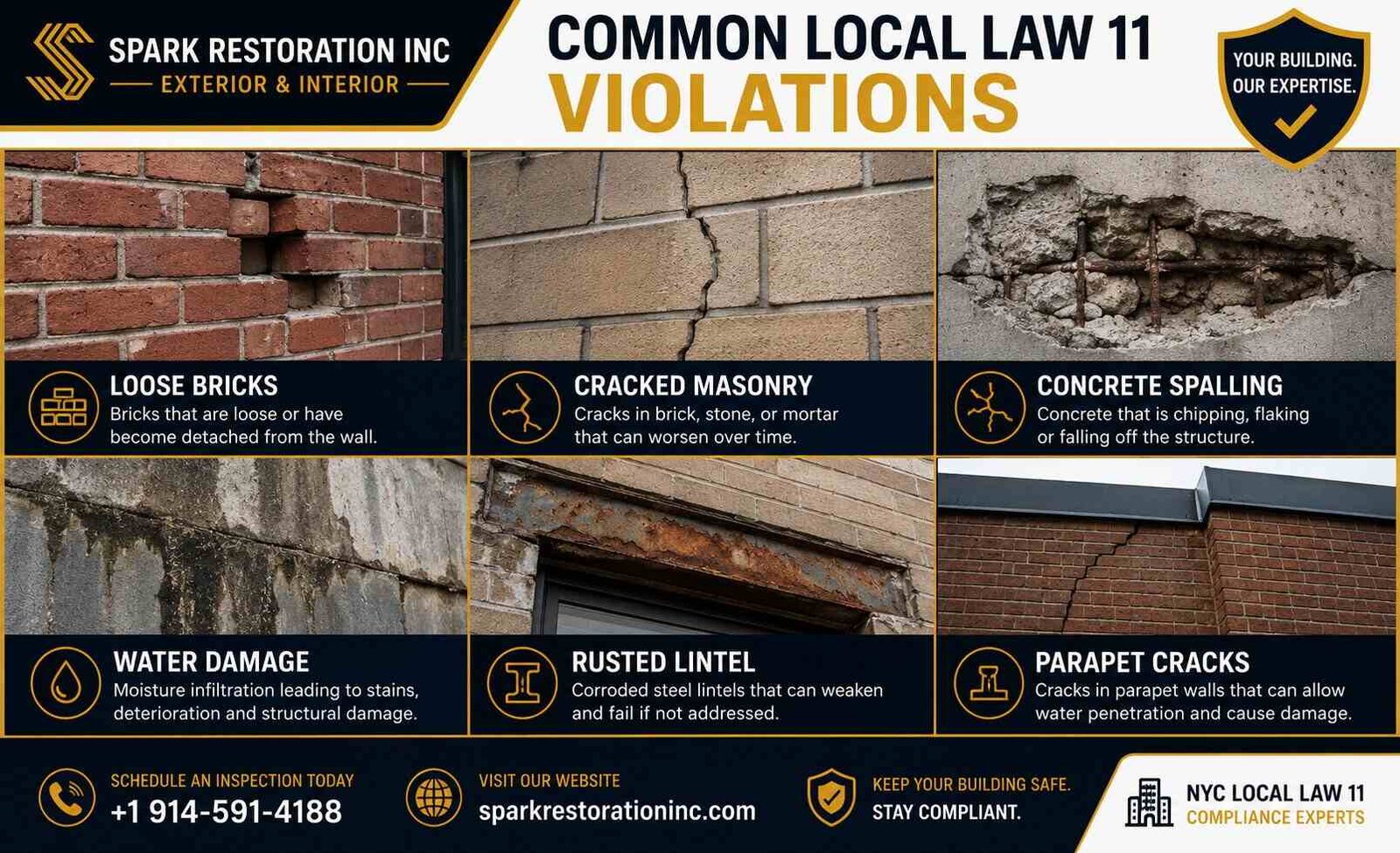
Common Local Law 11 Violations
Every inspection cycle reveals thousands of façade deficiencies across New York City.
Many of these issues develop slowly over decades due to weather exposure, moisture, and aging materials.
Below are the most common problems identified during Local Law 11 inspections.
Cracked Brick Masonry
Brick walls naturally expand and contract over time.
This movement can create cracks that allow water to enter the building envelope.
If ignored, cracks can lead to:
- Brick displacement
- Water damage
- Interior leaks
- Structural deterioration
Missing or Deteriorated Mortar Joints
Mortar binds masonry units together.
Over time it begins to deteriorate because of:
- Freeze-thaw cycles
- Moisture
- UV exposure
- Age
Missing mortar weakens the façade and increases water penetration.
Professional repointing restores structural integrity.
Spalling Concrete
Concrete spalling occurs when moisture reaches reinforcing steel.
As steel rusts, it expands and forces surrounding concrete to crack and separate.
Signs include:
- Chipped concrete
- Exposed reinforcing steel
- Surface cracking
- Falling concrete pieces
Concrete restoration is essential to prevent structural damage.
Corroded Steel Lintels
Steel lintels support masonry above windows and doors.
When exposed to moisture, they begin to rust.
Rust expansion pushes surrounding masonry outward, causing:
- Horizontal cracks
- Brick displacement
- Bulging walls
- Water infiltration
Replacing deteriorated lintels is a common Local Law 11 repair.
Loose Stone or Terra Cotta
Decorative façade materials become unstable as anchors deteriorate.
Loose architectural components present serious safety hazards and often require immediate stabilization.
Damaged Parapet Walls
Parapets receive constant exposure to rain, snow, and temperature changes.
Common issues include:
- Cracks
- Leaning walls
- Loose coping stones
- Failed flashing
- Water infiltration
Parapet restoration is one of the most common services required during Local Law 11 compliance.
Waterproofing Failures
Failed waterproofing systems allow moisture to penetrate exterior walls.
This leads to:
- Interior leaks
- Mold growth
- Masonry deterioration
- Concrete damage
- Steel corrosion
Exterior waterproofing is one of the most effective preventive maintenance investments.
Façade Bulging
Bulging walls often indicate hidden structural movement.
Possible causes include:
- Corroded anchors
- Failed ties
- Water damage
- Foundation movement
Bulging masonry should never be ignored.
Local Law 11 Repairs
Receiving a repair recommendation does not necessarily mean the building is unsafe.
Many repairs are preventive and help maintain long-term structural performance.
At Spark Restoration INC, we specialize in comprehensive Local Law 11 repair solutions that restore safety, ensure compliance, and extend the lifespan of commercial and residential buildings throughout New York City.
Façade Restoration
Façade restoration involves repairing and preserving the building’s exterior while maintaining its structural integrity and architectural appearance.
Services may include:
- Brick replacement
- Stone restoration
- Concrete repair
- Façade cleaning
- Sealant replacement
- Waterproof coating application
Proper façade restoration improves both safety and curb appeal.
Masonry Restoration
Masonry restoration addresses damaged brick, block, and stone components.
Typical work includes:
- Brick replacement
- Stone repair
- Mortar repointing
- Crack stitching
- Structural reinforcement
High-quality masonry restoration protects buildings from long-term deterioration.
Brick Pointing & Repointing
Repointing involves removing deteriorated mortar and replacing it with new mortar that matches the original material.
Benefits include:
- Improved structural stability
- Reduced water infiltration
- Extended façade lifespan
- Better appearance
Proper repointing is one of the most cost-effective preventative maintenance services.
Concrete Restoration
Concrete restoration includes repairing damaged structural concrete.
Typical repairs involve:
- Removing deteriorated concrete
- Treating corroded reinforcing steel
- Applying structural repair mortar
- Surface refinishing
- Protective coatings
This process restores structural performance while preventing future deterioration.
Structural Crack Repairs
Structural cracks require professional evaluation to determine their cause.
Repair methods vary depending on:
- Settlement
- Corrosion
- Thermal movement
- Water damage
- Structural loading
Addressing structural cracks early prevents more extensive damage.
Parapet Wall Repair
Parapet walls are among the most vulnerable building components.
Typical repairs include:
- Rebuilding damaged sections
- Installing new flashing
- Replacing coping stones
- Waterproofing
- Reinforcing masonry
Proper parapet repairs reduce water intrusion and improve public safety.
Waterproofing Services
Exterior waterproofing is critical for protecting the building envelope.
Spark Restoration INC provides:
- Exterior waterproof coatings
- Masonry sealers
- Joint sealant replacement
- Flashing repairs
- Expansion joint sealing
- Leak investigations
A properly waterproofed building experiences fewer façade problems over time.
Window Lintel Replacement
Deteriorated steel lintels often require complete replacement.
Our process includes:
- Temporary structural support
- Brick removal
- Lintel replacement
- Corrosion protection
- Masonry reconstruction
- Mortar matching
Proper installation restores structural integrity and prevents recurring damage.
Emergency Façade Stabilization
Some buildings require immediate action following an Unsafe classification.
Emergency services may include:
- Loose material removal
- Temporary shoring
- Sidewalk protection
- Safety netting
- Emergency scaffolding
- Temporary waterproofing
Rapid response helps protect the public while permanent repairs are planned.
Why Choose Spark Restoration INC for Local Law 11 Repairs?
Local Law 11 compliance requires more than simply fixing visible damage—it demands experience, technical expertise, and a thorough understanding of New York City’s building regulations.
Spark Restoration INC delivers complete exterior restoration solutions tailored to the needs of commercial, residential, condominium, cooperative, and mixed-use properties across NYC.
Our services include:
- ✅ Façade Restoration
- ✅ Masonry Restoration
- ✅ Waterproofing
- ✅ Brick Pointing & Repointing
- ✅ Concrete Restoration
- ✅ Parapet Wall Repair
- ✅ Window Lintel Replacement
- ✅ Sidewalk Shed & Scaffolding Coordination
- ✅ Exterior Building Maintenance
- ✅ Local Law 11 Repair Support
We work closely with property owners, property managers, engineers, architects, and Qualified Exterior Wall Inspectors (QEWI) to ensure projects are completed safely, efficiently, and in full compliance with NYC regulations.
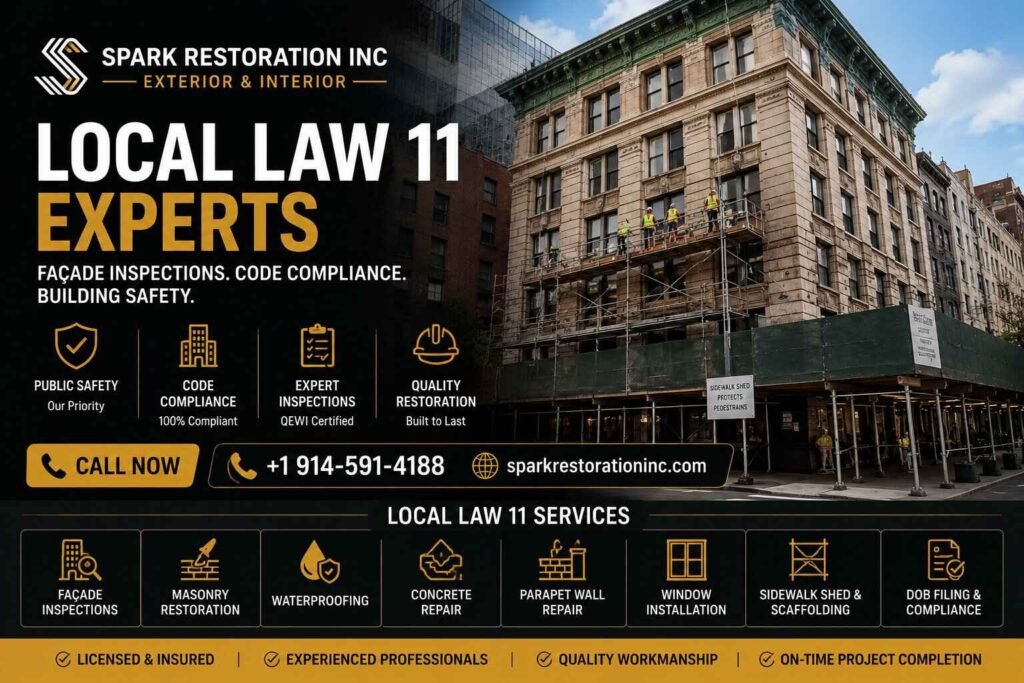
Sidewalk Sheds & Scaffolding Under Local Law 11
If a building is found to have unsafe façade conditions during a Local Law 11 inspection, one of the first safety measures required by the NYC Department of Buildings (DOB) is the installation of a sidewalk shed or appropriate scaffolding.
Although many property owners view sidewalk sheds as an inconvenience, they play a vital role in protecting pedestrians and workers from falling debris while façade repairs are underway.
At Spark Restoration INC, we coordinate sidewalk shed installation and scaffolding systems as part of comprehensive Local Law 11 compliance projects.
What Is a Sidewalk Shed?
A sidewalk shed is a temporary overhead protective structure installed along the perimeter of a building.
Its primary purpose is to protect pedestrians from debris that may fall during façade inspections or restoration work.
When Is a Sidewalk Shed Required?
A sidewalk shed may be required when:
- A building receives an Unsafe classification.
- Loose masonry or façade materials pose a risk to the public.
- Large-scale exterior restoration is underway.
- Structural repairs require extended work at height.
- The DOB mandates public protection measures.
Types of Scaffolding Used
Depending on the project, contractors may use:
- Supported scaffolding
- Suspended scaffolding
- Pipe scaffolding
- Frame scaffolding
- Swing stages
- Mast climbers
- Aerial lifts
- Boom lifts
Each system is selected based on building height, access requirements, and repair scope.
Why Professional Installation Matters?
Improperly installed scaffolding creates additional safety risks.
Professional installation ensures:
- Worker safety
- Pedestrian protection
- OSHA compliance
- NYC DOB compliance
- Efficient access for restoration crews
Local Law 11 Filing Process
Many building owners assume that completing repairs automatically satisfies Local Law 11 requirements.
In reality, compliance involves a formal filing process with the NYC Department of Buildings.
Step 1 – Hire a Qualified Exterior Wall Inspector (QEWI)
The first step is selecting a licensed Professional Engineer (PE) or Registered Architect (RA) qualified to perform FISP inspections.
Step 2 – Complete the Façade Inspection
The QEWI performs:
- Visual inspection
- Close-up examination
- Documentation
- Condition assessment
- Photographic reporting
Step 3 – Prepare the Engineering Report
The inspection report includes:
- Building information
- Inspection methods
- Existing conditions
- Photographs
- Repair recommendations
- Classification (Safe, SWARMP, or Unsafe)
Step 4 – Submit Report to NYC DOB
The completed report is filed electronically through the Department of Buildings.
Step 5 – Complete Required Repairs
If deficiencies are identified, repairs must be completed according to the engineer’s recommendations and applicable deadlines.
Step 6 – Final Documentation
Once repairs are complete, follow-up documentation may be required to verify compliance.
How Much Does Local Law 11 Cost?
One of the most frequently asked questions is:
“How much does Local Law 11 cost?”
The answer depends on several factors.
Inspection Costs
Inspection costs vary depending on:
- Building height
- Number of façades
- Building complexity
- Accessibility
- Inspection methods
Engineering Fees
Engineering costs depend on:
- Report preparation
- Documentation
- DOB filing
- Follow-up inspections
Repair Costs
Repair costs vary significantly based on the building’s condition.
Examples include:
- Brick replacement
- Masonry restoration
- Concrete restoration
- Waterproofing
- Lintel replacement
- Parapet reconstruction
- Façade stabilization
Sidewalk Shed Costs
Costs depend on:
- Building frontage
- Duration of installation
- Permit requirements
- Labor
- Materials
Factors That Affect Total Project Cost
Several variables influence the overall cost of Local Law 11 compliance:
- Building size
- Height
- Accessibility
- Severity of damage
- Repair methods
- Material selection
- Engineering requirements
- Permit fees
- Scaffolding duration
Investing in regular maintenance can significantly reduce these costs over time by preventing major structural deterioration.
Penalties for Non-Compliance
Ignoring Local Law 11 can have serious financial, legal, and safety consequences.
Financial Penalties
Failure to comply may result in:
- Late filing penalties
- Civil penalties
- Additional enforcement actions
Unsafe Conditions
Buildings classified as Unsafe may require:
- Emergency repairs
- Sidewalk sheds
- Immediate stabilization
- Re-inspections
Legal Liability
If falling façade materials cause injury or property damage, owners may face:
- Lawsuits
- Insurance claims
- Increased liability exposure
Property Value Impact
Outstanding Local Law 11 issues can negatively affect:
- Property sales
- Commercial leasing
- Financing
- Insurance renewals
- Investor confidence
How to Prepare for a Local Law 11 Inspection?
Preparation can make the inspection process smoother and help reduce unexpected issues.
Property Owner Checklist
✔ Review previous FISP reports
✔ Schedule inspections early
✔ Address visible façade damage
✔ Repair water leaks promptly
✔ Remove vegetation growing on exterior walls
✔ Maintain roof drainage systems
✔ Keep maintenance records
✔ Hire experienced restoration professionals
✔ Budget for potential repairs
✔ Coordinate with your QEWI and contractor
Regular preventive maintenance is often the most effective way to minimize future repair costs and maintain compliance.
Why Choose Spark Restoration INC?
When it comes to Local Law 11 compliance, experience matters.
At Spark Restoration INC, we provide comprehensive exterior restoration solutions designed to help New York City property owners maintain safe, compliant, and visually appealing buildings.
Our Local Law 11 Services Include:
- Façade Restoration
- Masonry Restoration
- Brick Replacement
- Brick Pointing & Repointing
- Concrete Restoration
- Structural Repairs
- Waterproofing
- Parapet Wall Repair
- Window Installation
- Window Lintel Replacement
- Sidewalk Shed Coordination
- Scaffolding Coordination
- Exterior Building Maintenance
- Commercial Building Restoration
- Residential Building Restoration
- Local Law 11 Repair Support
Our experienced team works alongside engineers, architects, property managers, and building owners to deliver high-quality workmanship while meeting NYC Department of Buildings requirements.
Whether your property needs routine façade maintenance or extensive structural restoration, we are committed to delivering reliable solutions with safety, quality, and compliance at the forefront.
Final Thoughts
Local Law 11 is more than a regulatory requirement—it is a critical safety measure that helps protect New York City’s buildings, residents, workers, and pedestrians. Regular inspections, timely repairs, and proactive maintenance not only ensure compliance with the Façade Inspection & Safety Program but also preserve the structural integrity, appearance, and value of your property.
Whether you own a commercial office building, residential apartment complex, condominium, cooperative, or mixed-use property, partnering with experienced professionals can make the compliance process far more efficient and cost-effective.
At Spark Restoration INC, we are committed to delivering expert façade restoration, masonry repair, waterproofing, concrete restoration, and Local Law 11 support tailored to your property’s specific needs. Our focus on quality craftsmanship, safety, and regulatory compliance helps property owners throughout New York City protect their investments with confidence.
Contact Spark Restoration INC Today
If your building requires Local Law 11 repairs, façade restoration, masonry restoration, waterproofing, sidewalk shed coordination, or exterior maintenance, our experienced team is ready to help.
Schedule a consultation today and let Spark Restoration INC provide reliable, code-compliant solutions that keep your property safe, attractive, and fully compliant with NYC regulations.