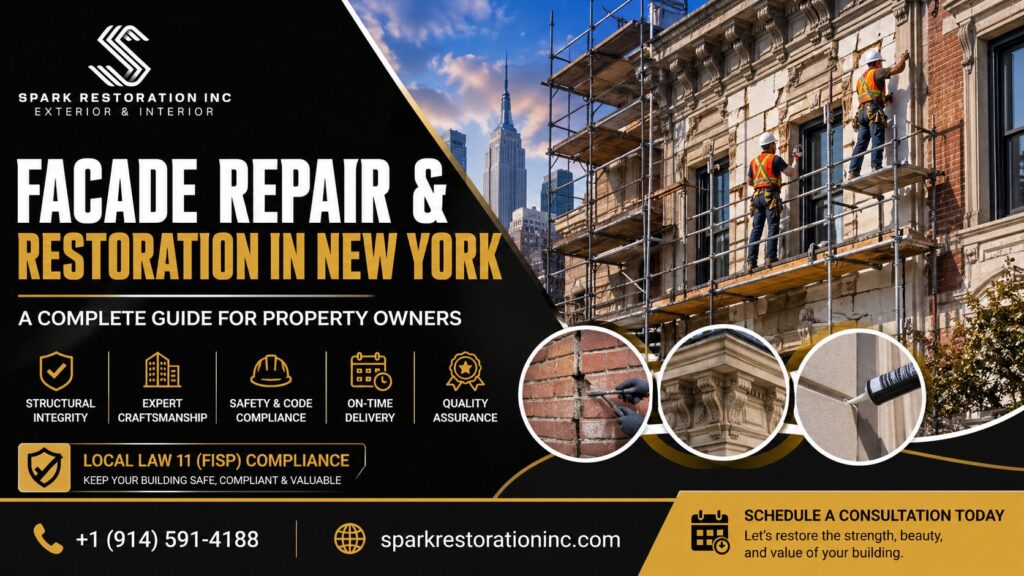
Facade Repair & Restoration in New York is not just about improving a building’s appearance—it is a critical construction process that directly impacts structural integrity, safety compliance, and long-term asset value. In a city like New York, where buildings are constantly exposed to harsh environmental conditions and strict regulatory requirements, maintaining the building façade is essential for both residential and commercial properties.
The façade acts as the primary protective barrier of a structure, shielding it from water intrusion, temperature fluctuations, wind loads, and environmental pollutants. Over time, even the most durable materials begin to deteriorate due to aging, weather exposure, and lack of maintenance. Without timely intervention, minor façade issues can quickly escalate into serious structural problems and costly repairs.
For property owners, real estate developers, and facility managers, investing in professional façade restoration is not just a maintenance decision—it is a strategic investment that ensures compliance with New York City building regulations, enhances property value, and reduces long-term operational costs.
In New York, façade-related issues are also closely monitored under strict safety regulations such as Local Law 11 (FISP), making regular inspections and timely repairs mandatory for many buildings. Failure to address façade deterioration can result in legal penalties, safety hazards, and emergency repair situations, all of which can significantly impact your property and finances.
This comprehensive guide is designed to provide a complete understanding of facade repair and restoration, covering everything from inspection and damage identification to repair methods, costs, compliance requirements, and contractor selection. Whether you are planning a restoration project or simply want to understand the condition of your building, this guide will help you make informed, cost-effective, and compliant decisions.
What is Facade Repair & Restoration?
Facade repair and restoration refers to the systematic process of inspecting, repairing, stabilizing, and upgrading the exterior envelope of a building to ensure long-term performance, safety, and compliance. In a construction context, the façade is not just an outer layer—it is an integrated system that plays a critical role in protecting the structure, regulating environmental exposure, and maintaining overall building integrity.
In New York’s demanding construction environment, facade repair & restoration is a technical and regulated process that requires professional planning, engineering expertise, and strict adherence to building codes.
Definition & Scope
Facade repair involves addressing localized damage or deterioration, such as:
- Cracks in masonry
- Loose bricks or stones
- Minor water infiltration issues
Facade restoration, on the other hand, is a more comprehensive process that may include:
- Structural stabilization
- Replacement of deteriorated materials
- Full exterior upgrades
- Waterproofing system installation
👉 In many cases, projects involve a combination of repair and restoration, depending on the building’s condition.
Understanding the Building Envelope
The façade is a key component of the building envelope, which includes all exterior elements that separate the interior from the external environment.
Functions of the building envelope:
- Prevent water penetration
- Control air leakage
- Provide thermal insulation
- Maintain structural stability
Any failure in the façade directly impacts the overall performance of the building.
Core Objectives of Facade Repair & Restoration
A professionally executed facade restoration project focuses on several critical objectives:
Structural Integrity
Ensuring the façade remains stable and securely attached to the building structure.
Water Resistance
Preventing moisture intrusion that can lead to mold, corrosion, and interior damage.
Energy Efficiency
Improving insulation and reducing energy loss through the building envelope.
Aesthetic Enhancement
Restoring the visual appeal of the property, which is especially important in competitive real estate markets like New York.
Code Compliance
Meeting all NYC building regulations, including Local Law 11 requirements.
Types of Facade Work
Facade repair and restoration projects can vary significantly depending on the condition of the building:
Minor Repairs
- Crack sealing
- Joint repointing
- Surface patching
Preventive Maintenance
- Waterproofing application
- Sealant replacement
- Routine inspections
Full Restoration
- Large-scale masonry repair
- Material replacement
- Structural reinforcement
Structural Rehabilitation
- Anchoring systems
- Load-bearing repairs
- Façade stabilization
Why Professional Execution Matters?
Facade repair is not a simple surface-level task. Poor workmanship or incorrect material selection can lead to:
- Recurring damage
- Code violations
- Increased long-term costs
- Safety risks
That’s why working with an experienced facade repair & restoration contractor in New York ensures:
- Proper diagnosis of issues
- Compliance with local regulations
- Use of high-quality materials
- Long-lasting results
Why Facade Restoration is Critical in New York?
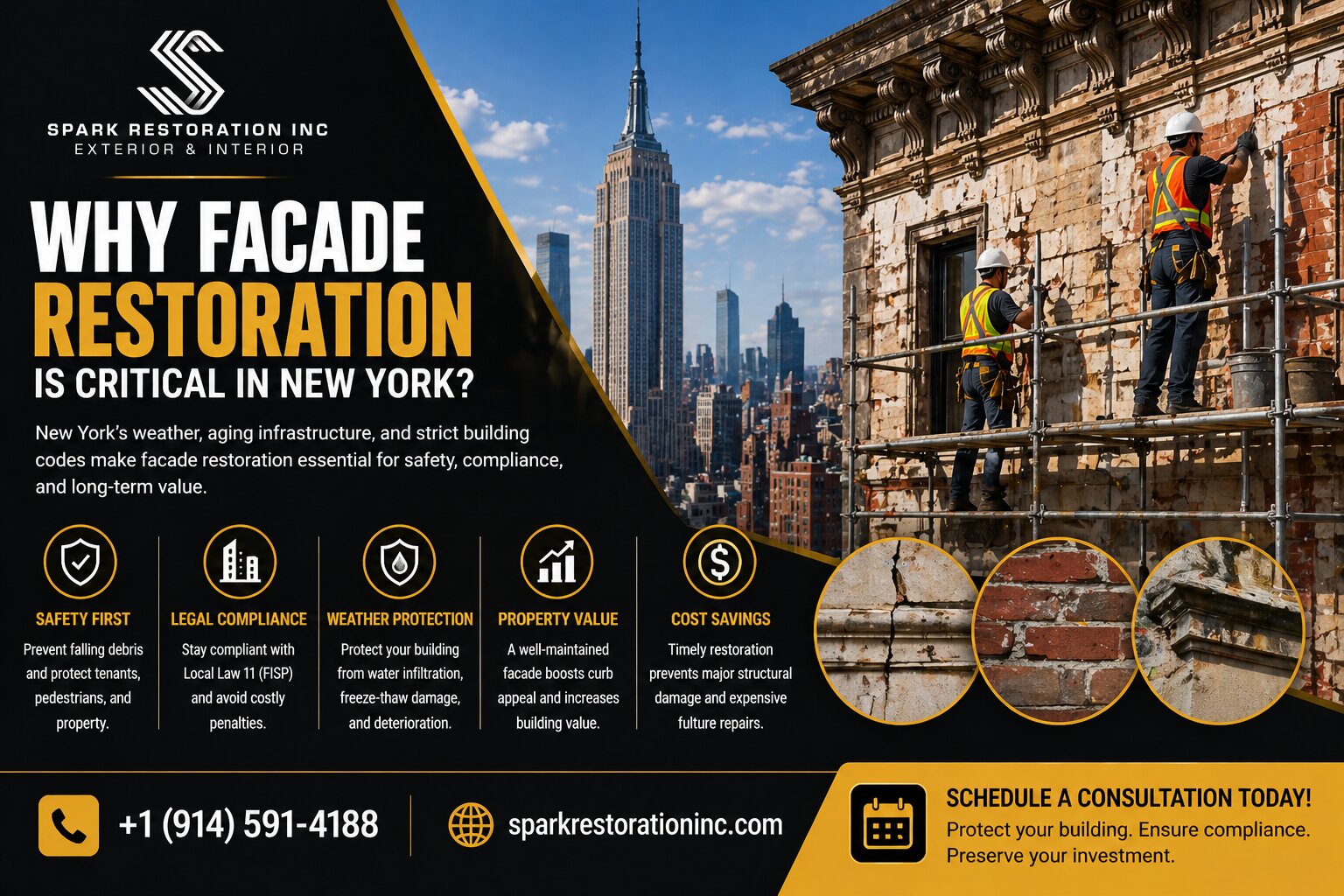
Facade repair and restoration in New York is not optional maintenance—it is a critical requirement driven by environmental exposure, aging infrastructure, and strict regulatory enforcement. Buildings in New York operate under some of the most demanding conditions in the United States, making façade performance a key factor in structural safety, compliance, and long-term asset protection.
Environmental Stress Factors
New York’s climate places continuous stress on building facades. Over time, these conditions accelerate material deterioration and structural fatigue.
Key environmental challenges include:
- Freeze-thaw cycles causing expansion and contraction of materials
- Heavy rainfall leading to water infiltration
- Snow and ice accumulation adding weight and moisture exposure
- Temperature fluctuations weakening joints and sealants
- UV exposure degrading surface materials
These conditions can cause micro-damage that gradually develops into significant structural issues if not addressed through timely restoration.
Aging Building Infrastructure
A large percentage of New York’s buildings were constructed decades ago, many using traditional masonry systems that require ongoing maintenance.
Common aging-related issues include:
- Deterioration of mortar joints
- Cracking and displacement of bricks or stones
- Corrosion of embedded steel components
- Failure of original waterproofing systems
As buildings age, their façade systems lose their ability to effectively resist environmental forces. Without proper restoration, this leads to compromised structural integrity and increased repair costs over time.
Safety Risks and Liability
Facade deterioration is not just a maintenance concern—it is a serious safety issue. In dense urban environments like New York, failing façade elements can pose risks to both occupants and pedestrians.
Potential hazards include:
- Falling bricks or façade components
- Structural instability in exterior walls
- Water penetration leading to interior damage
- Mold growth affecting indoor air quality
Property owners are legally responsible for maintaining safe building conditions. Neglecting façade repairs can result in liability claims, insurance complications, and emergency repair situations.
Regulatory Requirements and Compliance Pressure
New York City enforces strict façade safety regulations through programs like Local Law 11 (FISP). These laws are designed to ensure that building exteriors are regularly inspected and maintained.
Key compliance factors:
- Mandatory inspections for buildings over six stories
- Required reporting by certified professionals
- Classification of building conditions (Safe, SWARMP, Unsafe)
- Deadlines for required repairs
Failure to comply can result in:
- Financial penalties
- Legal enforcement actions
- Mandatory emergency repairs
- Increased scrutiny from regulatory authorities
Financial Impact of Neglect
Delaying façade restoration may seem cost-saving in the short term, but it significantly increases long-term expenses.
Consequences of delayed maintenance:
- Escalation of minor issues into major structural repairs
- Higher project costs due to extensive damage
- Emergency repair premiums
- Loss of property value
- Reduced tenant satisfaction and retention
In contrast, proactive façade restoration allows for controlled budgeting, planned execution, and long-term cost efficiency.
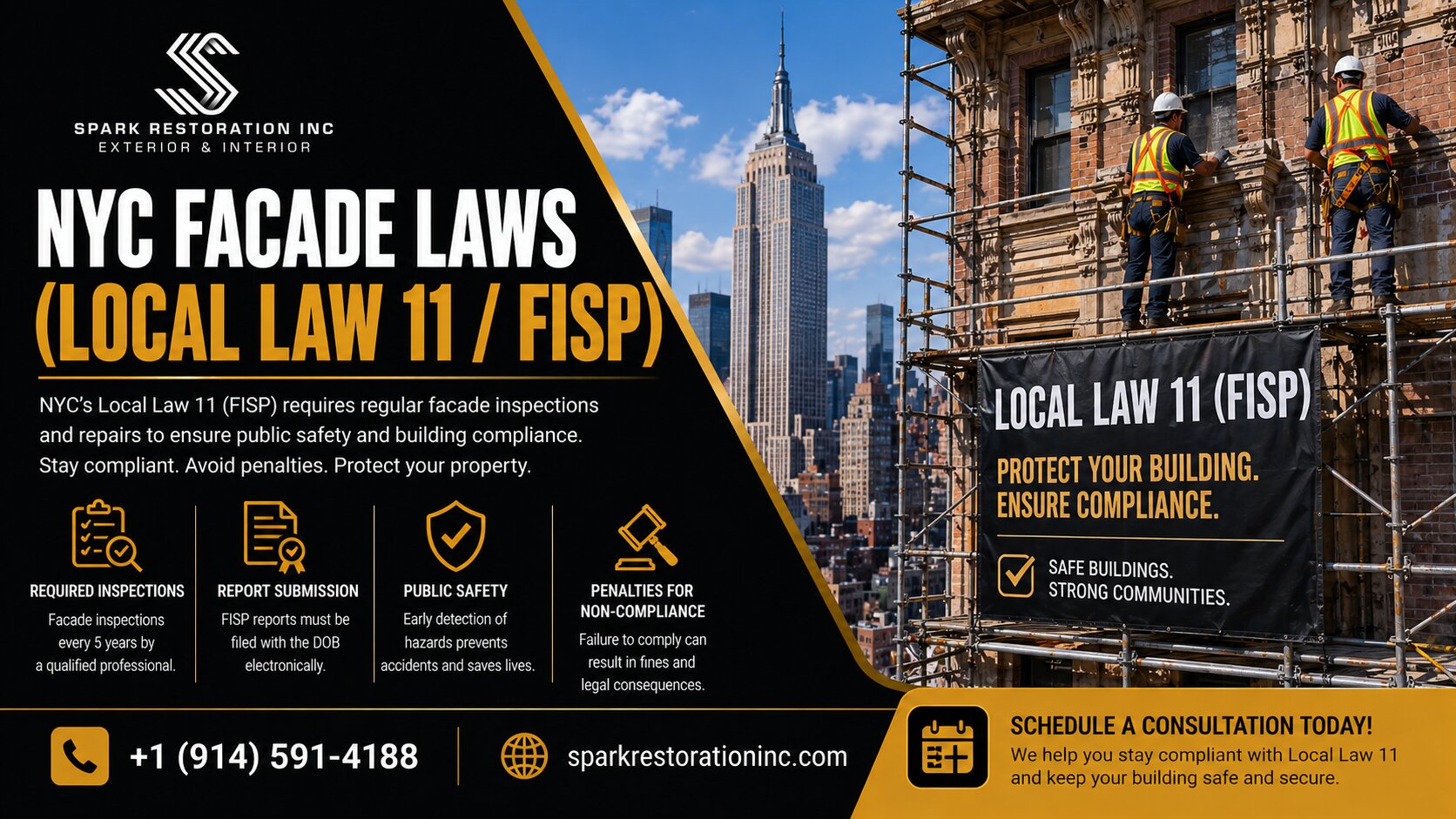
NYC Facade Laws (Local Law 11 / FISP)
In New York City, facade repair and restoration is not just a best practice—it is a legal requirement governed by strict building safety regulations. The primary law that controls façade inspection and maintenance is the Facade Inspection Safety Program (FISP), commonly known as Local Law 11.
This regulation was introduced to prevent accidents caused by deteriorating building exteriors, particularly falling debris in high-density urban areas.
What is Local Law 11 (FISP)?
Local Law 11, officially known as the Facade Inspection Safety Program (FISP), requires periodic inspections of building exteriors to ensure they are structurally sound and safe for occupants and the public.
The law mandates that building facades must be evaluated by qualified professionals and maintained in a safe condition at all times.
Who Needs to Comply?
FISP applies to:
- Buildings that are six stories or taller
- Residential, commercial, and mixed-use properties
- Property owners, co-op boards, and building managers
If your building falls under this category, compliance is mandatory—there are no exceptions.
Inspection Cycle Requirements
Facade inspections must be conducted:
- Every five years
- Within assigned compliance cycles set by NYC Department of Buildings
Each cycle is divided into sub-cycles based on the last digit of the building’s block number, which determines your filing deadline.
Failing to meet inspection deadlines can result in immediate penalties.
Role of Qualified Exterior Wall Inspector (QEWI)
All inspections must be performed by a Qualified Exterior Wall Inspector (QEWI), which includes:
- Licensed Professional Engineers (PE)
- Registered Architects (RA)
The QEWI is responsible for:
- Conducting detailed inspections
- Identifying structural or safety issues
- Submitting official reports to the NYC Department of Buildings
Building Classification Categories
After inspection, buildings are classified into one of three categories:
1. Safe
- No issues detected
- No immediate repairs required
2. Safe With Repair and Maintenance Program (SWARMP)
- Issues exist but are not immediately dangerous
- Repairs must be completed within a specified timeframe
3. Unsafe
- Immediate hazards are present
- Repairs must be carried out without delay
- Public safety measures (sidewalk sheds, barriers) are required
Penalties for Non-Compliance
Failure to comply with Local Law 11 can result in serious consequences:
- Civil penalties and fines
- Additional monthly penalties for late filing
- Legal action from city authorities
- Mandatory emergency repairs
- Increased insurance risks
In some cases, buildings may be required to install sidewalk sheds, which can remain in place for extended periods until violations are resolved.
Importance of Early Compliance Planning
Proactive planning is essential to avoid compliance issues.
Best practices include:
- Scheduling inspections well before deadlines
- Budgeting for potential repairs in advance
- Working with experienced facade contractors
- Addressing SWARMP conditions promptly
Early action allows property owners to avoid emergency work, reduce costs, and maintain full compliance with NYC regulations.
Signs Your Building Needs Facade Repair & Restoration
Identifying early signs of façade deterioration is critical for preventing costly structural damage and ensuring compliance with New York City regulations. In many cases, visible issues on the exterior surface are indicators of deeper structural or moisture-related problems.
Timely detection allows property owners to address minor defects before they escalate into major restoration projects or safety hazards.
Structural Warning Signs
Structural issues are often the most serious indicators that façade repair is required. These problems typically affect the stability and load-bearing capacity of the exterior wall system.
Common structural signs include:
- Vertical, horizontal, or stair-step cracks in masonry
- Bulging or bowing sections of the façade
- Displacement or shifting of bricks and stones
- Loose or detached façade elements
- Separation at expansion joints
These conditions may indicate underlying structural stress or failure of anchoring systems and should be evaluated immediately by a professional.
Moisture and Water Intrusion Issues
Water infiltration is one of the leading causes of façade deterioration. Even small amounts of moisture penetration can lead to long-term damage if not properly addressed.
Indicators of moisture-related problems:
- Water stains on interior or exterior walls
- Dampness or discoloration around windows and joints
- Mold or mildew growth inside the building
- Efflorescence (white, powdery residue on masonry surfaces)
- Peeling paint or coating failure
Moisture intrusion not only damages the façade but can also affect interior finishes, insulation, and air quality.
Material Deterioration
Over time, façade materials naturally degrade due to environmental exposure and aging. However, visible material breakdown is a clear sign that restoration is required.
Common material-related issues:
- Spalling (flaking or chipping) of brick or concrete
- Crumbling or missing mortar joints
- Surface erosion of stone or stucco
- Rust stains caused by corroded embedded steel
- Delamination of façade layers
If left untreated, material deterioration can compromise the structural performance of the entire façade system.
Sealant and Joint Failures
Sealants and expansion joints play a critical role in preventing water and air infiltration. Failure in these components can lead to widespread damage.
Signs of joint failure include:
- Cracked or hardened sealant
- Gaps between façade panels or materials
- Visible air leakage or drafts
- Water penetration around joints
Sealant failure is often an early-stage issue that can be repaired cost-effectively if addressed in time.
Safety and Emergency Indicators
Some façade conditions require immediate action due to safety risks.
Urgent warning signs:
- Falling debris or loose materials
- Large or widening cracks
- Sections of façade detaching from the structure
- Visible instability in exterior walls
In such cases, immediate measures such as protective barriers or sidewalk sheds may be required to ensure public safety.
When to Schedule a Professional Inspection?
If any of the above signs are present, a professional façade inspection should be scheduled without delay.
Recommended scenarios for inspection:
- Before buying or selling a property
- Prior to Local Law 11 compliance deadlines
- After severe weather events
- When visible damage is detected
- As part of routine maintenance planning
Early inspection and diagnosis help reduce repair costs, improve safety, and ensure regulatory compliance.
Facade Inspection Process
A professional facade inspection is the foundation of any successful repair and restoration project. In New York, inspections are not only essential for identifying visible damage but are also required for compliance under Local Law 11 (FISP). A thorough inspection ensures that all structural, material, and safety-related issues are properly diagnosed before any repair work begins.
A well-executed inspection process helps property owners avoid unnecessary costs, plan accurately, and ensure long-term performance of the building envelope.
Preliminary Visual Inspection
The first step in the inspection process is a general visual assessment of the building façade.
This includes:
- Identifying visible cracks, stains, and surface damage
- Observing signs of material deterioration
- Checking for water infiltration indicators
- Reviewing previous repair work
This stage provides an overall understanding of the building’s condition and helps determine whether a more detailed inspection is required.
Close-Up (Hands-On) Inspection
For a more accurate evaluation, contractors perform a close-up inspection using:
- Scaffolding systems
- Swing stages
- Boom lifts or aerial platforms
During this phase:
- Individual bricks, joints, and panels are examined
- Cracks and defects are measured and documented
- Loose or unstable elements are identified
- Sealants and expansion joints are inspected
Close-up inspection is critical for detecting issues that are not visible from ground level.
Non-Destructive Testing (NDT)
Advanced diagnostic methods are used to detect hidden problems without damaging the structure.
Common NDT techniques include:
- Moisture meters to detect water infiltration
- Infrared thermography to identify temperature variations and hidden voids
- Ultrasonic testing for structural integrity assessment
- Ground-penetrating radar (in some cases)
These methods help identify internal issues such as trapped moisture, voids, or weakened structural components.
Structural Evaluation
Once surface and subsurface conditions are assessed, a structural evaluation is performed to determine the stability of the façade system.
This includes:
- Assessing load-bearing components
- Evaluating anchoring systems
- Identifying movement or displacement in structural elements
- Reviewing potential safety risks
This step is especially important for older buildings or those showing significant signs of deterioration.
Documentation and Reporting
After completing the inspection, a detailed report is prepared.
The report typically includes:
- Summary of findings
- Photographic documentation
- Identification of problem areas
- Recommended repair scope
- Estimated repair priorities
- Compliance status (for FISP reporting)
This report serves as the basis for planning the restoration project and budgeting accordingly.
Importance of Professional Inspection
A professional inspection ensures:
- Accurate identification of all issues
- Compliance with NYC regulations
- Proper planning of repair work
- Avoidance of unnecessary or incomplete repairs
Attempting to skip or minimize the inspection phase can result in missed defects, leading to repeated repairs and increased long-term costs.
Step-by-Step Facade Repair & Restoration Process
A successful facade repair and restoration project in New York requires a structured, well-managed process that ensures safety, compliance, quality, and long-term durability. From initial consultation to final handover, each phase must be executed with precision, proper supervision, and adherence to building codes.
This section outlines how professional contractors handle facade restoration projects from start to finish.
Consultation & Site Assessment
The process begins with an in-depth consultation to understand the building’s condition and the client’s requirements.
Key activities:
- Reviewing inspection reports (if available)
- Conducting an initial site visit
- Identifying visible issues and risk areas
- Discussing project goals, timelines, and budget expectations
This stage establishes the foundation for accurate planning and cost estimation.
Engineering & Project Planning
Once the assessment is complete, the next step is developing a detailed restoration plan.
This includes:
- Structural analysis by engineers (if required)
- Defining the scope of work
- Selecting appropriate materials and repair methods
- Preparing technical drawings and specifications
Proper planning ensures that all aspects of the project are addressed before execution begins.
Permits & Regulatory Compliance
In New York, facade restoration projects often require approvals from the NYC Department of Buildings.
Compliance steps include:
- Filing necessary permits
- Ensuring alignment with Local Law 11 (FISP) requirements
- Coordinating with inspectors and regulatory authorities
Failure to secure proper permits can result in project delays, fines, or work stoppages.
Project Scheduling & Resource Allocation
A detailed project schedule is created to ensure efficient execution.
This includes:
- Timeline planning with defined milestones
- Labor and workforce allocation
- Procurement of materials and equipment
- Coordination with building management and occupants
Effective scheduling minimizes disruptions and ensures timely completion.
Site Preparation & Safety Setup
Before repair work begins, the site must be properly prepared to ensure safety and accessibility.
Preparation activities:
- Installation of scaffolding or suspended platforms
- Setting up sidewalk sheds and protective barriers
- Implementing safety protocols for workers and the public
- Securing work zones
Safety compliance at this stage is critical, especially in high-traffic urban environments.
Execution Phase (Repair & Restoration Work)
This is the core phase where all repair and restoration activities are carried out.
Common restoration tasks include:
Masonry Repair & Repointing
- Removing damaged mortar
- Replacing with new, compatible mortar
- Restoring structural integrity
Crack Injection & Structural Stabilization
- Sealing cracks using epoxy or polyurethane
- Reinforcing weakened sections
Material Replacement
- Replacing damaged bricks, stones, or panels
- Matching original materials for consistency
Waterproofing Application
- Applying sealants, coatings, or membranes
- Installing flashing systems to prevent water intrusion
Joint & Sealant Replacement
- Removing deteriorated sealants
- Installing new expansion joints
Each activity is performed with strict adherence to engineering specifications and quality standards.
Quality Control & Ongoing Inspection
Throughout the execution phase, continuous monitoring is essential to maintain quality and compliance.
Quality control measures:
- Regular site inspections
- Verification of materials and workmanship
- Safety compliance checks
- Coordination with engineers and inspectors
This ensures that all work meets required standards and project specifications.
Final Inspection & Project Handover
After completion of all restoration work, a final inspection is conducted.
This includes:
- Reviewing completed repairs
- Ensuring compliance with building codes
- Addressing any remaining issues
- Preparing final documentation
The project is then handed over to the client along with maintenance recommendations.
Importance of Professional Project Management
A well-managed facade restoration project ensures:
- On-time completion
- Budget control
- Compliance with regulations
- High-quality results
Professional contractors bring expertise in coordination, execution, and supervision, which is essential for complex projects in New York.
Types of Facade Materials & Repair Methods
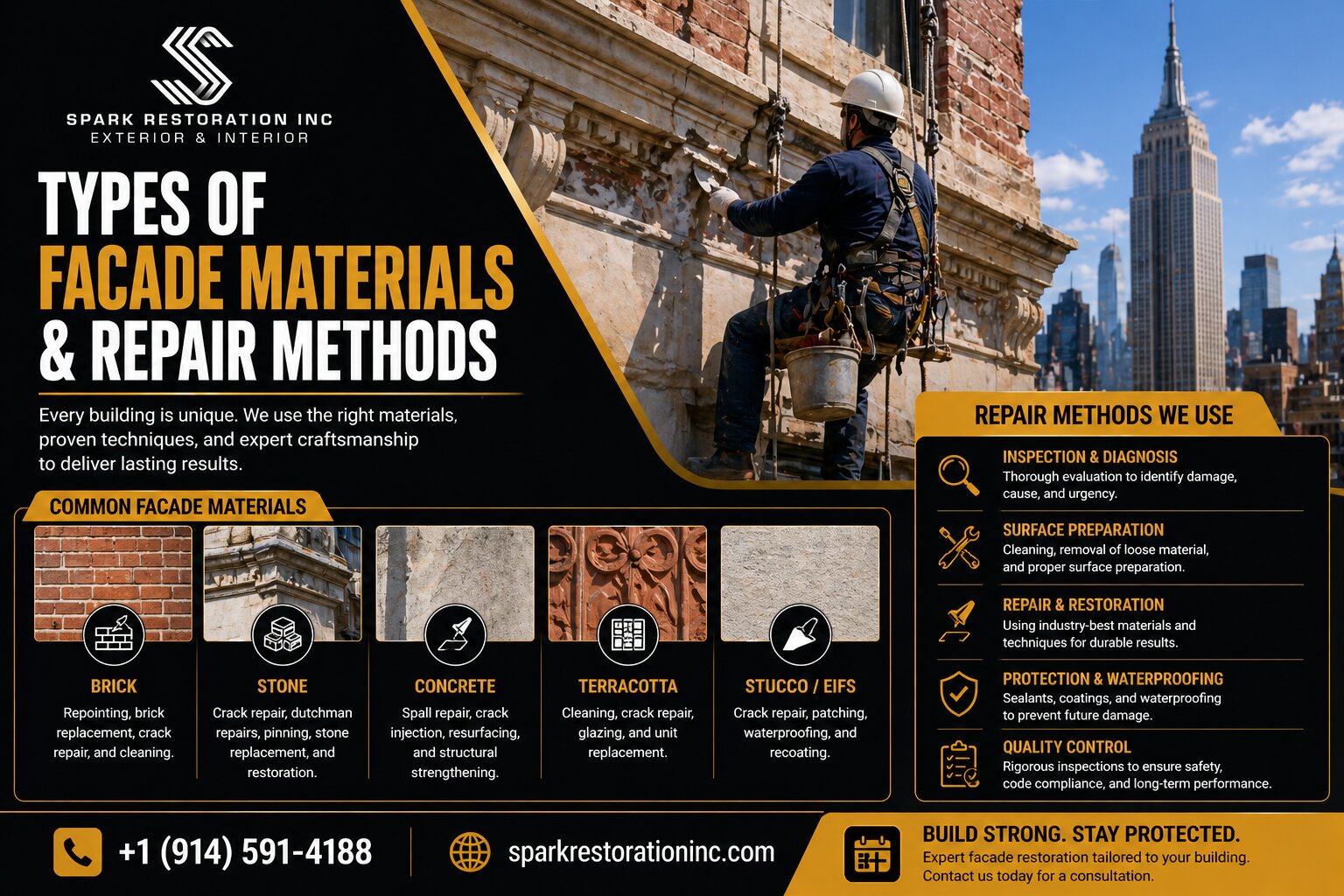
Facade repair and restoration is highly dependent on the type of material used in the building exterior. Each material behaves differently under environmental stress and requires specialized repair techniques to ensure durability, compatibility, and long-term performance.
Using the wrong repair method or incompatible materials can lead to premature failure, structural issues, and repeated maintenance costs. That’s why professional contractors tailor their approach based on the façade system.
Brick Facades (Masonry Systems)
Brick is one of the most common façade materials in New York, especially in older residential and commercial buildings. While durable, brick facades are highly dependent on the condition of mortar joints.
Common issues:
- Deteriorated or missing mortar joints
- Cracked or spalling bricks
- Water penetration through joints
Repair methods:
Repointing (Tuckpointing)
- Removing damaged mortar
- Replacing it with new, compatible mortar
- Restoring joint strength and sealing gaps
Brick Replacement
- Removing damaged bricks
- Installing new bricks that match the original in size, color, and texture
Cleaning & Sealing
- Removing dirt, stains, and efflorescence
- Applying protective sealants
Proper repointing is critical because mortar joints act as the first line of defense against moisture intrusion.
Concrete Facades
Concrete is widely used in modern and high-rise buildings due to its strength and versatility. However, it is prone to cracking and reinforcement corrosion over time.
Common issues:
- Surface cracking
- Spalling due to steel corrosion
- Delamination (layer separation)
Repair methods:
Crack Injection
- Using epoxy or polyurethane to seal cracks
- Restoring structural continuity
Surface Patching
- Removing damaged concrete
- Applying repair mortar or patching compounds
Structural Reinforcement
- Treating corroded steel reinforcement
- Strengthening affected areas
Concrete repairs require precise techniques to ensure that the repaired sections bond effectively with the existing structure.
Natural Stone Facades
Stone facades are often found in historic and high-end commercial buildings. While aesthetically valuable, stone requires careful handling during restoration.
Common issues:
- Surface erosion
- Cracking or displacement
- Loose anchoring
Repair methods:
Stone Replacement
- Replacing damaged or severely deteriorated stones
- Matching original material for consistency
Anchoring Systems
- Installing or repairing anchors to secure stone panels
Surface Restoration
- Cleaning, polishing, or refinishing stone surfaces
Preserving the architectural integrity of stone facades is a key priority in restoration projects.
Stucco Facades
Stucco is commonly used in both residential and low-rise commercial properties. It provides a smooth finish but is vulnerable to cracking and moisture penetration.
Common issues:
- Hairline or structural cracks
- Moisture infiltration behind stucco layers
- Surface discoloration
Repair methods:
Crack Repair
- Filling cracks with appropriate sealants or patching materials
Re-Coating
- Applying new stucco layers to restore surface integrity
Waterproofing
- Adding protective coatings to prevent water intrusion
Proper sealing is essential to prevent hidden moisture damage beneath stucco systems.
Glass & Modern Curtain Wall Systems
Modern commercial buildings often use glass curtain wall systems, which require specialized maintenance and repair.
Common issues:
- Sealant failure
- Water leakage
- Thermal inefficiency
Repair methods:
- Replacement of damaged panels
- Resealing joints and connections
- Upgrading insulation and glazing systems
These systems require precision and expertise due to their complexity and integration with building systems.
Importance of Material Compatibility
One of the most critical aspects of facade restoration is ensuring material compatibility.
Why it matters:
- Prevents chemical reactions between old and new materials
- Ensures proper bonding and durability
- Maintains structural integrity
- Preserves the original appearance
Using incompatible materials can lead to accelerated deterioration and costly rework.
Waterproofing in Facade Restoration
Waterproofing is one of the most critical components of facade repair and restoration. In New York’s climate, where buildings are exposed to frequent rain, snow, and humidity, water intrusion is the primary cause of façade deterioration and structural damage.
Without effective waterproofing, even a newly restored façade can fail prematurely, leading to recurring repairs, interior damage, and increased maintenance costs.
Why Waterproofing is Critical?
The façade acts as a protective barrier, but over time, small gaps, cracks, and material degradation allow moisture to penetrate the building envelope.
Risks of inadequate waterproofing:
- Water infiltration into walls and interiors
- Mold and mildew growth
- Corrosion of embedded steel reinforcement
- Freeze-thaw damage causing expansion and cracking
- Damage to insulation and reduced energy efficiency
Moisture-related issues often remain hidden until significant damage has already occurred, making waterproofing a preventive and protective investment.
Common Entry Points for Water
Understanding where water enters helps in designing effective waterproofing systems.
Typical vulnerable areas include:
- Cracks in masonry or concrete
- Deteriorated mortar joints
- Failed sealants around windows and joints
- Roof-to-wall intersections
- Expansion joints
- Flashing failures
Addressing these areas is essential for a long-lasting restoration.
Common Waterproofing Methods
Professional facade restoration projects incorporate multiple waterproofing techniques based on building type and condition.
Sealants and Joint Systems
- Used to seal gaps around windows, doors, and expansion joints
- Flexible materials accommodate building movement
Elastomeric Coatings
- Applied to exterior surfaces
- Provide a flexible, water-resistant barrier
- Help bridge small cracks
Waterproof Membranes
- Fluid-applied or sheet-based systems
- Create a continuous protective layer
- Used in high-risk areas
Flashing Systems
- Installed at joints and transitions
- Direct water away from vulnerable areas
- Critical for preventing leaks
Drainage Systems
- Designed to channel water away from the building
- Prevent accumulation and pressure buildup
Benefits of Proper Waterproofing
A well-executed waterproofing system provides long-term advantages:
- Extends the lifespan of the façade
- Prevents structural damage
- Reduces maintenance and repair costs
- Improves indoor air quality
- Enhances energy efficiency
Integration with Facade Restoration
Waterproofing is not a separate task—it is integrated into every stage of facade restoration.
During restoration:
- Cracks are sealed before coating
- Joints are repaired before applying membranes
- Surface preparation ensures proper adhesion
This integrated approach ensures that the façade remains protected under all environmental conditions.
Long-Term Performance and Maintenance
Even the best waterproofing systems require periodic maintenance.
Recommended practices:
- Regular inspections of sealants and joints
- Reapplication of coatings when needed
- Immediate repair of minor leaks
Proactive maintenance helps avoid major restoration costs in the future.
Cost of Facade Repair & Restoration in New York
Understanding the cost of facade repair and restoration is essential for effective project planning and budget control. In New York, costs can vary significantly depending on building conditions, project scope, and compliance requirements. For property owners and commercial clients, having a clear cost framework helps avoid unexpected expenses and ensures better financial decision-making.
Facade restoration should be viewed as a long-term investment rather than a short-term expense, as it directly impacts property value, safety, and operational efficiency.
Key Factors That Affect Cost
Several variables influence the total cost of a facade repair project:
Building Size and Height
- Larger buildings require more materials and labor
- High-rise structures increase costs due to access challenges
Extent of Damage
- Minor repairs are less expensive
- Structural damage requires extensive work and higher costs
Type of Materials
- Brick, stone, concrete, and glass all have different repair costs
- Historic materials may require specialized restoration techniques
Accessibility and Equipment
- Scaffolding, swing stages, and lifts add to project costs
- Urban locations may require additional safety measures
Labor and Skilled Workforce
- Experienced contractors and specialized labor increase quality but also cost
Permits and Compliance
- NYC Department of Buildings permits
- Local Law 11 compliance requirements
Average Cost Estimates
While actual costs vary, the following ranges provide a general benchmark for New York projects:
| Project Type | Cost per Sq. Ft. |
|---|---|
| Minor Repairs | $15 – $40 |
| Moderate Restoration | $40 – $80 |
| Major Restoration | $80 – $150+ |
For large commercial or high-rise buildings, total project costs can reach hundreds of thousands to over one million dollars, depending on complexity.
Hidden Costs to Consider
Many property owners underestimate additional expenses that arise during facade restoration.
Common hidden costs include:
- Structural repairs discovered during the project
- Extended scaffolding rental due to delays
- Weather-related interruptions
- Material price fluctuations
- Additional compliance requirements
Proper planning and contingency budgeting are essential to manage these risks.
Cost of Delayed Repairs
Postponing facade repair often leads to significantly higher costs.
Financial impact of delays:
- Minor cracks turning into major structural damage
- Increased labor and material requirements
- Emergency repair premiums
- Potential legal penalties and fines
Proactive maintenance is always more cost-effective than reactive repairs.
Budget Planning and Cost Control
Effective cost management starts with proper planning.
Best practices for budgeting:
- Conduct a professional inspection before estimating costs
- Define a clear scope of work
- Include a contingency budget (typically 10–20%)
- Work with experienced contractors for accurate estimates
- Schedule projects during favorable weather conditions
A well-planned project minimizes unexpected expenses and ensures smooth execution.
Value vs Cost Perspective
It is important to evaluate facade restoration from a value perspective rather than focusing only on upfront cost.
Long-term benefits include:
- Increased property value
- Reduced maintenance expenses
- Improved energy efficiency
- Enhanced tenant satisfaction
- Compliance with regulations
Investing in quality restoration ensures durability and avoids repeated repair cycles.
Commercial vs Residential Facade Restoration
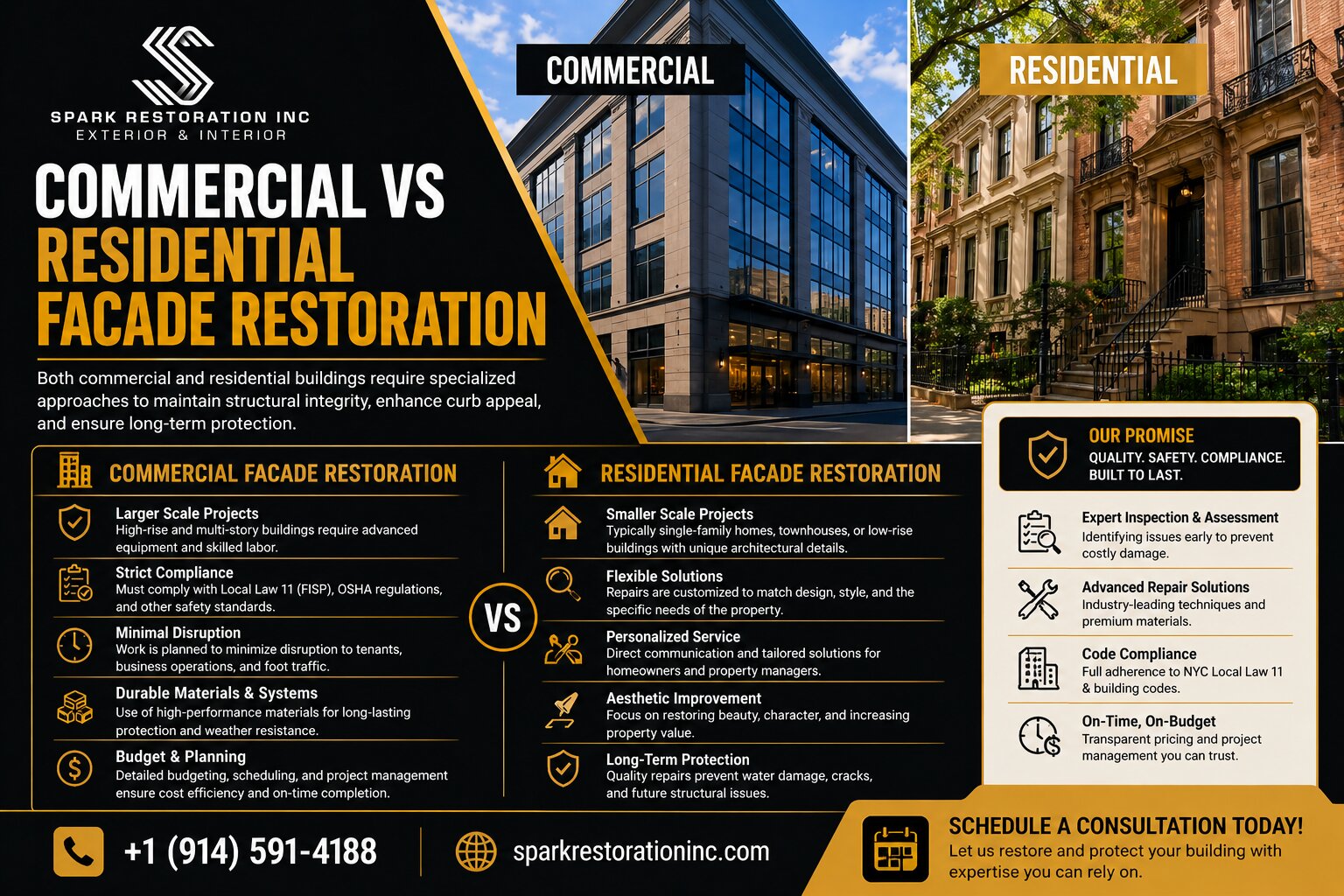
Facade repair and restoration requirements can vary significantly between commercial and residential properties. While both involve maintaining the building envelope, commercial projects are typically more complex, larger in scale, and driven by stricter operational and compliance considerations.
Understanding these differences helps property owners and developers plan projects more effectively and choose the right contractor for their specific needs.
Key Differences Between Commercial and Residential Projects
Project Scale and Complexity
- Residential projects are usually smaller in size and simpler in scope
- Commercial projects often involve high-rise buildings, large surface areas, and complex facade systems
Material Systems
- Residential properties commonly use brick, stucco, or basic masonry systems
- Commercial buildings may include glass curtain walls, metal panels, concrete systems, and mixed materials
Regulatory Requirements
- Commercial properties are subject to stricter compliance standards, especially under Local Law 11
- Residential buildings (particularly low-rise) may have fewer regulatory requirements
Budget and Investment Approach
- Residential projects are typically budget-sensitive and focused on maintenance
- Commercial projects are treated as capital investments, with emphasis on ROI and long-term performance
Commercial Project Challenges
Commercial facade restoration involves several operational and logistical challenges:
Minimal Disruption to Operations
- Work must be planned to avoid impacting business activities
- Phased execution may be required
Safety and Liability Management
- High foot traffic areas require enhanced safety measures
- Strict compliance with OSHA and NYC safety regulations
Complex Scheduling
- Coordination with tenants, building management, and stakeholders
- Night or off-hour work may be required
Large-Scale Project Management
- Multiple teams working simultaneously
- Detailed supervision and coordination
Tenant and Occupant Considerations
For commercial buildings, tenant experience is a critical factor.
Key considerations include:
- Noise and dust control
- Maintaining access to entrances and facilities
- Clear communication with occupants
- Minimizing business interruptions
A well-managed project ensures tenant satisfaction and avoids operational disruptions.
Residential Project Considerations
Residential facade restoration is generally more straightforward but still requires professional execution.
Focus areas:
- Safety of residents
- Aesthetic improvements
- Cost control
- Preventive maintenance
While less complex than commercial projects, improper work can still lead to long-term issues.
Importance of Specialized Contractors
Commercial facade restoration requires contractors with:
- Experience in large-scale projects
- Knowledge of complex facade systems
- Strong project management capabilities
- Compliance expertise
Residential projects may require less complexity, but hiring a qualified contractor is still essential for quality and durability.
Long-Term Planning Differences
Commercial Properties:
- Planned as part of long-term asset management
- Focus on lifecycle cost and ROI
Residential Properties:
- Often reactive rather than proactive
- Maintenance-driven approach
ROI of Facade Restoration
Facade repair and restoration is not just a maintenance activity—it is a strategic investment that delivers measurable financial and operational returns. In a competitive market like New York, where property value and tenant expectations are high, a well-maintained façade directly contributes to long-term asset performance.
For property owners, developers, and investors, understanding the return on investment (ROI) of facade restoration is essential for making informed decisions.
Increase in Property Value
One of the most immediate benefits of facade restoration is the increase in overall property value.
- A well-maintained exterior improves curb appeal
- Buildings appear newer, safer, and more attractive
- Buyers and investors perceive lower future maintenance risk
In many cases, façade restoration can significantly enhance the marketability of a property, especially in high-demand urban areas.
Higher Rental Income and Tenant Retention
For commercial and multi-unit residential properties, façade condition plays a key role in tenant decisions.
Benefits include:
- Ability to command higher rental rates
- Improved tenant satisfaction
- Increased occupancy rates
- Reduced tenant turnover
A clean, structurally sound façade reflects professionalism and reliability, which is particularly important for commercial tenants.
Reduction in Long-Term Maintenance Costs
Proactive facade restoration helps avoid recurring and escalating repair expenses.
Cost-saving advantages:
- Prevents major structural damage
- Reduces frequency of emergency repairs
- Extends lifespan of building materials
- Minimizes ongoing maintenance requirements
Investing in restoration early is significantly more cost-effective than addressing advanced deterioration later.
Improved Energy Efficiency
Facade restoration often includes upgrades to insulation, sealants, and waterproofing systems.
This results in:
- Reduced air leakage
- Improved thermal performance
- Lower heating and cooling costs
Energy-efficient buildings are more attractive to tenants and contribute to long-term operational savings.
Compliance and Risk Reduction
Maintaining a compliant façade reduces legal and financial risks.
Key benefits:
- Avoidance of fines and penalties
- Reduced liability for accidents or falling debris
- Lower insurance risks
- Compliance with Local Law 11 requirements
A compliant building is not only safer but also more financially stable.
Competitive Advantage in the Market
In a market like New York, where properties compete for visibility and tenants, façade condition can be a deciding factor.
A restored façade helps:
- Differentiate your property from competitors
- Attract premium tenants or buyers
- Strengthen your brand image (for commercial properties)
Long-Term Asset Protection
Ultimately, facade restoration protects the building as a long-term asset.
- Preserves structural integrity
- Extends building lifespan
- Maintains consistent property performance
This makes it a critical component of any long-term asset management strategy.
Risks of Delaying Facade Repairs
Delaying facade repair and restoration may seem like a short-term cost-saving decision, but in reality, it often leads to significantly higher expenses, increased safety risks, and legal complications. In New York’s demanding environment, façade issues tend to worsen rapidly when left unaddressed.
For property owners and managers, postponing necessary repairs can have serious consequences that impact both the building and its occupants.
Structural Deterioration
Minor façade issues rarely remain minor. Over time, small defects can develop into major structural problems.
Common outcomes of delayed repairs:
- Expansion of cracks in masonry or concrete
- Weakening of load-bearing components
- Displacement of façade elements
- Increased risk of partial structural failure
What could have been resolved with simple repairs may eventually require full-scale restoration or structural rehabilitation.
Safety Hazards
Facade deterioration poses direct risks to both occupants and pedestrians, especially in high-density urban areas like New York.
Potential safety issues include:
- Falling bricks, stones, or façade panels
- Loose materials detaching from the building
- Instability in exterior walls
These hazards can lead to accidents, injuries, and serious liability concerns for property owners.
Water Damage and Interior Impact
When façade issues are ignored, water infiltration becomes inevitable.
Consequences of water intrusion:
- Damage to interior walls and ceilings
- Mold and mildew growth
- Corrosion of structural components
- Reduced indoor air quality
Water damage often spreads beyond the façade, affecting multiple building systems and increasing repair costs.
Legal and Compliance Issues
Failure to address façade problems can result in violations of NYC building regulations.
Legal consequences may include:
- Fines and penalties under Local Law 11 (FISP)
- Mandatory emergency repair orders
- Increased inspections and scrutiny
- Potential legal action in case of accidents
Non-compliance not only affects finances but also damages the building’s reputation.
Increased Repair Costs
One of the biggest risks of delaying repairs is the escalation of costs.
Financial impact:
- Minor repairs turning into major restoration projects
- Higher labor and material costs
- Emergency repair premiums
- Additional expenses for safety measures (e.g., sidewalk sheds)
Proactive maintenance is always more cost-effective than reactive emergency work.
Disruption and Operational Impact
Delays often lead to unplanned, urgent projects that disrupt building operations.
Possible disruptions:
- Sudden need for extensive construction work
- Inconvenience to tenants and occupants
- Business interruptions in commercial properties
Planned restoration allows for controlled scheduling, while delayed repairs often result in unexpected disruptions.
Loss of Property Value
A deteriorating façade negatively impacts the perception and market value of a property.
- Reduced curb appeal
- Lower buyer or tenant interest
- Decreased resale value
In competitive markets like New York, façade condition plays a key role in property positioning.
Modern Technologies in Facade Restoration
Advancements in construction technology have significantly improved the way facade repair and restoration projects are executed in New York. Modern tools and techniques allow contractors to diagnose issues more accurately, reduce project timelines, enhance safety, and improve long-term performance.
For property owners and developers, leveraging these technologies ensures more efficient project delivery and better overall results.
Drone-Based Facade Inspections
Drone technology has transformed the initial inspection phase, especially for high-rise and hard-to-access buildings.
Key advantages:
- Rapid assessment of large surface areas
- Access to difficult or hazardous locations without scaffolding
- High-resolution imaging for detailed analysis
- Reduced inspection time and cost
Drones are particularly useful for preliminary surveys before conducting close-up inspections.
3D Scanning and Digital Mapping
3D scanning technology allows contractors to create accurate digital models of building facades.
Benefits include:
- Precise measurement of structural elements
- Identification of surface irregularities
- Better planning and visualization of repair work
- Improved coordination between engineers and contractors
This technology enhances accuracy and reduces errors during execution.
Infrared Thermography
Infrared imaging is used to detect hidden issues within the facade system.
It helps identify:
- Moisture intrusion behind surfaces
- Insulation gaps
- Delamination or voids
This non-destructive method allows contractors to address problems that are not visible to the naked eye.
Advanced Waterproofing and Coating Systems
Modern materials have significantly improved the durability and effectiveness of facade protection systems.
Examples include:
- High-performance elastomeric coatings
- Silicone-based sealants with longer lifespan
- Breathable waterproof membranes
- Self-healing coatings (in advanced applications)
These materials provide better resistance to weather conditions and extend the lifespan of the façade.
Building Information Modeling (BIM)
BIM technology is increasingly used in large-scale commercial facade projects.
Key benefits:
- Centralized project data management
- Improved coordination between stakeholders
- Enhanced project planning and scheduling
- Reduction in conflicts and delays
BIM allows for more efficient execution, especially in complex projects.
Prefabrication and Modular Systems
In some cases, facade components are manufactured off-site and installed on-site.
Advantages:
- Faster installation
- Improved quality control
- Reduced on-site labor
- Minimized disruption
This approach is commonly used in modern commercial construction.
Improved Safety Technologies
Safety has also benefited from technological advancements.
Examples include:
- Smart scaffolding systems
- Real-time monitoring of site conditions
- Advanced fall protection systems
These innovations reduce risk and ensure compliance with safety standards.
Impact on Project Efficiency
The integration of modern technologies results in:
- Faster project completion
- More accurate diagnostics
- Reduced rework and errors
- Improved overall quality
For property owners, this translates into better value, reduced downtime, and long-term reliability.
How to Choose the Right Facade Contractor in New York?
Selecting the right contractor is one of the most critical decisions in any facade repair and restoration project. In a market like New York—where projects are complex, highly regulated, and safety-sensitive—working with an experienced and qualified contractor directly impacts project success, compliance, cost control, and long-term durability.
A poor contractor choice can lead to delays, substandard work, legal issues, and repeated repair costs. On the other hand, the right contractor ensures professional execution, transparency, and reliable results.
Key Qualifications to Look For
Before hiring a facade contractor, it is essential to evaluate their credentials and capabilities.
Licensed and Insured
- Must hold valid NYC contractor licenses
- General liability and workers’ compensation insurance are mandatory
Experience with NYC Regulations
- Proven experience with Local Law 11 (FISP) compliance
- Familiarity with NYC Department of Buildings requirements
Relevant Project Portfolio
- Completed projects similar in size and scope
- Experience with your specific facade material (brick, stone, concrete, etc.)
Strong Project Management System
- Ability to handle scheduling, coordination, and execution
- Dedicated project managers and site supervisors
Skilled Workforce
- Trained and experienced labor teams
- Knowledge of modern restoration techniques
Questions to Ask Before Hiring
Asking the right questions helps you assess the contractor’s reliability and expertise.
Important questions include:
- What is your experience with facade repair projects in New York?
- Are you compliant with Local Law 11 requirements?
- Can you provide references from past clients?
- What is your estimated timeline for this project?
- How do you handle safety and quality control?
- Will you assist with permits and compliance documentation?
Clear and confident answers indicate a professional and experienced contractor.
Red Flags to Avoid
Certain warning signs may indicate that a contractor is not suitable for your project.
Common red flags:
- Lack of proper licensing or insurance
- Unrealistically low cost estimates
- No verifiable portfolio or references
- Poor communication or unclear project scope
- Limited knowledge of NYC regulations
Choosing a contractor based solely on price often leads to higher long-term costs.
Importance of Detailed Proposals
A professional contractor should provide a clear and detailed proposal.
A strong proposal includes:
- Defined scope of work
- Material specifications
- Project timeline
- Cost breakdown
- Safety measures
- Compliance requirements
This ensures transparency and helps avoid misunderstandings during the project.
Role of Communication and Transparency
Effective communication is essential throughout the project lifecycle.
Look for contractors who:
- Provide regular progress updates
- Maintain clear documentation
- Address concerns promptly
- Offer realistic timelines and expectations
Transparency builds trust and ensures smooth project execution.
Long-Term Partnership Value
Facade restoration is not a one-time activity. Buildings require ongoing maintenance and periodic inspections.
Working with a reliable contractor allows you to:
- Plan future maintenance effectively
- Ensure consistent quality
- Build a long-term professional relationship
Safety Standards & Compliance
Safety is a non-negotiable component of facade repair and restoration projects, especially in a high-density environment like New York. Given the risks associated with working at heights, heavy materials, and public exposure, strict adherence to safety standards is essential for protecting workers, occupants, and pedestrians.
Professional facade contractors must operate under well-defined safety protocols and comply with all applicable regulations to ensure a secure and incident-free project.
OSHA Compliance Requirements
All facade restoration projects must comply with Occupational Safety and Health Administration (OSHA) standards.
Key OSHA requirements include:
- Fall protection systems for workers at height
- Proper use of personal protective equipment (PPE)
- Safe handling and storage of materials
- Hazard communication and training
- Regular site safety inspections
Failure to comply with OSHA standards can result in fines, work stoppages, and serious safety risks.
Scaffolding and Access Safety
Scaffolding systems are a critical part of facade restoration projects and must be installed and maintained properly.
Safety measures include:
- Professional design and installation of scaffolding
- Regular inspection for stability and load capacity
- Secure anchoring to the building structure
- Safe access points for workers
Improper scaffolding can lead to accidents and structural hazards, making this a high-priority safety area.
Public Protection Systems
In urban environments like New York, protecting pedestrians and surrounding properties is essential.
Common public safety measures:
- Sidewalk sheds to protect against falling debris
- Safety netting and barriers
- Controlled work zones
- Warning signage and restricted access areas
These measures are often mandatory, especially for projects involving high-rise buildings or unsafe façade conditions.
Worker Training and Site Supervision
A well-trained workforce is essential for maintaining safety standards.
Key components:
- Certified and trained workers
- On-site supervisors to monitor safety compliance
- Regular safety briefings and toolbox talks
- Emergency response preparedness
Proper supervision ensures that safety protocols are consistently followed throughout the project.
Compliance with NYC Building Codes
In addition to OSHA, contractors must comply with NYC-specific building codes and safety regulations.
This includes:
- Adhering to Department of Buildings (DOB) requirements
- Following Local Law 11 safety guidelines
- Maintaining proper documentation and permits
- Coordinating with inspectors and regulatory authorities
Compliance ensures that the project meets all legal requirements and avoids penalties.
Risk Management and Prevention
Professional contractors implement proactive risk management strategies to minimize hazards.
Risk management practices:
- Identifying potential hazards before work begins
- Implementing preventive measures
- Continuous monitoring of site conditions
- Immediate response to safety concerns
This approach reduces the likelihood of accidents and ensures a controlled work environment.
Importance of Safety in Project Success
Strong safety practices contribute to:
- Reduced risk of accidents and injuries
- Smooth project execution without interruptions
- Compliance with regulations
- Increased trust from clients and stakeholders
Safety is not just a regulatory requirement—it is a key factor in delivering a successful facade restoration project.
Project Timeline Expectations
Understanding the timeline of a facade repair and restoration project is essential for effective planning, budgeting, and coordination. In New York, project durations can vary significantly depending on building size, scope of work, weather conditions, and regulatory approvals.
A well-structured timeline ensures that the project is completed efficiently while minimizing disruption to occupants and operations.
Factors That Affect Project Duration
Several key factors influence how long a facade restoration project will take:
Building Size and Height
- Larger buildings require more time due to increased surface area
- High-rise structures involve additional setup and safety measures
Scope of Work
- Minor repairs can be completed quickly
- Full-scale restoration or structural work requires extended timelines
Condition of the Facade
- Well-maintained buildings require less time
- Severely deteriorated facades need more extensive repairs
Accessibility and Logistics
- Installation of scaffolding or swing stages adds time
- Urban constraints and limited access points can slow progress
Weather Conditions
- Rain, snow, and extreme temperatures can delay work
- Seasonal planning plays a critical role in scheduling
Permits and Approvals
- Time required for obtaining permits from NYC Department of Buildings
- Inspection scheduling and compliance processes
Typical Project Timelines
While each project is unique, the following estimates provide a general guideline:
Small-Scale Projects
- Minor repairs or maintenance work
- Estimated duration: 2 to 4 weeks
Medium-Scale Projects
- Partial facade restoration
- Waterproofing and material repairs
- Estimated duration: 1 to 3 months
Large-Scale Projects
- Full facade restoration
- Structural repairs and compliance work
- Estimated duration: 3 to 6+ months
Phased Execution for Large Projects
For commercial or high-rise buildings, projects are often executed in phases.
Benefits of phased execution:
- Minimizes disruption to building operations
- Allows sections of the building to remain functional
- Improves project control and coordination
This approach is commonly used in occupied commercial properties.
Importance of Proper Scheduling
A detailed project schedule helps ensure:
- Efficient use of labor and resources
- Timely completion of each phase
- Coordination with tenants and building management
- Reduced risk of delays
Professional contractors use structured scheduling methods to manage complex projects effectively.
Managing Delays and Challenges
Even with proper planning, delays can occur.
Common causes of delays:
- Unexpected structural issues discovered during work
- Weather interruptions
- Material supply delays
- Changes in project scope
Experienced contractors anticipate these risks and include contingency plans to minimize impact.
Communication During the Project
Clear communication is essential for keeping the project on track.
Best practices include:
- Regular progress updates
- Transparent reporting of delays or issues
- Coordination with stakeholders and occupants
Effective communication ensures smooth execution and avoids misunderstandings.
Maintenance After Facade Restoration
Completing a facade repair and restoration project is a significant investment, but maintaining those results is equally important. Without proper maintenance, even a newly restored façade can begin to deteriorate prematurely, leading to additional repair costs and reduced performance over time.
A proactive maintenance strategy helps preserve structural integrity, extend the lifespan of materials, and ensure continued compliance with New York regulations.
Importance of Routine Inspections
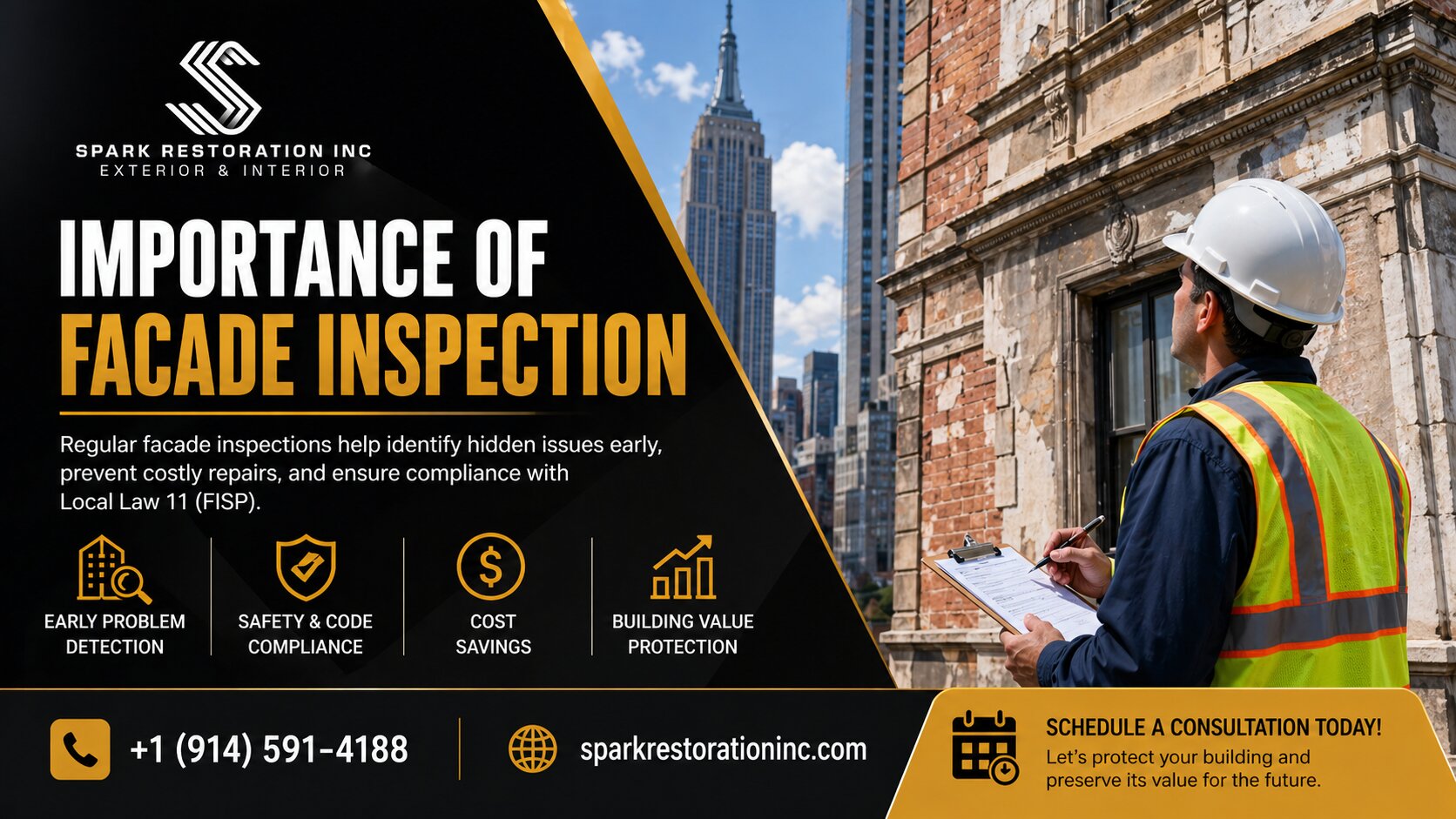
Regular inspections are essential to identify minor issues before they develop into major problems.
Recommended inspection practices:
- Conduct visual inspections at least once or twice a year
- Schedule professional inspections periodically, especially for large or commercial buildings
- Inspect after severe weather events such as heavy storms or freezing conditions
Early detection allows for cost-effective repairs and prevents long-term damage.
Monitoring High-Risk Areas
Certain areas of the façade are more vulnerable and should be monitored closely.
Key areas include:
- Expansion joints and sealants
- Window and door perimeters
- Roof-to-wall intersections
- Previously repaired sections
These areas are more likely to experience wear and require maintenance.
Maintaining Waterproofing Systems
Waterproofing components require ongoing attention to remain effective.
Maintenance steps:
- Check for cracks or gaps in sealants
- Reapply coatings when necessary
- Ensure proper drainage systems are functioning
- Address leaks immediately
Proper maintenance of waterproofing systems prevents moisture intrusion and structural damage.
Cleaning and Surface Care
Regular cleaning helps maintain both the appearance and performance of the façade.
Benefits of cleaning:
- Removes dirt, pollutants, and biological growth
- Prevents surface degradation
- Enhances the building’s visual appeal
Cleaning methods should be selected carefully to avoid damaging materials.
Addressing Minor Repairs Promptly
Small issues should never be ignored.
Examples of minor repairs:
- Sealing small cracks
- Replacing damaged sealants
- Fixing localized material damage
Timely repairs prevent the need for more extensive restoration work in the future.
Documentation and Maintenance Planning
Keeping detailed records of maintenance activities is essential.
This includes:
- Inspection reports
- Repair history
- Warranty information
- Scheduled maintenance plans
Proper documentation helps track the condition of the façade and plan future work effectively.
Long-Term Maintenance Strategy
For commercial and large residential properties, a structured maintenance plan is highly recommended.
Key components:
- Scheduled inspections
- Preventive maintenance programs
- Budget allocation for ongoing repairs
- Coordination with professional contractors
A long-term strategy ensures consistent performance and reduces unexpected costs.
Benefits of Ongoing Maintenance
Maintaining your façade provides several long-term advantages:
- Extends the lifespan of restoration work
- Reduces overall maintenance costs
- Ensures continued compliance with regulations
- Preserves property value
- Enhances safety and performance
Why Professional Facade Restoration Matters?
Facade repair and restoration is a highly specialized construction process that requires technical expertise, regulatory knowledge, and precise execution. Attempting to cut corners by hiring inexperienced contractors or using substandard methods can lead to serious consequences, including structural issues, compliance violations, and increased long-term costs.
In a market like New York—where buildings are complex and regulations are strict—professional execution is essential for achieving safe, durable, and compliant results.
Risks of Inexperienced or Unqualified Contractors
Hiring an unqualified contractor may reduce upfront costs, but it often leads to significant problems during and after the project.
Common risks include:
- Incorrect diagnosis of façade issues
- Use of incompatible or low-quality materials
- Poor workmanship leading to recurring damage
- Failure to meet NYC building code requirements
- Delays and project mismanagement
These issues can result in additional repair work, higher expenses, and potential legal complications.
Importance of Technical Expertise
Professional facade contractors bring specialized knowledge and experience to the project.
Key advantages:
- Accurate identification of structural and material issues
- Selection of appropriate repair methods
- Proper handling of complex façade systems
- Ability to manage large-scale and high-rise projects
Technical expertise ensures that repairs are done correctly the first time, reducing the risk of future problems.
Compliance with Regulations
New York has strict building codes and safety regulations, particularly under Local Law 11 (FISP).
Professional contractors ensure:
- Proper filing of permits and documentation
- Compliance with inspection requirements
- Adherence to safety and construction standards
This helps property owners avoid fines, legal issues, and project delays.
Quality Assurance and Durability
High-quality workmanship is essential for long-term performance.
Professional contractors provide:
- Use of durable, industry-approved materials
- Strict quality control processes
- Continuous supervision and inspection
- Reliable and long-lasting results
This ensures that the façade remains stable, safe, and visually appealing for years to come.
Efficient Project Management
Facade restoration projects involve multiple phases, teams, and coordination efforts.
Professional contractors offer:
- Structured project planning and scheduling
- Efficient resource management
- Clear communication with stakeholders
- Timely completion of work
Effective project management minimizes disruptions and keeps the project on track.
Safety and Risk Management
Safety is a critical aspect of facade restoration, especially in urban environments.
Experienced contractors implement:
- Proper safety protocols and equipment
- Trained workforce and supervision
- Public protection systems
- Compliance with OSHA and NYC safety standards
This reduces the risk of accidents and ensures a safe working environment.
Long-Term Cost Efficiency
While professional services may involve higher initial costs, they provide better long-term value.
Benefits include:
- Reduced need for repeated repairs
- Lower maintenance costs
- Extended lifespan of the façade
- Improved overall building performance
Investing in professional restoration ensures cost efficiency over the life of the building.
Facade Repair & Restoration Services in New York
When it comes to maintaining the structural integrity, safety, and long-term value of your property, working with an experienced and reliable contractor is essential. Facade repair and restoration is not just a service—it is a comprehensive construction solution that requires expertise, precision, and full compliance with New York regulations.
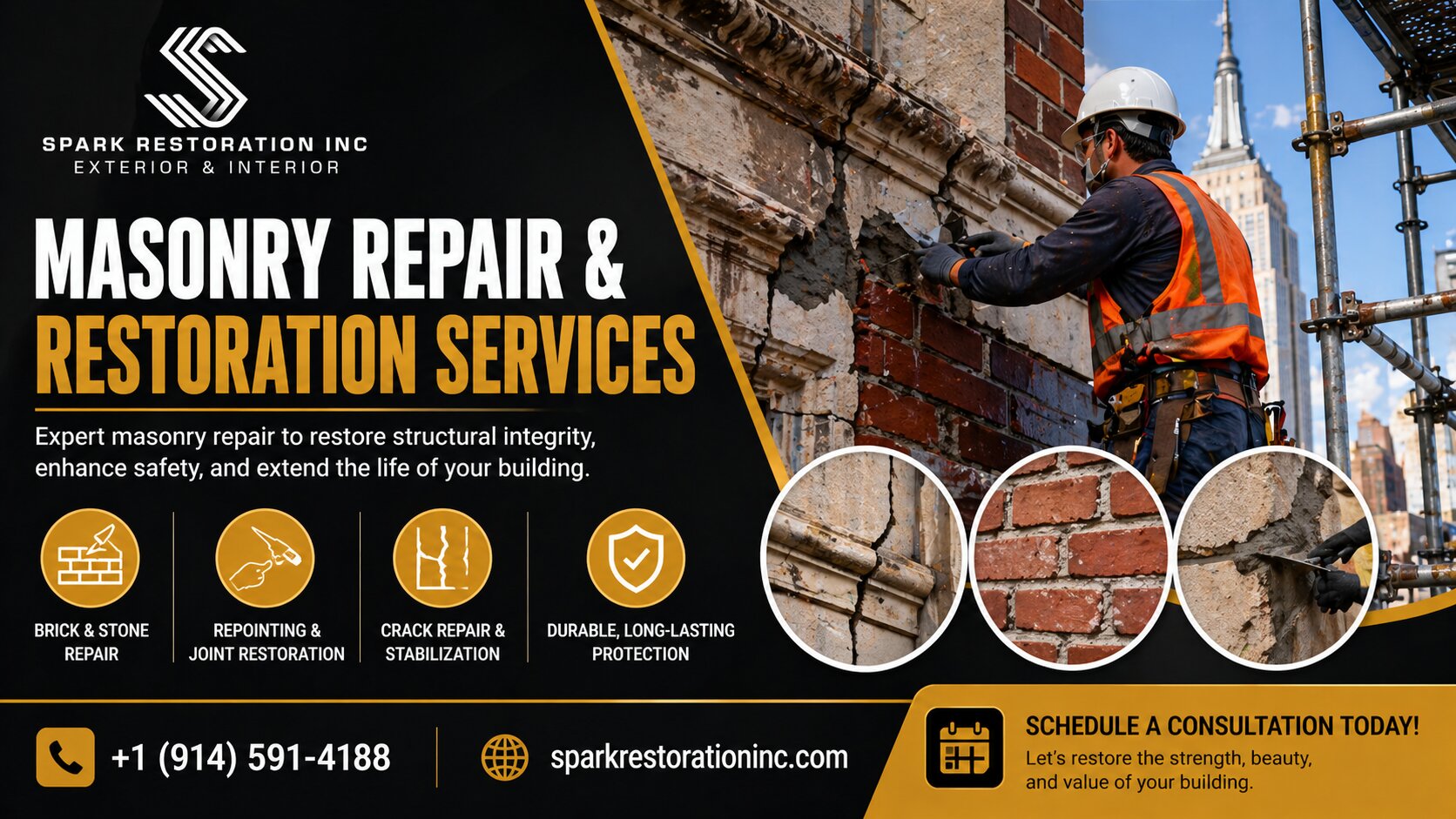
At Spark Restoration INC, we provide end-to-end facade repair and restoration services designed to meet the needs of property owners, real estate developers, commercial clients, and building managers across New York.
Our Facade Restoration Services
We offer a full range of facade repair and restoration solutions tailored to the specific condition and requirements of your building.
Comprehensive Facade Inspection
- Detailed condition assessment
- Identification of structural and material issues
- Compliance evaluation under Local Law 11 (FISP)
Masonry Repair & Restoration
- Brick and stone repair
- Repointing and joint restoration
- Replacement of damaged materials
Structural Facade Repair
- Crack injection and stabilization
- Reinforcement of weakened façade sections
- Repair of load-bearing components
Waterproofing & Protective Systems
- Sealant and joint replacement
- Application of waterproof coatings
- Installation of drainage and flashing systems
Exterior Coating & Finishing
- Protective coatings for durability
- Surface restoration and finishing
- Aesthetic improvements
Our Process (Turnkey Project Delivery)
We follow a structured, professional process to ensure quality, safety, and efficiency in every project.
1. Consultation & Site Evaluation
- Understanding project requirements
- Initial inspection and assessment
2. Planning & Cost Estimation
- Detailed scope of work
- Transparent budgeting and timelines
3. Permits & Compliance
- Handling all NYC regulatory requirements
- Ensuring full code compliance
4. Execution & Site Supervision
- Skilled workforce and experienced supervisors
- Strict adherence to safety standards
5. Quality Control & Final Inspection
- Continuous monitoring
- Final verification and project handover
Why Choose Spark Restoration INC?
Choosing the right contractor makes a significant difference in project success. At Spark Restoration INC, we focus on delivering reliable, high-quality, and compliant construction solutions.
Key advantages:
- Experienced in commercial and residential facade projects
- Strong understanding of NYC building codes and Local Law 11
- Dedicated project management and site supervision
- Use of high-quality materials and proven techniques
- Transparent pricing with no hidden costs
- Commitment to safety, quality, and client satisfaction
Industries We Serve
We work with a wide range of clients across New York:
- Commercial property owners
- Real estate developers
- Property management companies
- Residential building owners
- Industrial facility managers
Request a Consultation
If your building requires facade repair, restoration, or compliance work, our team is ready to assist you with a professional and results-driven approach.
Get Started Today:
- Schedule a site inspection
- Request a detailed project estimate
- Consult with an experienced facade specialist
Conclusion
Facade repair and restoration is not just a routine maintenance task—it is a critical investment in the safety, compliance, and long-term performance of your building. In a demanding market like New York, where environmental conditions and regulatory requirements are both rigorous, maintaining a structurally sound and well-protected façade is essential.
Throughout this guide, we’ve covered every major aspect of facade repair and restoration—from understanding materials and identifying damage to navigating Local Law 11 compliance, managing costs, and executing projects effectively. The key takeaway is clear: proactive planning and professional execution are the foundation of successful facade restoration.
Ignoring façade issues or delaying repairs can lead to serious consequences, including structural deterioration, safety hazards, increased costs, and legal penalties. On the other hand, timely restoration ensures:
- Structural stability and safety
- Protection against water intrusion and environmental damage
- Compliance with NYC regulations
- Increased property value and market appeal
- Long-term cost savings through preventive maintenance
Whether you are managing a commercial property, overseeing a residential building, or investing in real estate, facade restoration should be treated as a strategic, long-term asset management decision.
Partnering with an experienced contractor ensures that your project is handled with the highest standards of quality, safety, and compliance. From initial inspection to final handover, professional execution guarantees durable results and peace of mind.