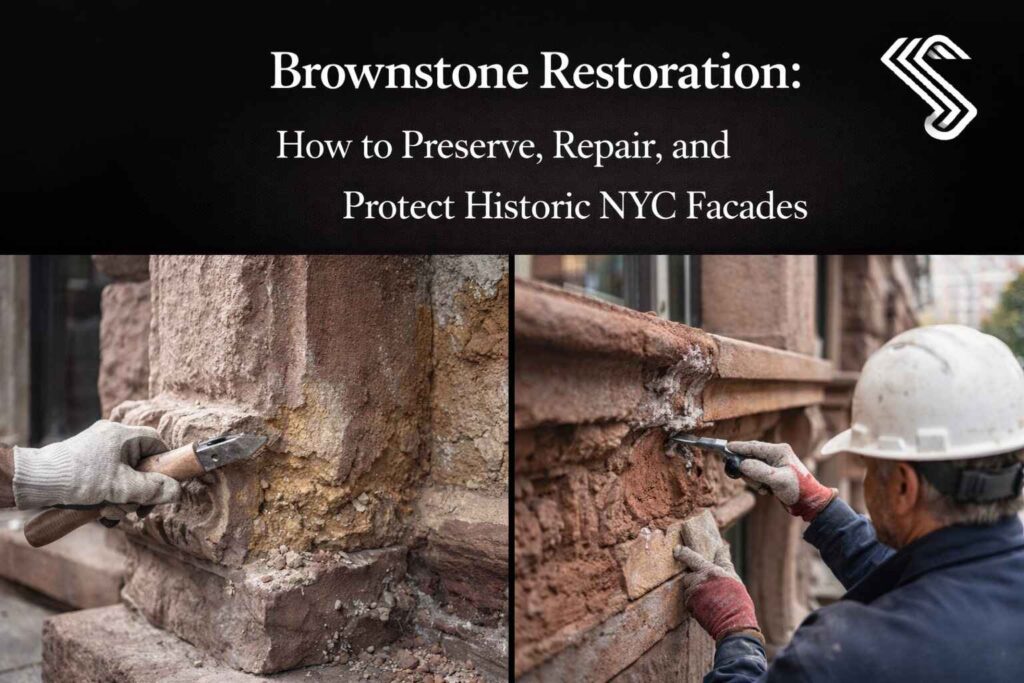
Brownstone buildings are among New York City’s most iconic architectural assets, defining neighborhoods such as Brooklyn Heights, Park Slope, Harlem, Upper West Side, and Bedford-Stuyvesant. Constructed primarily in the late 19th and early 20th centuries, these structures were built using natural brownstone, a sedimentary stone prized for its appearance but vulnerable to weathering.
Proper brownstone restoration is not cosmetic maintenance—it is structural preservation. When neglected, deteriorating brownstone can lead to moisture intrusion, surface delamination, falling masonry hazards, and Local Law 11 violations. At Spark Restoration Inc., restoration is approached as a combination of material science, craftsmanship, and regulatory compliance.
What Is Brownstone and Why It Deteriorates Over Time?
Brownstone is a porous sandstone, meaning it readily absorbs water. Over decades, repeated exposure to rain, freeze-thaw cycles, pollution, and salts causes the stone to weaken internally.
Primary causes of deterioration include:
- Freeze-thaw expansion inside stone pores
- Atmospheric pollution is accelerating surface erosion
- Incompatible past repairs using Portland cement
- Water infiltration from failed joints and flashing
Once internal bedding planes weaken, brownstone begins to flake, crack, or powder, a process known as spalling.
Common Signs That Brownstone Restoration Is Needed
Experienced façade specialists identify brownstone failure long before it becomes dangerous. Warning signs include:
- Surface scaling or peeling layers
- Cracks around window lintels and sills
- Soft or crumbling stone when probed
- Rust staining from embedded metal anchors
- Uneven coloration from failed patch repairs
Ignoring early indicators often escalates repair costs by 2–3x.
Brownstone Restoration vs. Brownstone Repair: Key Differences
Many property owners confuse repair with restoration. The distinction is critical.
| Repair | Restoration |
|---|---|
| Localized patching | Comprehensive façade treatment |
| Short-term fix | Long-term structural preservation |
| Cosmetic focus | Material compatibility focus |
| Often reactive | Proactive and preventive |
Accurate brownstone restoration addresses cause, not symptoms.
The Professional Brownstone Restoration Process
A proper restoration follows a defined, multi-step methodology.
1. Condition Assessment & Probing
Technicians conduct physical probes, moisture mapping, and visual surveys to determine stone integrity and the depth of deterioration.
2. Careful Removal of Failed Stone
Loose and delaminated stone is removed without damaging the stable substrate.
3. Brownstone Patching & Rebuilding
Custom brownstone repair mortars are formulated to match:
- Color
- Texture
- Permeability
- Thermal movement
4. Tooling & Surface Finishing
Repaired areas are hand-tooled to replicate original stone profiles, preserving architectural continuity.
Brownstone Patching: Why Mortar Compatibility Is Critical?
One of the most common failures seen in NYC brownstones is the use of hard cement-based patches. These materials trap moisture and accelerate stone decay.
Professional brownstone patching mortars must:
- Remain vapor permeable
- Match the original compressive strength
- Expand and contract with the stone
This is where true craftsmanship separates specialists from general masons.
Carving, Molding & Ornamental Brownstone Restoration
Decorative features such as cornices, lintels, keystones, and string courses often require custom carving or molding.
Techniques include:
- Hand carving for shallow profiles
- Mold casting for repetitive elements
- Hybrid patch-and-carve methods
Precision here is essential, especially in historic districts.
Brownstone Waterproofing & Protective Coatings
After restoration, the façade must be protected from future moisture intrusion.
Effective systems include:
- Breathable silane/siloxane sealers
- Properly detailed flashing and drip edges
- Sealant replacement at joints and transitions
Non-breathable coatings are avoided, as they accelerate stone failure.
NYC Local Law 11 and Brownstone Buildings
Under the NYC Façade Inspection & Safety Program (FISP / Local Law 11), brownstone façades are closely scrutinized due to their age and fragility.
Inspectors often flag:
- Spalled stone
- Loose decorative elements
- Failed to point around openings
Proactive restoration prevents violations, sidewalk sheds, and emergency repairs.
Landmark & Historic Brownstone Restoration Requirements
In Landmark Preservation Commission (LPC) districts, brownstone work must meet strict guidelines.
Key requirements:
- Original profiles must be preserved
- In-kind material replacement is preferred
- Visible alterations require LPC approval
Experienced contractors coordinate restoration and compliance seamlessly.
Cost Factors in Brownstone Restoration Projects
Brownstone restoration costs vary based on:
- Depth of stone deterioration
- Extent of decorative elements
- Scaffold and access requirements
- Landmark approval processes
In NYC, typical projects range from $20,000 for localized restoration to $250,000+ for full façades.
Preventive Maintenance for Brownstone Buildings
Preventive maintenance dramatically extends façade lifespan.
Recommended schedule:
- Visual inspections every 1–2 years
- Minor patch and sealant repairs every 5 years
- Complete façade evaluation every FISP cycle
Preventive programs reduce long-term restoration costs by up to 40%.
Choosing the Right Brownstone Restoration Contractor
Not all masonry contractors are brownstone specialists. Look for:
- Proven NYC brownstone portfolio
- Material-specific repair knowledge
- Landmark and Local Law 11 experience
- Custom mortar formulation capability
Spark Restoration Inc. specializes exclusively in restoration-grade masonry, not general construction patchwork.
Why Brownstone Restoration Is an Investment, Not an Expense?
Properly restored brownstone:
- Increases property value
- Enhances curb appeal
- Reduces long-term maintenance costs
- Protects occupants and pedestrians
In NYC’s real estate market, façade condition directly impacts asset value.
Conclusion
Brownstone restoration is both a technical discipline and a preservation art. Without proper materials, methods, and expertise, these historic façades deteriorate rapidly. With professional restoration, brownstone buildings remain structurally sound, visually authentic, and compliant with NYC regulations.
Spark Restoration Inc. delivers expert brownstone restoration solutions that respect New York City’s architectural heritage while protecting property owners’ investments.